



Shenzhen's Huaqiangbei rides AI boom, draws foreign buyers
At an electronics stall in Huaqiangbei in Shenzhen, south China's Guangdong Province, a shopkeeper surnamed Lin recently used her own AI translation device to demonstrate it to a French customer, who ended up buying two.
The number of foreign buyers visiting her shop, including those from South America and Africa, has surged this year, and sales of AI translators at her shop have tripled from last year.
The AI gold rush among overseas consumers reflects a broader shift at Huaqiangbei, long known for its dense electronics supply chain. Tapping into the trillion-yuan-plus (1 yuan equals about $0.14) electronics manufacturing cluster in Shenzhen and neighboring areas, Huaqiangbei is now riding a wave of AI hardware exports aimed at younger consumers overseas.
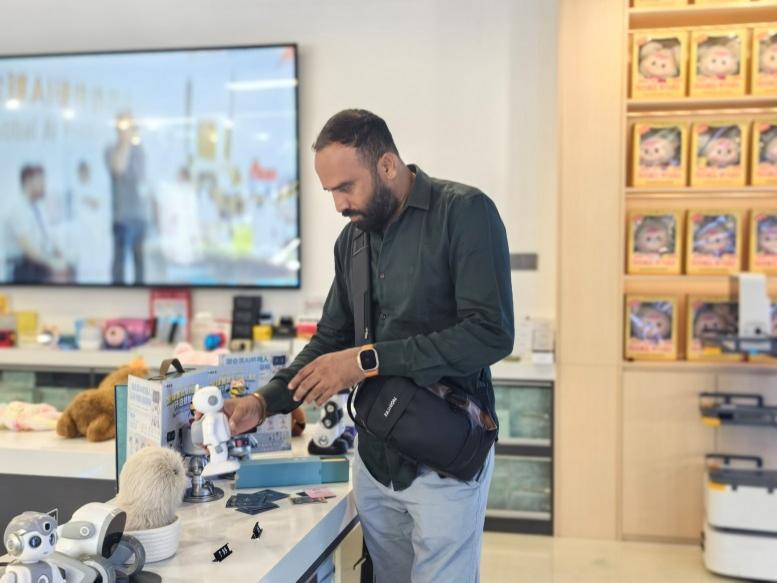
An Indian businessman shops at the global AI hardware selection center operated by Zhipinku, a supply chain and channel service platform, in Huaqiangbei, Shenzhen, south China's Guangdong Province. (Photo/Cheng Yuanzhou)
Bilingual signage has become standard, and shopkeepers now greet customers in English. Nearly 8,000 foreign buyers have visited Huaqiangbei daily so far this year, according to statistics from the Huaqiangbei subdistrict, although actual foot traffic may be even higher than the official count.
During China's biannual Canton Fair, some overseas buyers set aside three full days just to shop in Huaqiangbei, said Wang Chengzhu, deputy general manager of Shenzhen Huaqiang Electronic World Management Co., Ltd., whose three stores have recorded combined daily foot traffic of more than 150,000 at peak times.
Huaqiangbei's core 1.45-square-kilometer zone is home to 35 specialized electronics markets and over 1 million types of components, Wang said. Hong Kong shoppers still make up a large share of visitors, especially on holidays, while easing visa-free policies and coverage by overseas influencers have drawn more international buyers.
Tax refund services for overseas visitors have expanded too. Since July 1, new national measures have simplified the process — including fewer random inspections for small purchases, cross-province recognition for instant tax refunds, and paperless processing. Buyers using the "instant tax refund" services can now depart from any port across five provincial-level regions: Hunan, Fujian, Guangdong, Guangxi and Hainan.
In Huaqiangbei, some stores display reminders about instant tax refund services in Chinese and English, and a bank branch has opened what it calls China's first one-stop counter combining tax refunds, currency exchange and payment services.
AI translators and AI glasses have become almost standard items among foreign shoppers. The French customer at Lin's shop said he needed an AI translator to communicate with Japanese clients for work.
Lin said business customers now make up a growing share of her clientele, rising 30 percent from last year, as on-device AI processing has made AI translators more reliable even without an internet connection.
Data from Shenzhen Customs shows the city's imports and exports of high-tech products reached 1.7 trillion yuan in the first half of 2026, the highest in China, with AI-related products accounting for more than 1 trillion yuan of that total. Huaqiangbei's AI product sales rose more than 55 percent year on year from January to July this year, with AI glasses sales doubling.
Shenzhen Youyu Technology Co., Ltd., a local AI glasses maker, said monthly shipments have grown from 1,000 to 2,000 units last year to 4,000 to 5,000 units this year, with 95 percent going overseas — mainly to India, with Russia and Spain emerging as new markets, according to Peng Zhitao, a sales personnel of the company.
Peng said the company prices its AI glasses far below those of big-name competitors while matching their camera quality, and plans to launch a display-equipped model by year's end.
Global AI glasses shipments are expected to exceed 15 million units in 2026, according to global technology market research and consulting firm Omdia.
Privacy has become a growing concern, prompting some Huaqiangbei developers to design detachable camera modules or local-only data storage in AI glasses.
Newer product lines have also emerged, including a noninvasive brain-computer interface device from Peng Brain, a provider of brain science products and services. Paired with dedicated training software, the device can be used to assess and improve children's focus and self-control, as well as support rehabilitation training for children with autism. An overseas version is currently in development.
The company's noninvasive brain-computer sleep aid device has proven especially popular with overseas buyers, cutting the time it takes people with insomnia to fall asleep by 20 to 50 percent. The device now sells around 5,000 units a month, a figure the company expects to grow to 30,000, with growth driven mainly by demand from the U.S. and Japan, said Yang Jinlin, head of Peng Brain.
He said the company plans to expand its brain-computer technology into a pet "emotion translator," which uses dual-mode analysis of cats' and dogs' vocalizations and behavior captured on video to identify their emotional state with more than 90 percent accuracy — a feature he said overseas customers have specifically asked for.
Industry figures credit Huaqiangbei's dense supply chain for its rapid pace of innovation. Yang said his company has cut its design-to-sample cycle to 20 days, down from about six months before it could tap into Huaqiangbei's supply chain.
Photos

Related Stories
- How AI, energy empower each other across China
- China cracks down on AI misuse, removes 5.6 million pieces of unlawful, rule-violating content
- GT Voice: Geopolitics can't give US the AI open-source ecosystem it seeks
- Chinese researchers design AI-driven platform to empower marine materials innovation
- China to promote int'l cooperation in creating AI public goods for global chemical safety
Copyright © 2026 People's Daily Online. All Rights Reserved.
