



Xinjiang Diary, Day 6: Shihezi, an oasis built generation by generation
Note: Over the next several days, I'll be traveling across northwest China's Xinjiang Uygur Autonomous Region as part of People's Daily Online's "China Momentum" program. I'll be writing daily about what I see and experience.
The train out of Urumqi rocked a little as it picked up speed, and I pressed my forehead against the glass and watched the city give way to not much at all, scrubland the color of an old bruise, mountains sitting far off and refusing to get any closer no matter how long I looked at them. An hour and change like this, half asleep, and then without much warning the ground turned green. Rows of it, straight as rulers, running out to the edge of what I could see.
Somebody once decided this was worth doing, bringing water and order to a piece of desert, and more than 70 years later the fields were still here, even if the people who first cut them were long gone.
Shihezi's modern story began with the soldiers and settlers of the Xinjiang Production and Construction Corps, who came here with little and gradually turned difficult land into farmland and then into a city. You could feel that history the second you stepped off the train. Wide streets, poplar trees planted in lines so even they looked surveyed, a stillness that wasn't emptiness so much as a place that had grown up knowing exactly what it wanted to be.
We started the morning at three companies in the Shihezi Economic and Technological Development Zone, each working on a different part of the landscape those earlier generations had built.
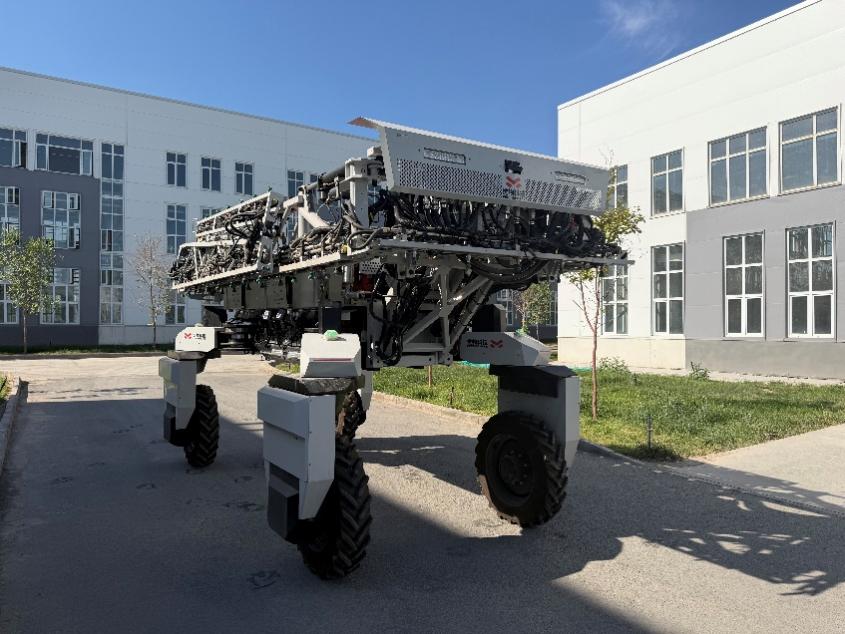
Photo of a Juewu Intelligent Equipment (Shihezi) Co., Ltd. robot in Shihezi, northwest China's Xinjiang Autonomous Region. (People's Daily Online/Michael Kurtagh)
At Juewu Intelligent Equipment (Shihezi) Co., Ltd., a company that didn't exist 20 months ago, we watched one of its agricultural robots run through what it could do, right there at the company. It was low and wide, and the wheels could turn in on themselves so the whole machine could slide sideways, crab-like, instead of just forward and back. It could rise and drop depending on the terrain, and someone switched on the spray system so we could see that work too.
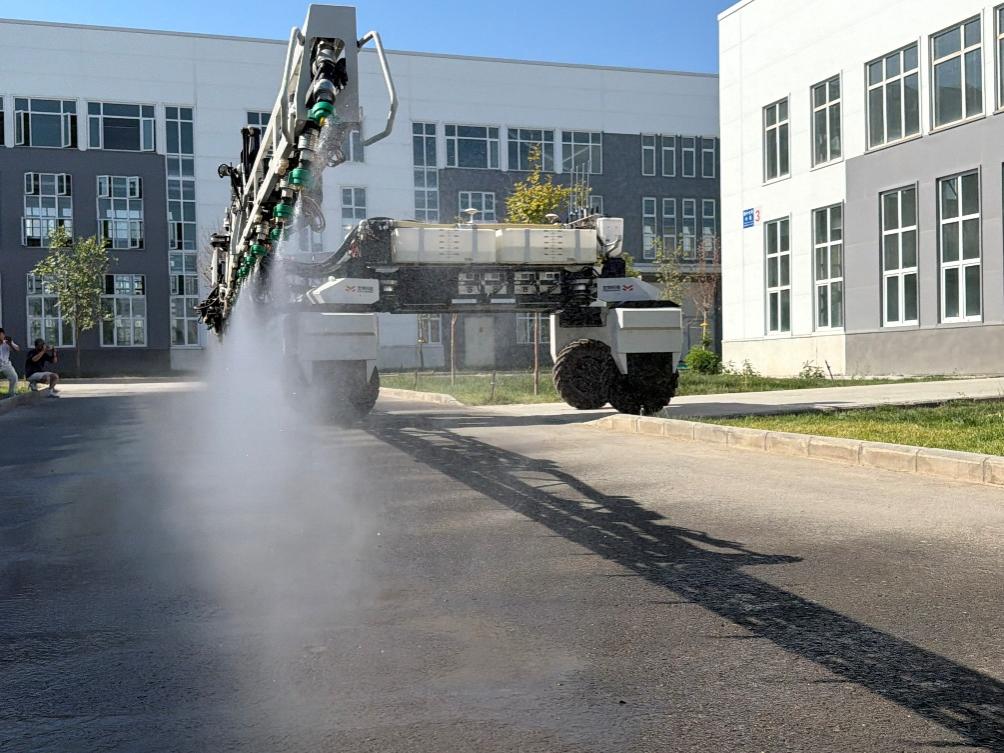
A Juewu Intelligent Equipment (Shihezi) Co., Ltd. robot sprays water in Shihezi, northwest China's Xinjiang Autonomous Region. (People's Daily Online/Michael Kurtagh)
Fifteen minutes down the road at Tianshan Machinery Manufacturing Co., Ltd., the future looked much more familiar. Nothing was running. Everything just sat, row after row of different models: chili harvesters, corn harvesters, plows, land-leveling equipment, cotton machinery. This was the less glamorous side of agricultural technology, the machinery that had to survive the enormous scale of farming in Xinjiang.
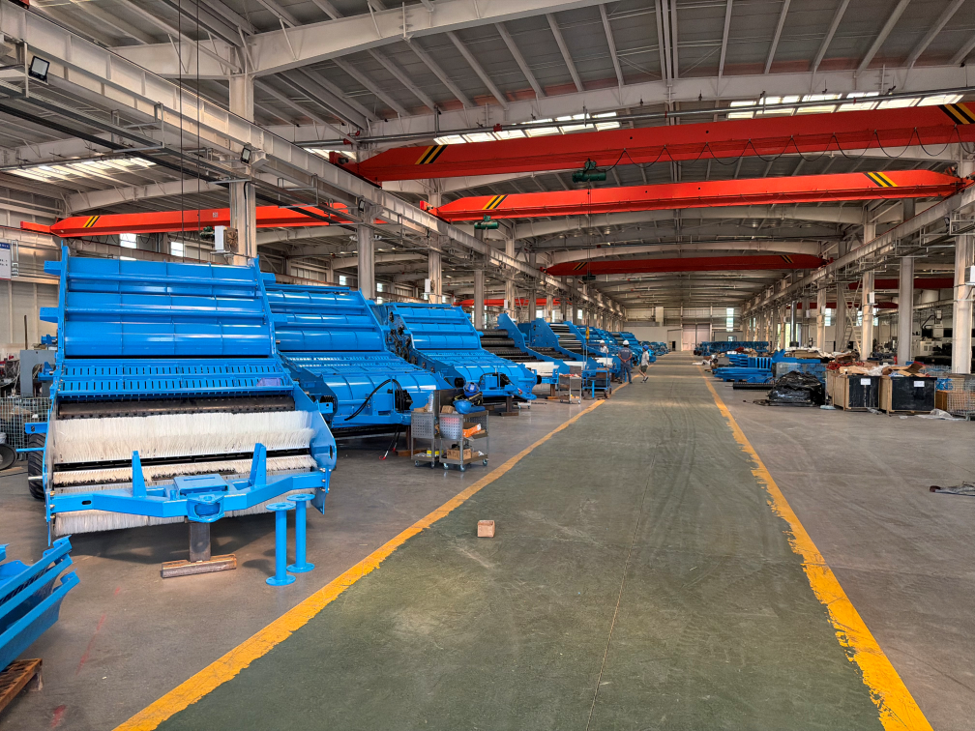
Agricultural machinery at the factory of Tianshan Machinery Manufacturing Co., Ltd. in Shihezi, northwest China's Xinjiang Autonomous Region. (People's Daily Online/Michael Kurtagh)
Our last stop was Xinjiang Tianfu Tianyao New Energy Technology Co., Ltd., where the subject shifted from the machines working the land to the energy behind them. We walked through the exhibition hall, then into the factory, where we saw parts of the photovoltaic manufacturing process in motion, glass, silicon cells and other components moving through the line and gradually becoming finished panels.
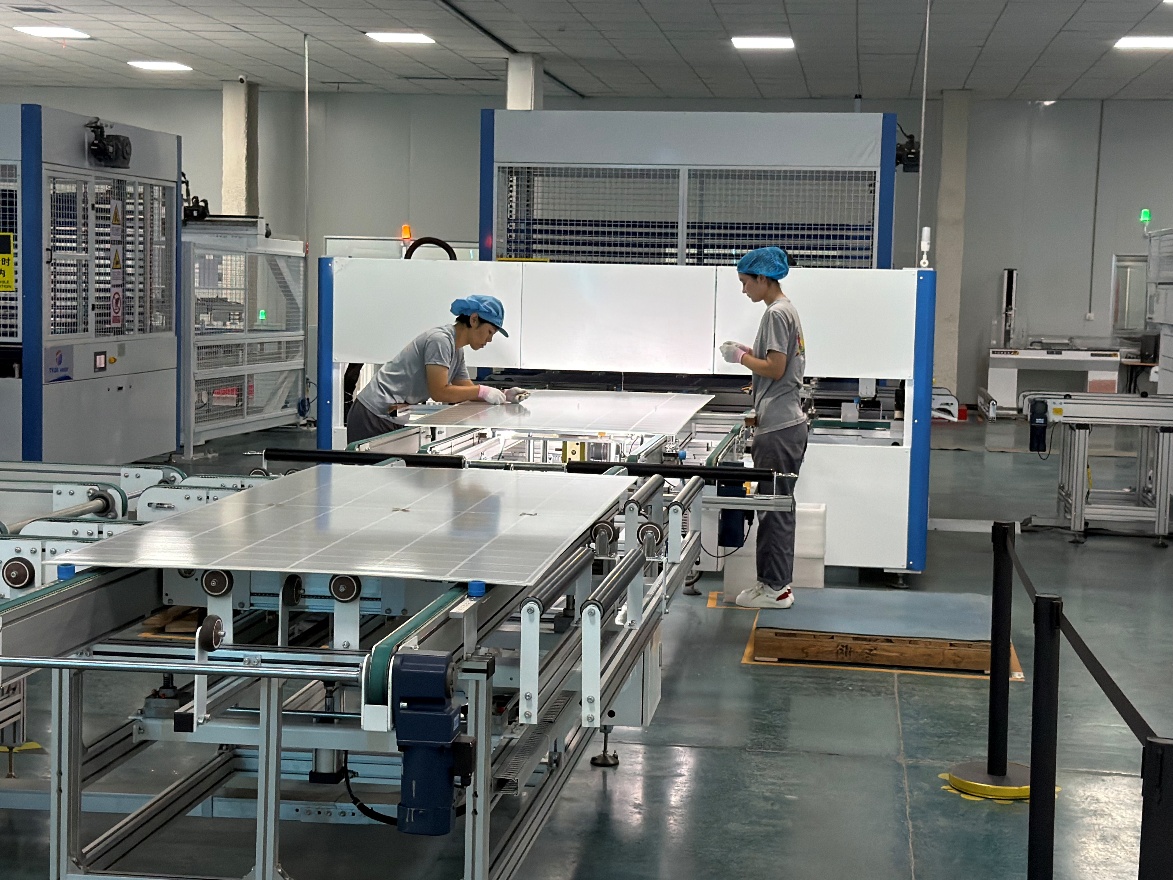
Two women assemble photovoltaic panels at the factory of Xinjiang Tianfu Tianyao New Energy Technology Co., Ltd. in Shihezi, northwest China's Xinjiang Autonomous Region. (People's Daily Online/Michael Kurtagh)
Three companies, three ways of pushing the same landscape forward. Agricultural robots, heavy machinery and solar panels. All of them were doing something the first generations of Shihezi residents could hardly have imagined, but none would have been possible without the foundation those generations created.
That became clearer after lunch, at the reclamation museum of the Xinjiang Production and Construction Corps.
I broke off from the group and walked the rooms on my own. What stopped me wasn't any one exhibit but the photographs, room after room of them, black and white, showing what this place looked like when there was still almost nothing here. Fields being opened. Roads being built. Homes going up. And then there were the people, faces I didn't have names for, caught in the middle of getting through something hard.
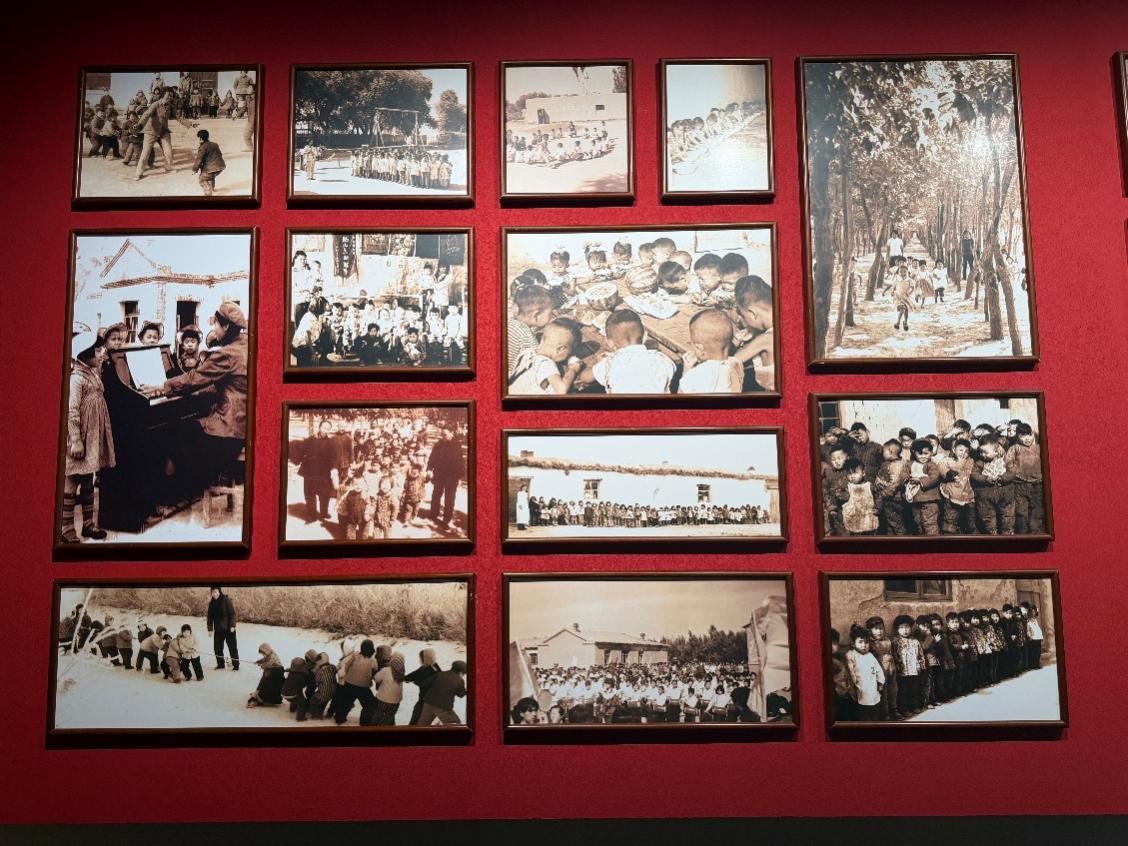
A series of pictures of children helped by the Xinjiang Production and Construction Corps on display at the reclamation museum of the Xinjiang Production and Construction Corps in Shihezi, northwest China's Xinjiang Autonomous Region. (People's Daily Online/Michael Kurtagh)
The robot from that morning came back to me, sliding sideways across a field.
The people in those photographs had not come here to build agricultural technology companies or solar-panel factories. They had come to make the land produce something. They cleared it, cultivated it and built the infrastructure that allowed a city to take shape around it.
The machinery came later. The automation came later still.
We ended the day at the Ai Qing Poetry Museum. I hadn't known much about Ai Qing before walking in, but I learned that he was sent to Shihezi in 1959 and spent 15 years here. He wrote about the place during those years, including "The Young City," a poem about Shihezi.
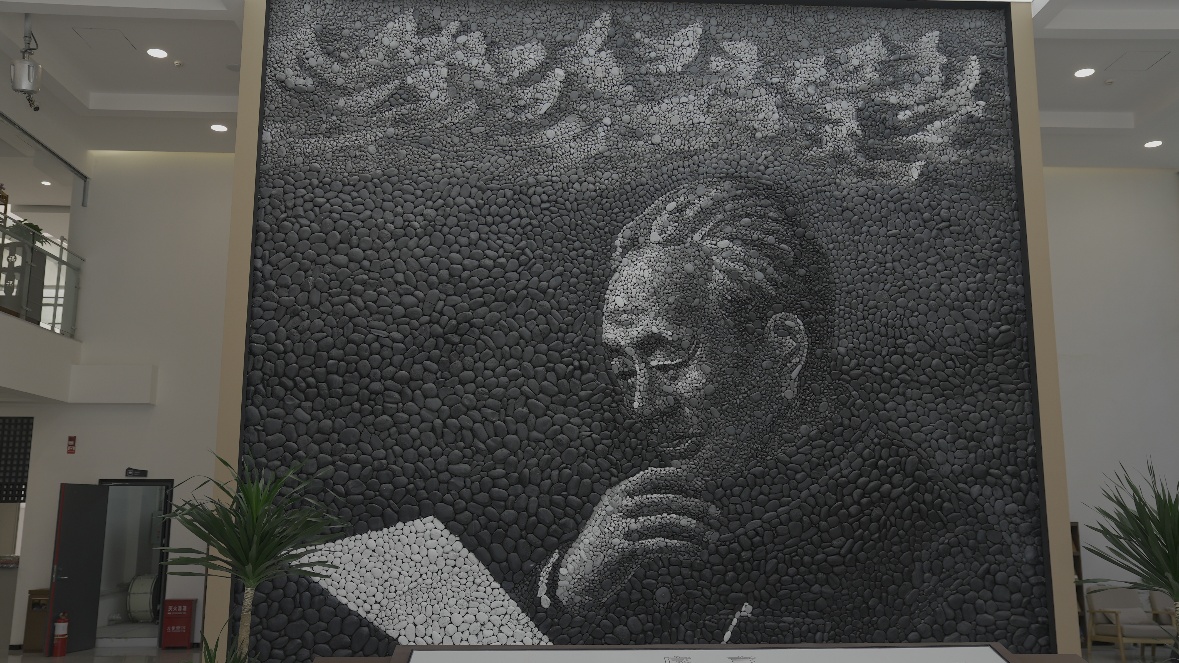
A rock mural assembled in the likeness of poet Ai Qing on display at the Ai Qing Poetry Museum in Shihezi, northwest China's Xinjiang Autonomous Region. (People's Daily Online/Xu Jingwen)
He had arrived while the city was still taking shape, and his writing captured a place in the middle of becoming something new. More than 70 years later, I had spent the day looking at what that becoming had produced, and at what might come next.
The first generation had been given difficult land and had to figure out how to make something of it. Those who followed inherited farmland, infrastructure and a functioning city. Now another generation was taking that foundation and trying to make agriculture more automated, machinery more capable and energy production more efficient.
The challenge had changed because Shihezi had changed.
As we headed back toward the train station that afternoon, the landscape outside the window seemed different from the one I had watched that morning. Where the people in those old photographs had seen desert, I had seen fields stretching toward the horizon. Where they had once relied on physical labor, I had watched machines learning to do more of it. Where they had been building the foundations of a city, companies were now building the technology that might carry it into its next stage.
Perhaps that was what made Shihezi interesting. Its story wasn't about choosing between the past and the future. The future here had grown out of what those earlier generations had built.
And in that sense, the changes taking place in Shihezi were bigger than Shihezi itself. The city offered a small, unusually clear picture of what was happening across Xinjiang: land that had once demanded enormous effort was becoming the foundation for modern agriculture, advanced manufacturing, renewable energy and new technology.
The people who came here decades ago had taken a piece of difficult land and made a city.
Now the people living and working in that city were asking a different question: how far could they take it?
The baton had been passed.
And Shihezi, like Xinjiang itself, was still moving forward.
One day to go.
Photos

Related Stories
- Xinjiang Diary, Day 4: Zhundong and Jiangbulake, one gives and the other welcomes
- Xinjiang Diary, Day 5: Beiting and Tianshan, between ruins and mountains
- Xinjiang Diary, Day 2: Turpan, where the heat provides
- Xinjiang Diary, Day 1: Hami, the gateway
- Xinjiang Diary, Day 3: Changji, where some fields tend themselves
Copyright © 2026 People's Daily Online. All Rights Reserved.
