



Chinese shipyards win over global buyers with smart, green upgrades
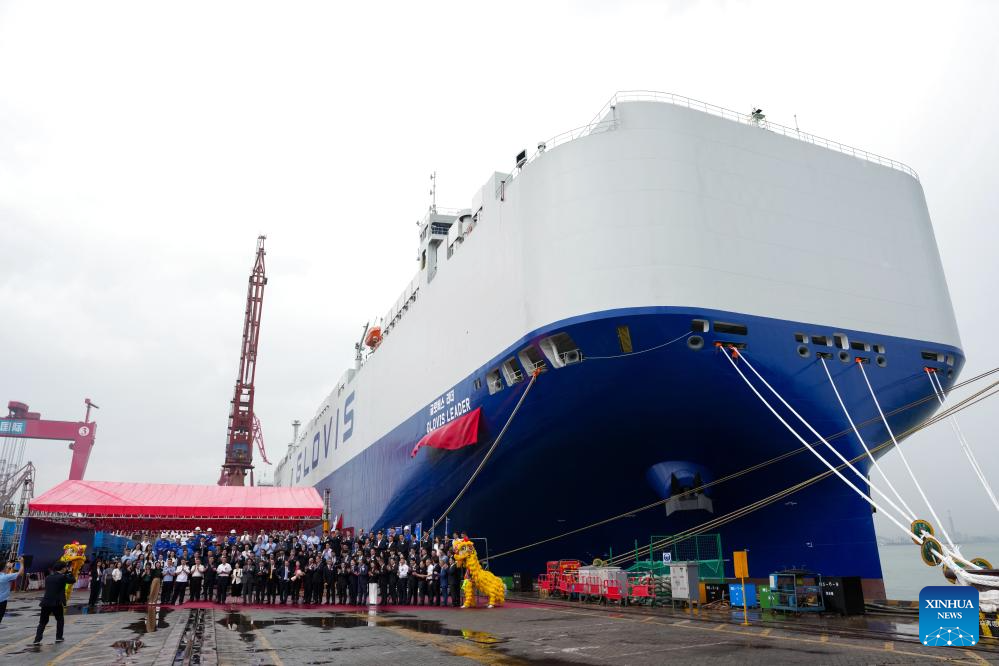
Guests pose for a group photo at the delivery ceremony of car carrier Glovis Leader in Guangzhou, south China's Guangdong Province, April 28, 2026. A car carrier with a maximum capacity of 10,800 car equivalent units, described as the world's largest of its kind, the vessel was built by Guangzhou Shipyard International Company Limited under the China State Shipbuilding Corporation (CSSC), together with China Shipbuilding Trading Co., Ltd. (Xinhua/Wu Lu)
Chinese shipyards are running at full capacity to fulfill orders from global buyers, thanks to efforts in intelligent manufacturing and green transformation.
Guangzhou Shipyard International Co., Ltd. (Guangzhou Shipyard), a subsidiary of China State Shipbuilding Corporation (CSSC) in south China's Guangdong Province, has contracts on hand worth nearly 100 billion yuan ($14 billion), said Zhou Xuhui, the company's general manager. More than 95 percent of the orders come from overseas buyers, and the order book extends through 2030.
The company sits in the Pearl River Delta, one of China's three major shipbuilding clusters. Longxue Island alone, in Guangzhou's Nansha district, is home to two core shipbuilding enterprises under CSSC. In the first half of the year, 35 domestically built vessels were cleared for departure at the Nansha checkpoint without delay, an increase of nearly 30 percent year on year.
In Dalian, northeast China's Liaoning Province, Hengli Heavy Industries Group Co., Ltd. (Hengli Heavy Industries) recently delivered two very large crude carriers (VLCCs), each with a deadweight of 306,000 tonnes, setting a new record for the global shipbuilding industry.
A representative of the Greek shipowner said he was very satisfied with the vessels. The company has now ordered more than 40 ships from Hengli Heavy Industries.
At Guangzhou Shipyard, an intelligent production line manufactures thin steel plate sections at 2.4 times the efficiency of traditional methods, with a single shift requiring only about 50 workers instead of 200. The sections are used to lower the center of gravity of roll-on/roll-off passenger ships and car carriers. Robotic welding keeps deformation on 5.5-millimeter plates within 1 millimeter.
At Hengli Heavy Industries, the company's "future factory" has deployed 10 intelligent production lines. Artificial intelligence and other frontier technologies now support full-process operations spanning design, procurement, manufacturing and quality control.
Wang Lei, deputy general manager of Hengli Shipbuilding (Dalian) Co., Ltd. under Hengli Heavy Industries, said AI-based scheduling has reduced work that once took one to two weeks to just two to three hours. He added that the company's order backlog now extends to 2030, with clients coming almost entirely from overseas.
A car carrier with capacity for 10,800 vehicles, delivered in Nansha in April, cuts carbon emissions by more than 30 percent compared with conventional ships powered by fuel oil, according to an executive from Guangzhou Shipyard. The vessel runs on a dual-fuel engine burning either liquefied natural gas (LNG) or fuel oil, and is fitted with an exhaust gas recirculation system and a domestically developed high-efficiency permanent magnet shaft generator.
Green transformation is accelerating not only in car carriers but also in VLCCs. Hengli Heavy Industries' engine assembly workshop can produce 180 marine engines a year, covering four low- and zero-carbon dual-fuel types: LNG, liquefied petroleum gas (LPG), methanol and ammonia.
Wang said the newly delivered VLCCs were independently designed and built by Hengli Heavy Industries. The vessels use next-generation desulfurization and denitrification technologies, along with the latest energy-saving and eco-friendly equipment, meeting current international green standards.
Ye Yuanfeng, head of the Nansha checkpoint, said its dedicated clearance model for new ships covers the entire process of sea trials, delivery and departure, achieving "zero-delay" clearance.
The model allows export vessels to skip the hassle of returning to port for a second inspection, cutting the time spent on docking, backtracking and paperwork by an average of nine hours per ship. That saves more than 800,000 yuan per vessel in fuel, towing and berthing costs combined, and has saved shipbuilders more than 15 million yuan in direct costs since the start of 2025.
China's shipbuilding industry continues to win over overseas clients, reflecting the systemic competitive edge the sector has built up over the years and underscoring China's strong industrial supply-chain capacity and overall cost advantages.
Photos
 China's first boring and blasting machine rolls off production line in Wuhan, China's Hubei
 Aerial crop protection operations launched in fields of NE China's Heilongjiang
 Parade celebrating intangible cultural heritage held in Yushu, NW China's Qinghai
 In pics: Beautiful scenery in the Qilian Mountains
Related Stories
- China's shipbuilding sector sees robust growth in Q1
- China's first privately funded scientific research vessel launched in Zhejiang
- World's largest car carrier delivered in China, boosting global auto transport capacity
- China delivers its largest domestically built LNG carrier
- China's shipbuilding industry extends global lead for 16th consecutive year
- China's shipbuilding sector maintains global lead in 2025
- China-developed methanol-fueled smart crude carrier delivered
- China unveils smart shipboard farm to supply offshore workers with fresh produce
- China's green shipbuilding drive boosts global maritime decarbonization
- China emerges as global leader in advanced vessel construction
Copyright © 2026 People's Daily Online. All Rights Reserved.
