



China's shipbuilding industry extends global lead for 16th consecutive year
China's shipbuilding sector maintained its global lead in terms of three major indicators for the 16th consecutive year in 2025.
The country's shipbuilding output reached 53.69 million deadweight tonnes (DWT) in 2025, accounting for 56.1 percent of the global total, according to data recently released by the Ministry of Industry and Information Technology. New orders reached 107.82 million DWT, representing 69 percent of the global market, while holding orders stood at 274.42 million DWT, making up 66.8 percent of the global market share.
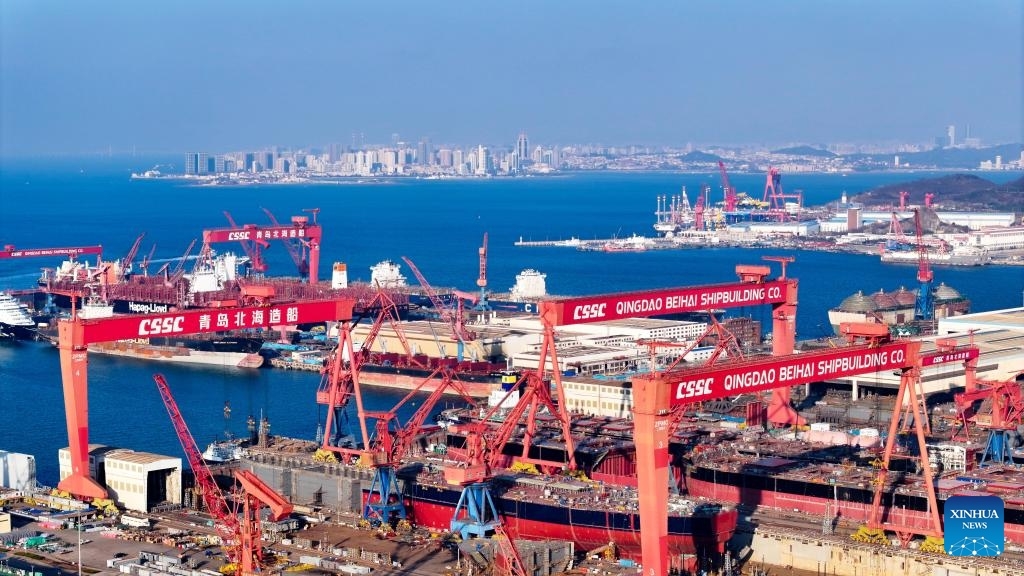
An aerial drone photo taken on Dec. 24, 2025 shows the China State Shipbuilding Corporation Qingdao Beihai Shipbuilding Co., Ltd. conducting shipbuilding work at the Haixi Bay Shipbuilding and Marine Engineering Industrial Base in Qingdao, east China's Shandong Province. (Xinhua/Guo Xulei)
The figures highlight how deeply China's manufacturing sector has woven itself into the fabric of the global economy.
International shipowners have been returning to the Chinese market in significant numbers, said Li Yanqing, vice president of the China Association of the National Shipbuilding Industry.
In 2025, China's export vessels accounted for 89.6 percent of its shipbuilding output, 89.5 percent of new orders and 93.2 percent of holding orders. In other words, for every 10 ships built in China, nearly nine are destined for the global shipping market.
China's shipbuilding industry delivered eye-catching results in 2025, with all three major indicators exceeding expectations, Li said.
What makes China so attractive to shipowners worldwide? Speed is part of the answer. In 2025, Hudong-Zhonghua Shipbuilding (Group) Co., Ltd., a subsidiary of China State Shipbuilding Corporation (CSSC), delivered multiple 174,000-cubic-meter liquefied natural gas (LNG) carriers under QatarEnergy's LNG transportation project.
After the first delivery in 2024, vessels have been arriving almost every month since, and this efficiency has far exceeded expectations, said Saad Sherida Al-Kaabi, Qatar's minister of state for energy affairs.
Value for money is another factor. Zhong Zhechao, founder and CEO of One Shipping, said that thanks to decades of development, China has a mature, fully integrated shipbuilding industrial chain and a strong competitive edge in the global market. Chinese shipbuilders can ensure large-scale construction, reliable delivery schedules, mature green vessel solutions and access to financing support — all of which help shipowners manage risks across technology, funding and delivery.
"There is a consensus in global shipbuilding: at equivalent technical standards, China offers the lowest total construction costs; at equivalent prices, China offers the strongest delivery capability and reliability," Zhong said.
Xu Guangjian, a professor at the School of Public Administration and Policy at Renmin University of China, pointed to China's systemic competitiveness across the entire shipbuilding industrial chain as the most critical underpinning factor. As the only country in the world that possesses all the industrial categories listed in the United Nations industrial classification, China's manufacturing value added accounts for 30 percent of the global total — a position it has held for 14 consecutive years.
"China's robust manufacturing system gives its shipbuilders exceptional resilience. When global supply chains are thrown into turmoil, Chinese shipbuilders can still secure a steady supply of components and keep production on track without being derailed by external disruptions — and that gives international shipowners real peace of mind," Xu said.
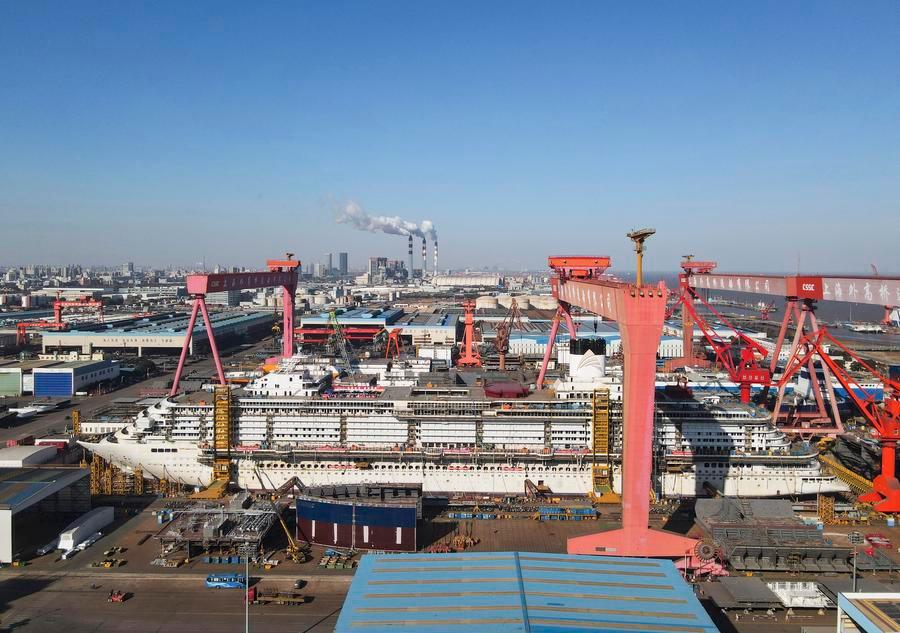
An aerial drone photo taken on Jan. 15, 2025 shows the cruise ship Adora Flora City under construction at Shanghai Waigaoqiao Shipbuilding Co., Ltd. in Shanghai, east China. (Xinhua/Fang Zhe)
China's sustained global leadership in shipbuilding rests not just on order volumes but on coordinated innovation across the full industrial chain and an openness to serving the world.
China's second domestically built large cruise ship, Adora Flora City, is now over 91 percent complete at the No. 2 dry dock of Shanghai Waigaoqiao Shipbuilding Co., Ltd., a subsidiary of CSSC — nearly eight months ahead of the schedule set by its predecessor.
"The scheduling algorithms for all materials going in and out of the warehouse are now handled by AI," said Yuan Yi, a senior director at Shanghai Waigaoqiao Shipbuilding Co., Ltd. In the thin-plate production workshop, laser cutting and plasma cutting stations run continuously under the direction of an AI system. Compared with the old approach of relying on experienced workers to arrange production manually, AI-driven scheduling has boosted the workshop's capacity by 25 percent.
Green transformation has become another hallmark of Chinese shipbuilding. In 2025, Chinese shipbuilders delivered multiple world-class green and intelligent vessels, marking significant breakthroughs in the industry's high-end transition and tangible progress in the sector's quality-driven development.
A CSSC executive said Chinese enterprises are continuing to advance their global strategies, expanding localized services and supply chain networks overseas to win greater recognition from international clients.
From ship-grade steel plates and engines to navigation systems and deck machinery, China has built a complete and self-reliant supply chain spanning core components, standard products and integrated solutions, the executive added.
Li noted that the shipbuilding industry is a vital pillar of China's strategies to become a manufacturing powerhouse, a transport powerhouse and a strong maritime country. China's shift from the world's largest consumer of ships to its largest supplier signals a deeper transition in Chinese manufacturing, from competing on scale to competing on systemic advantage.
The structural evolution has been equally striking. From a starting point dominated by medium- to low-end ships, including bulk carriers and oil tankers, China has now achieved across-the-board breakthroughs in high-end vessel types, including LNG carriers, large container ships and car carriers. In 16 of the 18 major ship categories, China ranks first globally in new orders received — a shift with far-reaching implications.
Against a backdrop of slowing global economic growth, the success of China's shipbuilding sector on the world stage is a testament to the resilience and competitiveness of Chinese manufacturing, providing a stabilizing force for global industrial and supply chains.
In 2025, six Chinese shipbuilders ranked among the world's top 10 across all three major indicators. CSSC became the world's largest listed shipbuilding company, accounting for 18 percent of global orders on its books, with its production schedule extending to 2029. That kind of scale translates into genuine market influence, positioning China's shipbuilding industry to play a leading role in the global shipping sector's green transition.
Photos




Related Stories
- China's shipbuilding sector maintains global lead in 2025
- China-developed methanol-fueled smart crude carrier delivered
- China unveils smart shipboard farm to supply offshore workers with fresh produce
- China's green shipbuilding drive boosts global maritime decarbonization
- China emerges as global leader in advanced vessel construction
Copyright © 2026 People's Daily Online. All Rights Reserved.
