



Man devotes over 40 years to afforestation in SW China's Yunnan
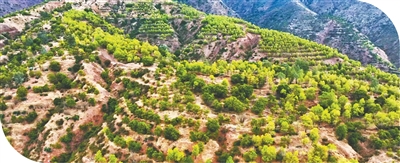
Photo shows a mountain in Yuanmou county, southwest China's Yunnan Province. (Photo/Xie Jiecheng)
Zhao Peixian, 62, a senior forestry engineer and former head of the ecological restoration section at Yuanmou county's forestry and grassland bureau in southwest China's Yunnan Province, has devoted over four decades to afforestation and ecological restoration in the dry-hot valley of the Jinsha River, the upper reaches of the Yangtze River.
Since starting work in 1984, he has helped pioneer a unique technique for afforestation and selected tree varieties suited to the region, gradually restoring vegetation to hills once stripped bare.
Average annual rainfall in the county is just 637 millimeters, while evaporation is 2.6 times greater. According to an official document, the county's forest coverage rate fell to a historic low of 5.2 percent in 1985.
Zhao recalled that when he began working, the hillsides were nearly bare, and strong spring winds regularly stirred up dust storms. Thin, sandy topsoil made the land more vulnerable to erosion during the rainy season. Starting in 1999, Yuanmou launched a large-scale afforestation campaign.
Early efforts to plant seeds directly into pits dug on barren slopes resulted in poor germination and survival rates — soil moisture in the topsoil, which needs to reach at least 8 percent for plants to survive, was insufficient. Zhao recalled that trees survived on fewer than 100 of the more than 10,000 mu (about 666.67 hectares) planted that year.
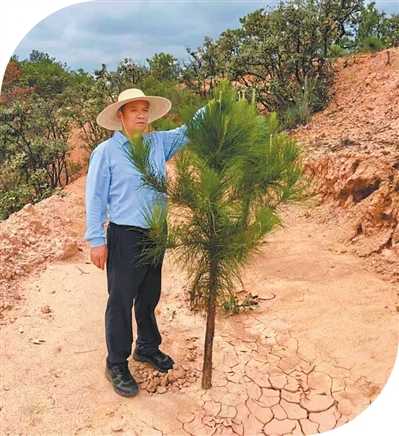
Zhao Peixian is pictured beside a tree in Yuanmou county, southwest China's Yunnan Province. (Photo courtesy of the interviewee)
Facing criticism that trees simply couldn't grow in Yuanmou, Zhao said the team "gritted its teeth and kept going, no matter how hard it got."
To improve survival rates, Zhao developed a technique of digging planting trenches along contour lines, breaking up compacted soil and rocks, letting them bake in the sun to mature, then refilling the trenches to create a gentle slope — higher on the outside and lower on the inside — that traps rainwater and allows tree roots to grow deeper. Zhao said the method improved the soil's water- and soil-retention capacity by more than 40 percent.
In the 1990s, the county required officials and staff to dig at least 25 meters of trenches and plant one tree per meter each year, work typically carried out between the Spring Festival and early May, ahead of the rainy season.
The county's officials and staff hauled water by bucket to the foot of the hills and then transported it by mule up the slopes, often saving their own drinking water to pour on the saplings.
Early plantings using Yunnan pine and Simao pine seeds frequently withered in the dry climate. After 2000, Yuanmou began working with the Chinese Academy of Forestry (CAF) and the Yunnan Academy of Forestry and Grassland to breed and acclimatize species suited to the valley. Zhao, together with Li Kun, then deputy director of the CAF's Research Institute of Resource Insects, and researcher Zhang Yanping, set up a test plot to grow Indian rosewood from seeds. However, early survival rates were low, with seedlings dying from drought, overwatering, disease or pest damage.
Zhao and researchers kept detailed records on watering, soil composition and fertilization, filling a thick notebook over years of trial and error. It took them eight or nine years to determine whether Indian rosewood was suited to Yuanmou's climate, as researchers needed to observe seedlings grown from second- and third-generation seeds over multiple years before drawing conclusions.
Researchers also introduced native species, building mixed forests that combine native and domesticated species through a tree-shrub-grass restoration model. In recent years, five local tree varieties in Yuanmou have received provincial-level certification as improved strains, providing germplasm resources for the restoration of the Jinsha River's vital ecosystems.
Yuanmou's forest area now covers 945,000 mu, with forest coverage rising from the historic low of 5.2 percent to 31.11 percent. The county is also exploring solar-powered irrigation to address drought, while developing the non-timber forest economy, forest-based wellness experiences and other sectors.
"Protecting the ecological barrier of the upper reaches of the Yangtze River and covering Yuanmou's dry-hot valley in green has been my lifelong wish," Zhao said.
He was honored as a national-level outstanding individual who leads efforts in afforestation in 2022, and the county's forestry and grassland bureau was recognized as a provincial-level outstanding unit for advancing ecological progress in 2026.
Photos

Related Stories
- 'Cliff afforestation team' in NW China's Shaanxi transforms barren cliffs
- Man spends 43 years turning barren valley green
- Over two decades, another 'Saihanba' has taken root
- Sand control, afforestation efforts in China's largest desert
- NW China's Shaanxi builds 'green miracle' in Yellow River Basin
- The greening of China in 2023
- County once tormented by desertification builds "green miracle" in NE China's Liaoning
- China makes notable achievements in afforestation in 2023
- China's Jiangsu to complete afforestation of 40,000 hectares by 2025
- Extending "green Great Wall" in north China
Copyright © 2026 People's Daily Online. All Rights Reserved.
