



From manufacturing to value creation, Yiwu is elevating its role in World Cup economy
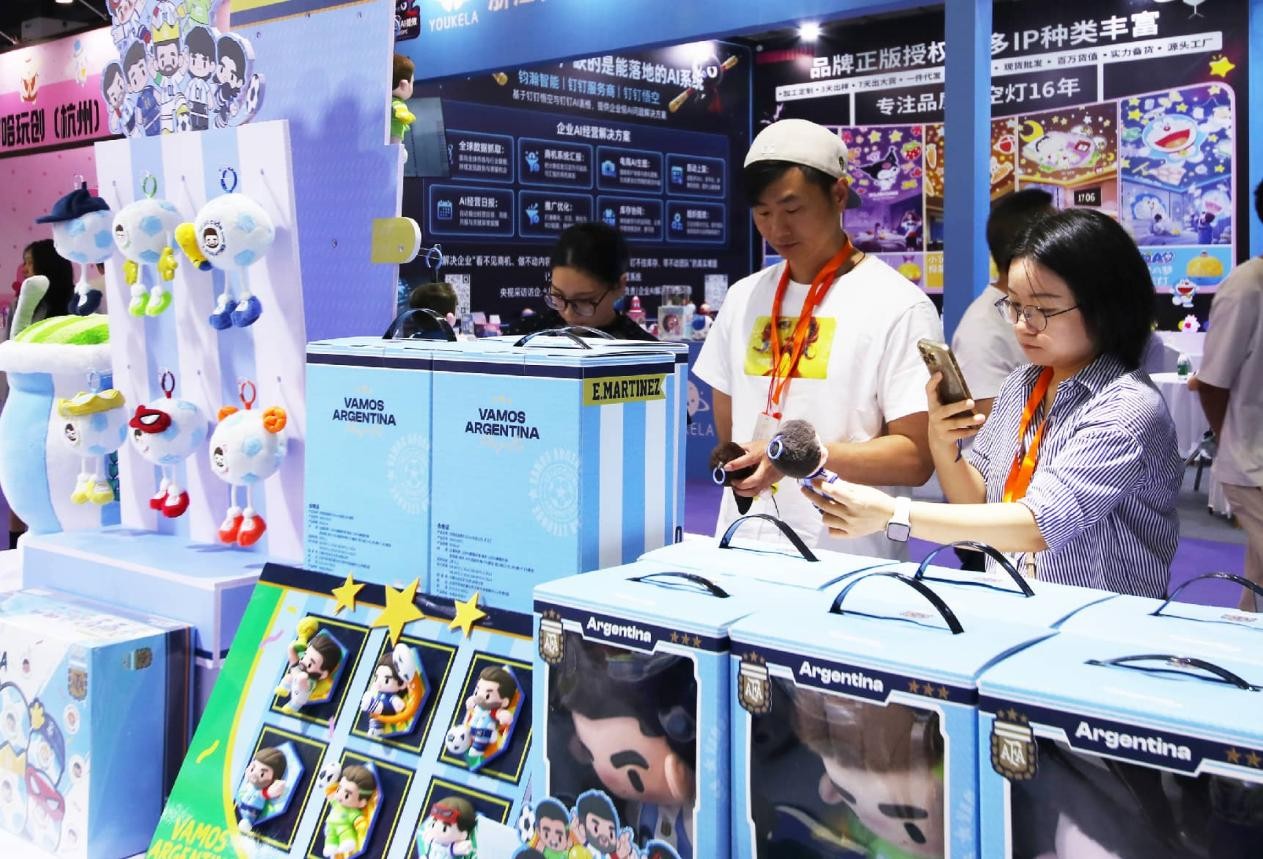
Plush toys inspired by teams participating in the 2026 FIFA World Cup in Canada, Mexico, and the United States are sold at Yiwu International Expo Center, Yiwu, east China's Zhejiang province. (Photo/Gong Xianming)
As the referee's whistle echoes through the 2026 United States-Canada-Mexico World Cup stadiums, China's manufacturing epicenter Yiwu -- thousands of miles away -- has already been shipping fan merchandise worldwide through meticulous supply chain mechanisms.
According to Yiwu customs, exports of sporting goods and equipment from Yiwu reached 2.83 billion yuan ($417.85 million) in the first quarter of this year, up 12 percent year on year. Products related to the World Cup accounted for a significant share of that growth.
Pan-African multilingual news network Africanews reported that retailers across Africa and around the world rely on Yiwu's manufacturing efficiency for everything from banners and flags to a wide range of fan merchandise, making Chinese manufacturing an indispensable behind-the-scenes force supporting major international sporting events.
Meanwhile, the British industry website Campaign Asia-Pacific noted that Yiwu supplies roughly 70 percent of the global market for World Cup-related products, calling it one of the busiest barometers of global football consumer demand.
Why has Yiwu always been able to seize opportunities created by the world's premier sporting events?
The answer lies in a quiet transformation taking place among Yiwu's merchants -- from simply responding to market demand to actively shaping it through design and securing competitive advantages through intellectual property. Behind this shift is a profound transition from passive order-taking to proactive value creation.
Intellectual property has become a powerful competitive moat, enabling businesses to move beyond contract manufacturing and toward shaping industry standards.
The era of relying solely on price competition has passed. Today, independent intellectual property has become a key source of both profitability and market recognition.
Merchant Wen Congjian began designing World Cup jerseys well in advance and simultaneously applied for overseas design patents. For this tournament alone, he has filed more than 40 design patent applications. Protected by these patents, his products can command price premiums of up to 20 percent.
An increasing number of Yiwu businesses are using intellectual property rights to safeguard innovation, signaling a broader evolution in Chinese manufacturing from a passive participant in global value chains to a creator of standards and rules.
At the same time, a growing emphasis on creativity and branding is reshaping the way Yiwu businesses compete.
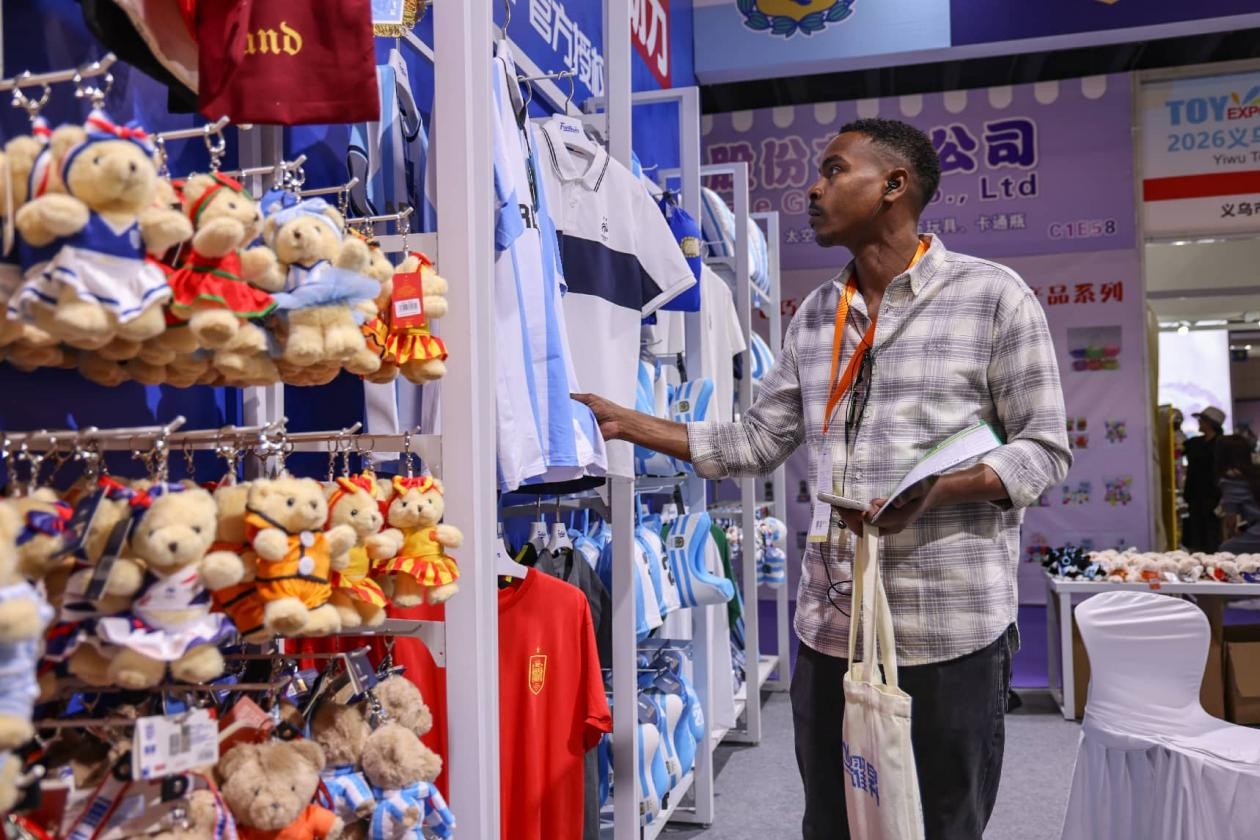
A businessman buys World Cup-related products at Yiwu International Expo Center, Yiwu, east China's Zhejiang province. (Photo/Jin Sicheng)
Merchant Luo Tianle secured full-category licensing rights for several national teams and expanded his product offerings into cultural and creative merchandise. Niche products such as pet jerseys and skin-friendly jerseys for infants and toddlers have enabled him to tap into emerging consumer demand while avoiding the race to the bottom associated with low-price competition.
Having experienced multiple World Cup cycles characterized by intense price wars, many Yiwu merchants now place greater value on overseas reputation and long-term brand development. Pursuing high-quality growth is increasingly becoming a shared business philosophy.
Underlying all of this is the confidence that comes from the "Yiwu speed" made possible by China's complete industrial ecosystem.
World Cup orders are typically large in volume, tight in schedule, and demanding in terms of production requirements. Yet these are precisely the conditions under which Yiwu excels. The city possesses a complete industrial chain covering design, prototyping, fabric sourcing, sewing, printing, and quality inspection. In some cases, a football can move from initial design sketch to finished product in less than a week.
This exceptional supply-chain capability, supported by China's vast manufacturing network, enables innovative designs and patented products to be rapidly transformed into market-ready goods for customers worldwide.
Yiwu's connection with the World Cup reflects the broader global recognition that Chinese manufacturing is earning.
When the jerseys worn and flags waved by football fans around the world increasingly bear the label "Made in China," it represents more than market share -- it is a vote of confidence. And that confidence extends well beyond football arenas.
In Mexico City, more than 95 percent of the shuttle buses serving football fans are Chinese-brand new-energy coaches. Meanwhile, urban rail projects such as Mexico City Metro Line 1, built with the participation of Chinese companies, are helping connect venues and improve transportation efficiency.
From flags and plush toys to green transportation solutions, Chinese manufacturing is becoming deeply integrated into the global sports economy through comprehensive, end-to-end participation.
From a patented football jersey sold overseas to Chinese-made electric buses operating around World Cup venues, the role of Chinese manufacturing on the global sporting stage has undergone a fundamental transformation.
The final whistle of a World Cup tournament will eventually blow. The momentum behind the upgrading of Chinese manufacturing, however, shows no sign of ending. If anything, its call is growing ever stronger.
Photos
Related Stories
Copyright © 2026 People's Daily Online. All Rights Reserved.
