



Chinese cultural IPs gain growing popularity across Europe
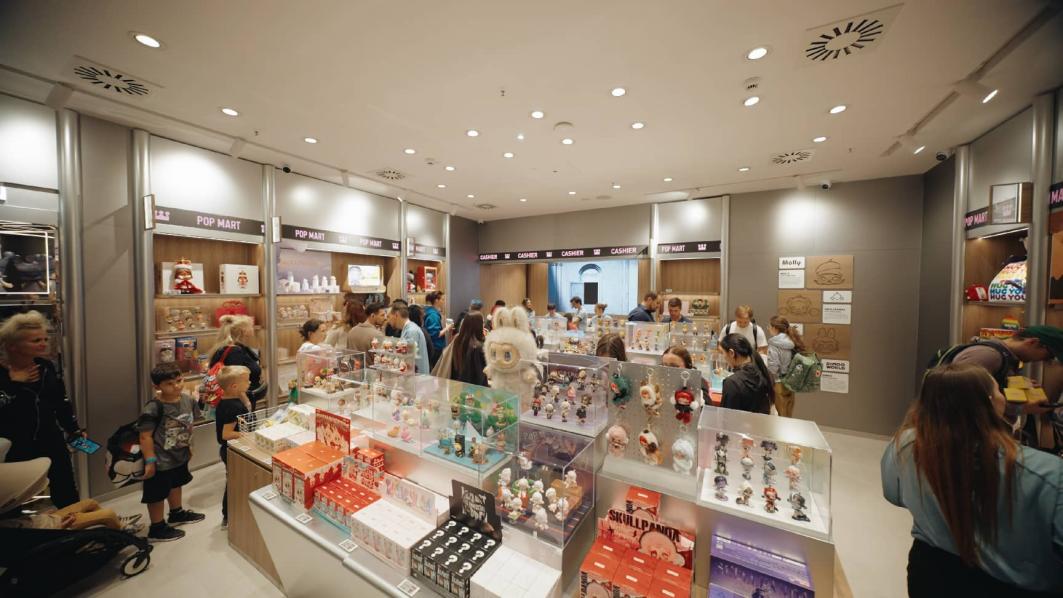
Customers visit the first store of Pop Mart in Germany. (People's Daily/Liu He)
Chinese cultural intellectual properties (IPs) are gaining widespread popularity across Europe, crossing geographical boundaries to win over local audiences. Spanning designer toys, animated films and video games, these cultural products have become fresh bridges connecting European audiences, especially young generations, with Chinese culture.
At the first store of Chinese toy brand Pop Mart in Germany, located near Berlin's Alexanderplatz, customers have streamed through the doors since the store's opening last year. Among its most sought-after products is Labubu, which has become a viral hit and a trending topic across local social media.
"I first got interested after watching Labubu unboxing clips on TikTok," said a 23-year-old college student Anlist from Hamburg.
"There's something thrilling about the surprise when you open a blind box. It makes you want to give it a try yourself." Anlist added.
Anlist is far from alone. Countless young European consumers discover Chinese cultural products through social media recommendations.
According to data from the Deutscher Verband der Spielwarenindustrie, or German Association of the Toy Industry, IP-themed toys account for around 28 percent of Germany's toy market, while demand for collectible toys continues to rise.
The trend closely aligns with the growing phenomenon of "kidulting" -- adults embracing childlike hobbies and consumption patterns.
These evolving consumer habits have provided fertile ground for Chinese cultural IPs to expand in Europe.
Interviewees shared various reasons why they are fond of Chinese IP products. Some said they love collecting these figurines, for these toys' quirky yet endearing looks win them over at first sight. Some pointed out that designed as bag charms, blind box accessories can be carried outdoors. Matched with outfits, they look stylish and help people showcase their unique personalities. Though their reasons vary, all consumers share the same eager anticipation of getting their favorite pieces.
The growing popularity of Chinese cultural IPs has translated directly into rising sales. Pop Mart, for example, reported total revenue of 37.12 billion yuan ($5.48 billion) in 2025, up 184.7 percent year-on-year. Revenue from Europe surged even faster, rising by 506.3 percent.
Labubu's success is just one example of a broader trend. Today, original Chinese IPs in animation, film and online gaming are increasingly becoming gateways for European audiences to learn about and engage with China.
In 2025, Chinese animated blockbuster Ne Zha 2 topped the global animation box office with worldwide revenue reaching nearly 15.95 billion yuan ($2.36 billion).
German audiences spoke highly of the production, noting that the film features breathtaking visuals and a dramatic plot, which has won them over. They also admitted that the exceptional craftsmanship of modern Chinese animation has greatly reshaped their views. These comments speak volumes about the charm of Chinese animated IPs.
A European film critic commented that Ne Zha 2 successfully blends the essence of traditional Chinese culture with modern storytelling, adding that it preserves the unique charm of Eastern culture while also matching global audience expectations, which allows European viewers to experience the depth of Chinese culture while enjoying the film.
Video games have emerged as another important vehicle carrying Chinese cultural IPs overseas.
At Gamescom 2025, the world's largest gaming expo held in Cologne, Germany, Chinese gaming products attracted considerable attention.
Chinese video game development studio Game Science unveiled Black Myth: Zhong Kui during the exhibition's closing showcase trailer presentation, positioning it as the next major title following Black Myth: Wukong. It marked the first time a Chinese game appeared as part of the finale presentation at a top-tier international gaming exhibition.
The popularity of Chinese games has also fueled growing curiosity about Chinese culture among younger Europeans. On overseas gaming forums, players have actively explored Chinese classics while discussing games. Many have begun reading works such as Journey to the West, searching for historical and cultural materials, and discussing concepts such as heavenly palaces and dragon kingdoms, demonstrating growing interest in traditional Chinese culture.
The global rise of Chinese cultural IPs is far from accidental. Rather, it reflects the emergence of an increasingly complete ecosystem that integrates design, manufacturing, content creation, cultural adaptation and consumer psychology into a new model for global expansion.
German retail expert Ghalia Boustani believes Chinese companies have achieved "emotional resonance and cultural identification" with overseas consumers through IP exports.
She argued that this approach accurately matches younger consumers' demand for individuality and emotional connection, an important reason why Chinese cultural IPs have gained traction across Europe.
Innovative storytelling formats, advanced technology and superior production quality are also key driving forces.
Ne Zha 2 took five and a half years to complete, involving more than 4,000 creators and nearly 2,000 visual effects shots, with attention devoted to even the smallest details.
The development of Black Myth: Wukong spanned more than six years, with the team investing heavily in art production to deliver premium visuals and performance.
Behind these successes stands an increasingly mature industrial ecosystem. From IP creation and product manufacturing to marketing and distribution, coordination across the entire value chain has provided strong support for bringing Chinese cultural products overseas.
Pop Mart illustrates this strength well. The company collaborates with artists worldwide and operates a diverse portfolio of IPs with different styles and audiences.
Supported by increasingly solid industrial capabilities and a vast domestic market, China is gradually becoming an important hub for original global creative IPs. More homegrown creations will continue to travel across borders and delight audiences worldwide.
Photos




Related Stories
- China strengthens customs IPR protection, steps up crackdown on infringement
- China cracks down on deceptive, misleading trademarks
- IP protection in new fields strengthened
- China enhances judicial IP protection in emerging industries
- China shares emerging industries' IP experience to boost global governance
- China's homegrown pop culture fuels rise of 'guzi' economy
- From volume to value: China's IP targets quality, new tech and economic payoff
- IP court of China's top court handles more than 24,000 cases over 7 years
- China establishes network to assist companies with overseas IP disputes
- Beijing to deepen high-quality IP development
Copyright © 2026 People's Daily Online. All Rights Reserved.
