



AI-powered cleaning robots team up with humans for home services
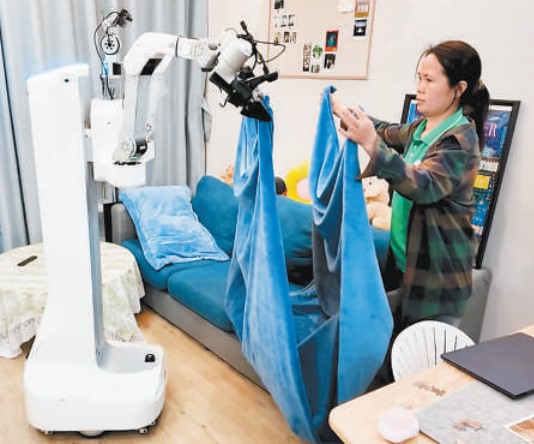
A human cleaner works with a robot to fold a bedding sheet. (Photo/Zhou Qian)
Shenzhen homeowner Chen Zishun experienced a surprise during a recent scheduled housekeeping visit. Alongside the human cleaner arrived an unusual new arrival: an AI-equipped robot with a long mechanical arm.
This innovative service stems from a collaboration between Shenzhen-based company X Square Robot and a major domestic service platform, 58.com Inc. The partnership has launched intelligent home-cleaning services in Shenzhen, where robots now work alongside human cleaners.
The new service soon gained great popularity, with reservations fully booked for half a month. Chen successfully booked a service order amid high demand.
When the cleaning work started, the robot was tasked with garbage removal and table arrangement in the living room and dining room, while human cleaner went straight to tidy up bedrooms.
In the living room, the robot moved slowly while skillfully avoiding obstacles. It accurately picked up scattered items and put them in order by category, then wiped tables with cleaning cloths. The movements were deliberate and somewhat slow, but orderly and methodical.
Li Ziwen, Shenzhen city manager at 58.com Inc., explained that under the current human-machine collaborative cleaning model, robots mainly handle repetitive, labor-intensive tasks such as sorting tabletops, arranging sofas and organizing shoes. Human cleaners handle more complex, fine-detail deep-cleaning work instead, including scrubbing hard-to-reach corners, polishing countertops, thoroughly sanitizing kitchens and bathrooms, and carrying out disinfection. The two sides follow a clear division of labor.
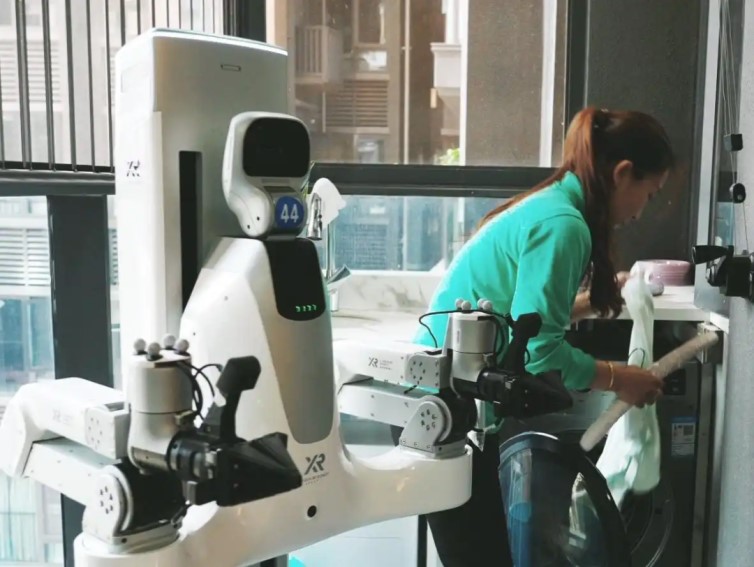
A human cleaner and a robot are on a home-cleaning mission. (Photo from Economic Daily)
These robots are continuously learning. After each job, anonymized data on their perception and actions feeds into a training platform to refine their model. Initial tests showed slow progress (e.g., taking over 10 minutes to pick up a towel), but rapid improvement followed. Within a week, the robot mastered table wiping, and it has since learned skills like cleaning up after pets and folding clothes.
During an on-site demonstration, People's Daily observed that the robot could accurately classify medicines simply by examining packaging, and could even identify and separate expired snacks on its own. For safety reasons, however, the robot is not yet used in water-related cleaning tasks, and its movements are intentionally programmed to remain relatively slow.
About three hours later, the human cleaner had finished the remaining rooms, while the robot completed organizing the living and dining areas. Traditionally, standard cleaning for a 130-square-meter apartment like this would usually take four to five hours.
So what does the future hold for smart home-cleaning robots?
Market response has strengthened Li's confidence. On the online platform of 58.com Inc., bookings for intelligent cleaning services have surged. Only eight appointments are released each day, and reservations are already scheduled more than two weeks in advance. Prices are the same as traditional housekeeping services: around 140 yuan for a three-hour standard cleaning session ($25.26). Recently, X Square Robot and 58.com Inc. launched intelligent cleaning services in Beijing.
Across the sector, the household scenario is widely regarded as the "last mile" for embodied AI applications. Even so, intelligent cleaning robots still face significant challenges. The range of cleaning scenarios robots can currently handle remains limited; the efficiency of human-machine collaboration still needs improvement; robots must become better at adapting to complex home environments; and customer acceptance remains relatively low.
"Household robots need to respond to unexpected situations with adult-like capability," explained Wang Jiashen, an application engineer at X Square Robot. Unlike repetitive industrial tasks, home-service robots demand greater adaptability and intelligence. To achieve this, the company developed the WALL-B foundation model, enabling robots to adjust in real-time and quickly correct operational errors.
According to Wang, the development team is now focused on improving robots' ability to adapt to home environments, optimizing navigation and obstacle avoidance so the machines can better "understand" the home while remaining stable and reliable in real-life settings.
On the human-machine collaboration side, engineers are also refining workflow standards to reduce waiting time and repetitive tasks, making cooperation smoother and services more standardized.
So far, the robot cleaners of X Square Robot have already served hundreds of households in Shenzhen and Beijing.
In the feedback section after the service, Chen wrote: "Maybe in the not-so-distant future, hiring a robot cleaner to work alone at home will become just as commonplace as robot vacuum cleaners or self-driving cars are today."
Photos



Related Stories
- Nobel laureate hails China's AI application in economy
- Riding AI boom, NW China emerges as key computing hub
- China accelerates AI application in healthcare
- Chinese premier stresses promoting deep integration of AI, advanced manufacturing
- China showcases space film, AI innovations at Sofia Science Festival
- AI drives boom in one-person companies nationwide
- China accelerates AI agent governance amid emerging security risks
- "AI plus transportation" takes center stage at international expo
- AI firms penalized for fake product review scheme
- Singapore PM calls for balance between AI safety, innovation
Copyright © 2026 People's Daily Online. All Rights Reserved.
