



Livestreaming breathes new life into rural industries
China had 20.074 million rural e-commerce businesses by the end of 2025, according to China's Ministry of Commerce.
Village-based livestreamers are bridging the gap between farms and consumers, boosting rural tourism, expanding sales channels for agricultural products, and helping local residents increase their incomes. In 2025, China's rural online retail sales surpassed 3 trillion yuan (about $441.46 billion) for the first time.
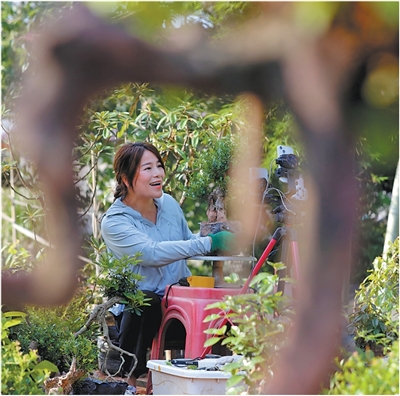
A woman sells bonsai during a livestreaming session in Dongcao village, Tong'an township, Yifeng county, Yichun city, east China's Jiangxi Province. (Photo/He Jianlai)
Early in the morning, Liu Yong from Yangbu village, Babao town, Kaiyuan city, northeast China's Liaoning Province, grabbed his phone and headed to the pigpen, aiming the camera at a litter of piglets.
"The first three to seven days after birth are critical. We need to make sure they get enough colostrum, stay warm, and are protected from crushing and disease," he said. After editing, he uploaded the video, which quickly received numerous likes.
When he joined various short video platforms in 2019, Liu noticed that many livestock-focused livestreamers were popular. Motivated, he recorded a one-minute, single-take video on piglet care, which quickly surpassed 200,000 views. From then on, Liu documented piglet growth daily and shared farming tips.
Watching livestreams on agriculture allows farmers to learn production techniques quickly and at almost no cost. Short video platform Kuaishou, for example, amassed 140 million users interested in agriculture, rural areas and farmers over the past year, according to a report released by the platform in October 2025.
He Jiandong, who has nearly 2 million followers on a short video platform, is based in Caojiazui village, Hekou town, Rongxian county, Zigong city, southwest China's Sichuan Province.
He started his account in 2021, inspired by other creators sharing rural life. He filmed Sichuan dishes and local scenery with his grandmother, adding subtitles and music, but his early videos gained little traction.
One night, he stayed up late editing videos and accidentally fell while going downstairs. His grandmother, who had climbed the mountain to gather medicinal herbs, brewed some for him. He refused to drink it, complaining it was too bitter. Worried, his grandmother gave him a gentle slap. He casually recorded the incident and posted it online, and to his surprise, the next day his followers had skyrocketed from tens of thousands to over 100,000.
Between September 2024 and September 2025, more than 1.36 billion videos featuring rural life were uploaded to the short video platform Douyin.
After three months of posting videos, Liu tried his first livestream. Despite hoping that his hands-on experience in rural life would give him an edge, he quickly ran into trouble. With little experience managing a livestream, he struggled to keep the broadcast engaging. To make his livestreams feel more authentic, Liu moved the broadcasts to everyday farm settings, including pigsties and cattle sheds.
Recognizing that limited experience and technical skills are common challenges for village-based livestreamers, local authorities have stepped in.
"We organize training in partnership with vocational colleges and e-commerce industrial parks, inviting top influencers and e-commerce experts to improve professional skills and capabilities for village-based livestreamers," said Liu Yang, deputy director of the commerce bureau of Kaiyuan. Since 2020, the city has held over 50 e-commerce training sessions, with a total attendance of more than 4,000.
To address talent shortages, Sichuan launched a rural talent cultivation program in 2024. Yang Guochao, director of the commerce bureau of Rongxian county, said the county has 42,000 e-commerce professionals. Among them, one village-based livestreamer has over 10 million followers, and 13 have over 1 million each.
Data from China's Ministry of Commerce show that leading e-commerce platforms hosted over 4 million agricultural livestreams in 2025.
He Jiandong cited the short shelf life of certain products as a major challenge, pointing to leaf-wrapped glutinous rice cakes called ye'erba, a Sichuan specialty, as an example. Poor packaging, he added, often leads to deformation during transport.
The commerce bureau of Rongxian county found a solution. "A food company designed compartmentalized packaging with cooling and pre-chilling to keep the cakes intact," said Yang. Now, ye'erba can travel thousands of kilometers while remaining fresh, helping He exceed 5 million yuan in annual livestream sales.
For Ji Yong, a livestreamer selling bonsai from Dongcao village, Tong'an township, Yifeng county, Yichun city, east China's Jiangxi Province, logistics costs are the main headache.
"My village is remote. Sending bonsai to Jiangsu, Zhejiang, or Shanghai costs around 15 yuan per order, and over 20 yuan to Beijing," he said.
In January 2025, Yifeng was designated a pilot county for Jiangxi's county-level logistics distribution system.
"Our goal is to establish logistics hubs in the county seat, distribution stations in townships and towns, and last-mile delivery points in villages by the end of 2026," said Liu Yanping, director of the commerce bureau of Yifeng county. Once fully operational, logistics costs could drop by about 20 percent, Liu noted.
Dongcao village has revitalized its economy through livestreaming bonsai sales. Today, annual revenue from these livestreams exceeds 10 million yuan, and more than 500 villagers have secured jobs close to home.
Photos



Related Stories
- Young professionals find their calling in China's countryside
- C China's Qianjiang writes story of rural revitalization through crayfish
- Mushroom industry empowers rural revitalization in China's Shandong
- Village in SW China's Sichuan turns distinctive resources into prosperity
- Gong Cai drives rural revitalization in county of SW China's Yunnan
Copyright © 2026 People's Daily Online. All Rights Reserved.
