



How China's 'AI+' initiative is powering shared global growth
Practical partnerships and on-the-ground initiatives jointly implemented by China and countries around the world have painted a broader picture of how artificial intelligence (AI) is transcending borders, reshaping the landscape of global development and cooperation.
China, a global leader in open-source AI development, has been pushing for and contributing to collaborative global AI development with an open and inclusive approach, as well as concrete actions.
In September 2025, China proposed the AI+ International Cooperation Initiative at a high-level meeting on the Global Development Initiative held at the U.N. headquarters in New York.
As a public good grounded in the vision of building a community with a shared future for humanity, the initiative outlines an action framework across five priority areas: public well-being, technological advancement, industrial application, cultural prosperity and talent cultivation.
It has drawn broad attention and positive responses from the international community.
At its core, the initiative places people's well-being first. It advocates harnessing AI to address real-world challenges, particularly in developing countries.
Such stories are unfolding in various regions, bringing tangible benefits to people around the world.
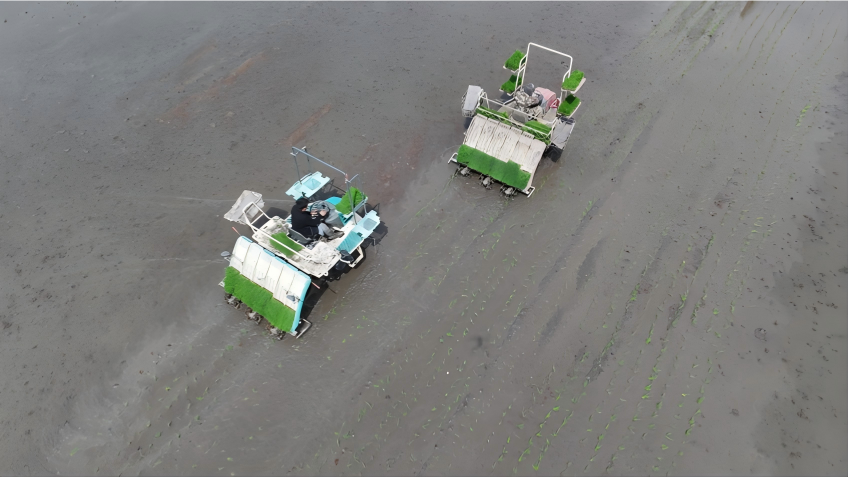
In Gaza Province, Mozambique, an agricultural cooperation project between China and Mozambique has introduced precision farming technology featuring agricultural drones integrated with China's BeiDou Navigation Satellite System.
The agricultural drones have been widely used for field mapping, rice planting, and pest and disease prevention and control, covering more than 80,000 mu (5,333 hectares) of farmland. They have raised rice output from around 150 kilograms per mu to over 400 kilograms, with some demonstration plots reaching 500 kilograms and high-performing fields exceeding 550 kilograms per mu.
In the health care sector, AI-assisted diagnostic systems are extending access to quality resources in remote areas, improving diagnostic accuracy at primary-level health care institutions through image recognition.
Meanwhile, in education, intelligent learning platforms are breaking down geographical barriers, allowing students in developing countries to access top global resources and bringing the benefits of technology to every corner.
Behind these applications lies a robust technological foundation.
China has emerged as a global frontrunner in large-scale AI model development and open-source ecosystems, providing accessible and cost-effective tools for global users.
Building on this foundation, China has advanced global AI cooperation on the twin pillars of model innovation and green computing infrastructure, laying a solid foundation for further collaboration worldwide.
By the end of 2025, China's intelligent computing capacity had reached 1.59 million PFLOPS, construction of the country's eight planned national computing hubs was accelerating, and a total of 306 national green computing facilities had been completed, providing a valuable model for the development of green computing infrastructure worldwide.
AI is also reshaping global industrial and supply chains.
By integrating computing power with real-world applications, China is fostering new forms of industrial collaboration. Platforms that leverage AI to match global design and manufacturing needs are helping enterprises participate more effectively in international markets.
Meanwhile, AI-driven solutions in agriculture, renewable energy, mining and urban management are being applied across regions such as Central Asia, Eastern Europe and South Asia.
In Russia's Far East, AI-powered intelligent agricultural machinery has significantly improved farming efficiency; in Uzbekistan, AI-enabled photovoltaic cleaning robots help ensure the stable output of green electricity; in Tajikistan's smart mining zones and Pakistan's urban intelligent security systems, China's digital and intelligent solutions are being deeply integrated with local needs. These examples underscore that multilateral cooperation remains an effective pathway to strengthening industrial capacity.
Beyond economics, "AI+" is emerging as a digital bridge for exchanges and mutual learning among civilizations.
AI-powered translation technologies are enabling faster and more accessible cross-cultural communication, while applications in digital heritage preservation and cultural tourism are breathing new life into cultural assets.
China and Malaysia offer a compelling example of how AI can foster people-to-people connectivity.
In 2025, a Chinese technology company and its Malaysian partner jointly established the AI multilingual translation center, which is capable of supporting translation across more than 130 languages and enabling rapid film and television content translation within 30 minutes.
At the 2025 Belt and Road and BRICS Competition of Skills Development and Technological Innovation, over a hundred teams from multiple countries competed in AI-enabled instructional design, highlighting growing international engagement in educational innovation.
The same period also saw the launch of the Global South AI Workshop in south China's Guangdong Province, which provides a new platform for deepening cooperation in AI-driven vocational education among participating countries.
AI is also driving greater exchange and mutual learning among different civilizations through applications in digital cultural tourism and heritage preservation.
Beyond its practical applications, the advancement of "AI+" requires strong talent and institutional support, which in turn is fostering deeper international cooperation and shared growth.
China advocates stepping up the joint development and sharing of AI education resources. The goal is to help all countries better understand, accept and apply AI as the technology continues to evolve.
It has shared not only technologies but also experience with global partners.
By the end of 2025, China had registered 5.32 million valid invention patents domestically, and its AI-related patents accounted for around 60 percent of the global total.
Relevant technologies have been shared worldwide through open-source communities and joint research and development projects, helping significantly lower barriers to entry for developing countries.
The country has also made efforts to promote international cooperation in AI capability building by intensifying institutional support.
In 2024, the 78th session of the U.N. General Assembly unanimously adopted a resolution, proposed by China and co-sponsored by over 140 countries, on strengthening international cooperation in AI capacity building.
So far, China has hosted a series of AI capacity-building workshops, bringing together representatives from multiple countries for in-depth discussions on AI development, governance and applications, thereby advancing the implementation of the resolution.
In addition, the country has supported partner countries in the cultivation of AI talent through localized talent training and joint educational programs, helping bridge the last mile of technology application and facilitating their transition from technology adoption to independent innovation.
Since the beginning of 2026, China has expanded dedicated AI capacity-building training sessions for ASEAN countries, Central Asia and Arab states, signaling a gradual shift from broad global accessibility toward more regionally targeted and in-depth cooperation.
AI knows no borders, and cooperation is key to achieving win-win outcomes in AI development.
China's AI+ International Cooperation Initiative represents a comprehensive framework that integrates vision, mechanisms and real-world practice.
From computing infrastructure to industrial transformation, from livelihood improvement to mutual learning among civilizations, and from technological innovation to talent cultivation, "AI+" is breaking barriers, fostering international cooperation and emerging as a powerful engine for shared global development.
In an increasingly interconnected world, "AI+" is set to bring the benefits of AI to all countries and peoples, and play an essential role in building a new chapter of shared future and shared prosperity in the digital era.
The author is an associate research fellow at the China Institute, Fudan University.
Photos



Related Stories
- AI and structural upgrades forge a more robust Chinese steel industry
- AI token boom gives new value to northwest China's computing hub
- China boosts global climate cooperation with AI-supported early warning system
- Shanghai aims to 'unlock' big ideas of AI
- Chinese Academy of Sciences unveils AI model system for scientific research
Copyright © 2026 People's Daily Online. All Rights Reserved.
