



AI and structural upgrades forge a more robust Chinese steel industry

Photo shows electrical steel products of Shougang Zhixin Qian'an Electromagnetic Material Co., Ltd. (Photo from the media center of Shougang Group)
China's steel industry is accelerating its transformation through structural upgrades and the deep integration of artificial intelligence (AI), strengthening its capacity to supply high-end materials for advanced manufacturing.
At Shougang Zhixin Qian'an Electromagnetic Material's production line, robotic arms handle coils of high-performance electrical steel with precision. Among these is an ultra-thin variant measuring just 0.1 millimeters -- the world's first when launched in August 2025.
Electrical steel is a key material for new energy vehicle motors, high-end home appliances, and ultra-high-voltage transformers, said An Dongyang, chief technical expert of the company.
"This material is critical for new energy vehicle motors, premium appliances, and ultra-high-voltage transformers," explained An Dongyang, the company's chief technical expert. Developed to meet demands for smaller, more powerful EV motors, the innovation attracted immediate interest from over a dozen automakers. Compared to standard 0.25 mm steel, it reduces energy loss by over 30% and significantly improves efficiency, extending vehicle range.
"Today, one in three new energy vehicles in China uses this product," An said, adding that specialized applications for humanoid robots are now being explored.
As a cornerstone of China's industrial system, the steel sector has in recent years stepped up efforts to upgrade its product mix and expand the supply of advanced materials. In 2025 alone, nearly 20 world's first steel products were launched.
China's top steel manufacturers are powering major national breakthroughs across key industries. Masteel, a subsidiary of China Baowu Group, produces high-speed railway wheels for the CR450, the world's fastest bullet train. Pangang Group Company Limited, under Ansteel Group, supplies special blade steel for China's first homegrown F-class 50MW heavy-duty gas turbine. Nanjing Steel Group provides exclusive steel plates and sections for Adora Magic City, China's first large domestically built cruise liner.
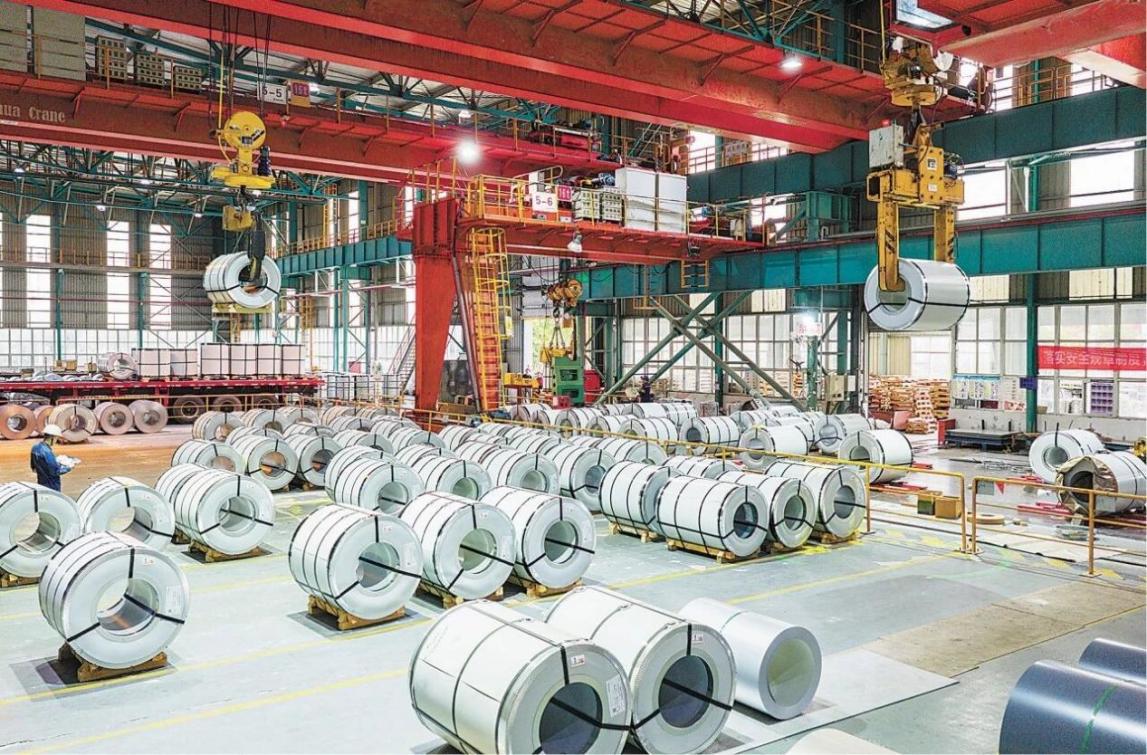
Photo shows a workshop of Baosteel Huangshi Coated and Galvanized Sheet Co., Ltd. in Huangshi, central China's Hubei province. (Photo/Zhou Wei)
These developments reflect a broader shift in demand. In 2025, steel used in construction accounted for 49 percent of total demand, down from 58 percent in 2020, while manufacturing's share rose from 42 percent to 51 percent.
"For the first time in China's history, steel demand from manufacturing has surpassed that from construction," said Jiang Wei, vice chairman and secretary-general of the China Iron and Steel Association. "This reflects the industry's proactive adaptation to changing demand and its push toward higher-quality development."
During the 14th Five-Year Plan period (2021-2025), China's steel self-sufficiency rate remained close to 100 percent, ensuring strong support for the broader economy.
Alongside product upgrading, digital and intelligent technologies are reshaping production processes.
At a plant of HBIS Group's Tangsteel Company in Tangshan, north China's Hebei province, molten steel at 1,650 degrees Celsius poured from a converter. In the control room, chief expert Zhou Quanlin monitored operations on a screen. With a few taps, the system autonomously completed key smelting processes.
Achieving precise temperature control in steelmaking is highly complex. Last year, HBIS Group integrated large AI models into its proprietary platform to develop an intelligent steelmaking system, now applied in core production stages.
"In the past, we relied on experience, watching the flame and judging when and how much material to add," Zhou explained. "Now, the AI model analyzes vast historical data along with real-time signals such as furnace sound and gas emissions to precisely control reactions inside the furnace."
The results have been significant: since deployment, steelmaking efficiency has increased by 10.3 percent, while overall energy consumption has dropped by about 10 percent.
AI is reshaping every link of China's steel industry, far beyond steelmaking itself. Steel manufacturer Baosteel uses an AI cloud surface inspection system. It accurately spots 96 percent of critical material flaws, and cuts missed inspections by 35 percent.
Meanwhile, Shanghai Steel Information Technology Co., Ltd. leverages AI for smarter supply chain operations. It handles more than 10 million daily transactions with over 95 percent accuracy, and completes billions of intelligent trade matches efficiently.
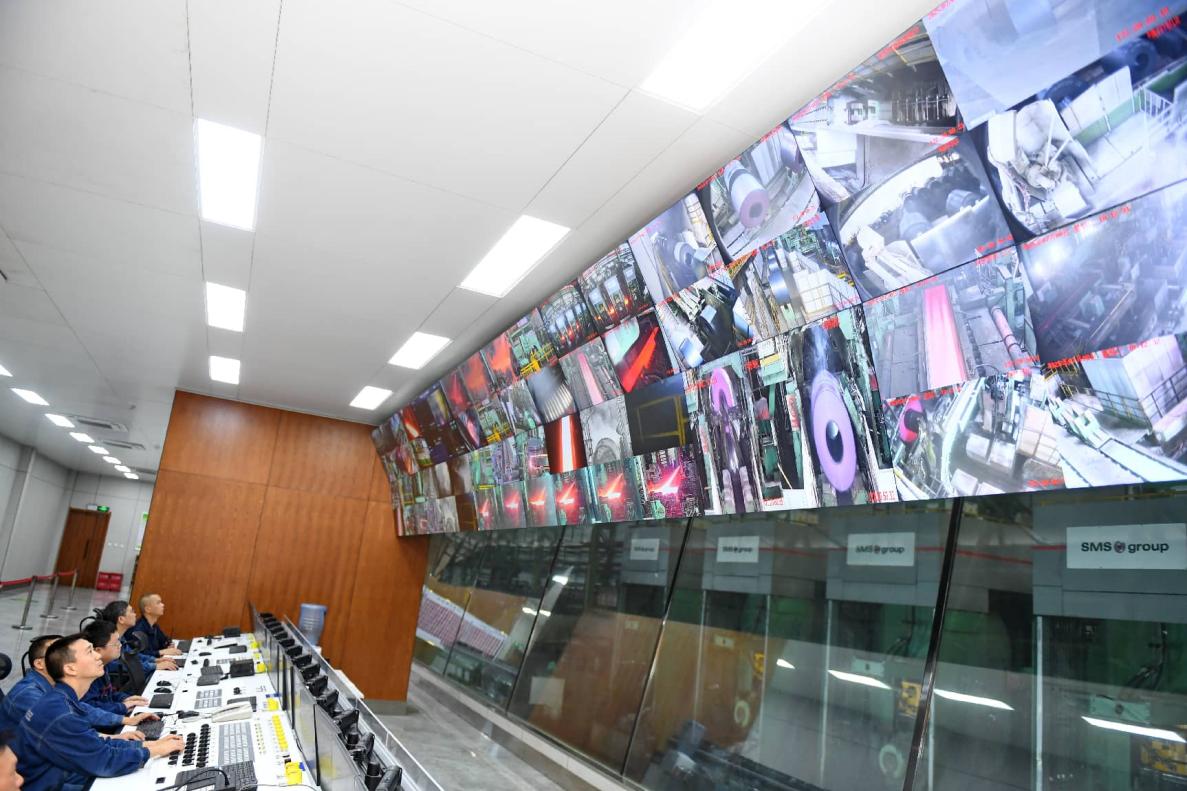
Operators monitor and remotely control steel strip rolling processes in a centralized control room of a vanadium steel sheet plant under Ansteel Group in Panzhihua, southwest China's Sichuan province. (Photo/Li Xiangyu)
Today, AI is integrated into every aspect of steel production, manufacturing, and operations, accelerating industry-wide intelligent transformation. Over 95% of major steel enterprises tracked by the China Iron and Steel Association have incorporated digitalization into core strategies, shifting from pilot projects to systematic implementation.
As a pillar industry of the national economy, the steel sector boasts massive data resources and diverse industrial application scenarios, and thus serves as a perfect platform where next-generation AI can make a difference, said Zhang Longqiang, president of the China Metallurgical Information and Standardization Institute.
"AI-steel integration holds immense long-term potential," he added. "With large language models permeating production chains, industry-wide intelligent upgrading will accelerate significantly."
Photos



Related Stories
- AI token boom gives new value to northwest China's computing hub
- China boosts global climate cooperation with AI-supported early warning system
- Shanghai aims to 'unlock' big ideas of AI
- Chinese Academy of Sciences unveils AI model system for scientific research
- AI market kicks off ahead of 9th Digital China Summit in China's Fujian
- AI-powered toys entering Chinese children's playrooms
- Interview: From "Made in China" to "Innovated in China," Saudi strategist eyes deeper technological ties with China
- How should we view China’s decision to halt the Manus acquisition?
- Embodied AI makes quantum leap in China
- Why can't AI serve as qualified doctors despite high test scores?
Copyright © 2026 People's Daily Online. All Rights Reserved.
