



China approves world's first implantable brain-computer interface for medical use
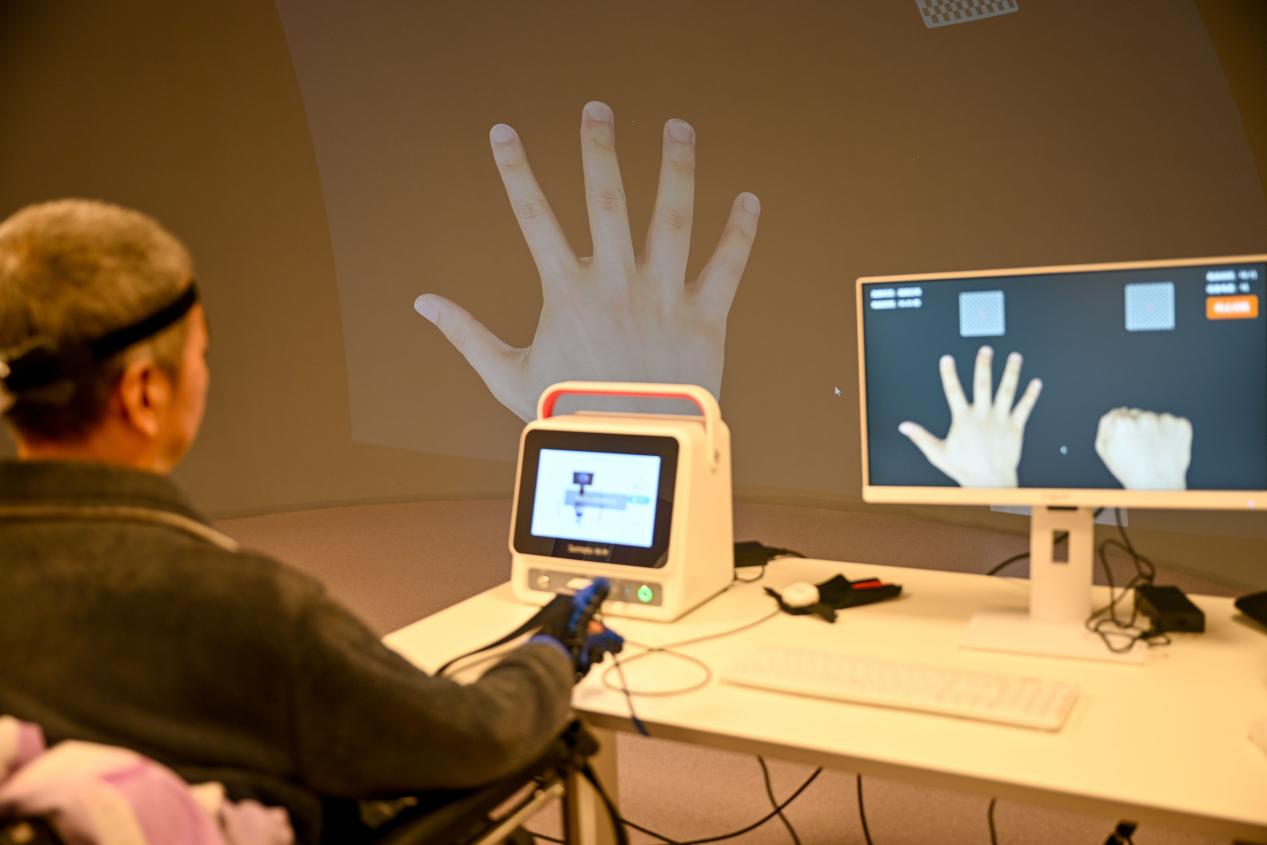
A patient undergoes rehabilitation training using a brain-computer interface system at the Guizhou Hospital of Beijing Jishuitan Hospital in Guiyang, southwest China's Guizhou province. (Photo/Yuan Fuhong)
Recently, China's National Medical Products Administration has granted the world's first regulatory approval for an implantable brain-computer interface (BCI) device, marking a historic milestone in medical technology. This breakthrough transitions BCI -- long considered the pinnacle of human-machine interaction -- from laboratory research to clinical application.
BCI technology, first explored by scientists in the 1970s, establishes direct communication between the brain and external devices. "The fundamental principle of a brain-computer interface is to establish an information pathway between the brain and external equipment that bypasses peripheral nerves or muscles," said Hong Bo, a professor at the School of Biomedical Engineering at Tsinghua University.
By collecting and interpreting neural electrical signals generated during brain activity and translating them into actionable commands, users are able to control external devices using nothing but their thoughts.
The newly approved implantable BCI system for hand motor function augmentation, dubbed NEO, was jointly developed by Neuracle Technology (Shanghai) Co., Ltd. (Neuracle) and the School of Biomedical Engineering at Tsinghua University.
"For patients with quadriplegia caused by cervical spinal cord injuries, who are unable to perform grasping movements with their fingers, we implant a coin-sized device in a minimally invasive procedure outside the dura mater," said Wang Yujing, product director at Neuracle.
"The system collects and decodes the patient's brain signals in real time, enabling them to control a pneumatic glove with their thoughts to perform actions such as grasping objects or drinking water," she added.
"Among all technical approaches, implantable BCIs are widely considered the most challenging," Wang noted. Directly implanting electrodes into the cerebral cortex involves significant risks and challenges, including craniotomy procedures, long-term biological tissue responses, wireless data transmission, and safe power supply.
In the past, patients often relied on wired systems, with visible external leads, to connect the brain to external devices. Muming Poo, an academician of the Chinese Academy of Sciences and director of the Center for Excellence in Brain Science and Intelligence Technology, noted that in recent years, BCIs have advanced toward miniaturized chips, faster decoding algorithms, and breakthroughs in high-precision electrode technology, gradually transitioning from laboratory research to clinical application.
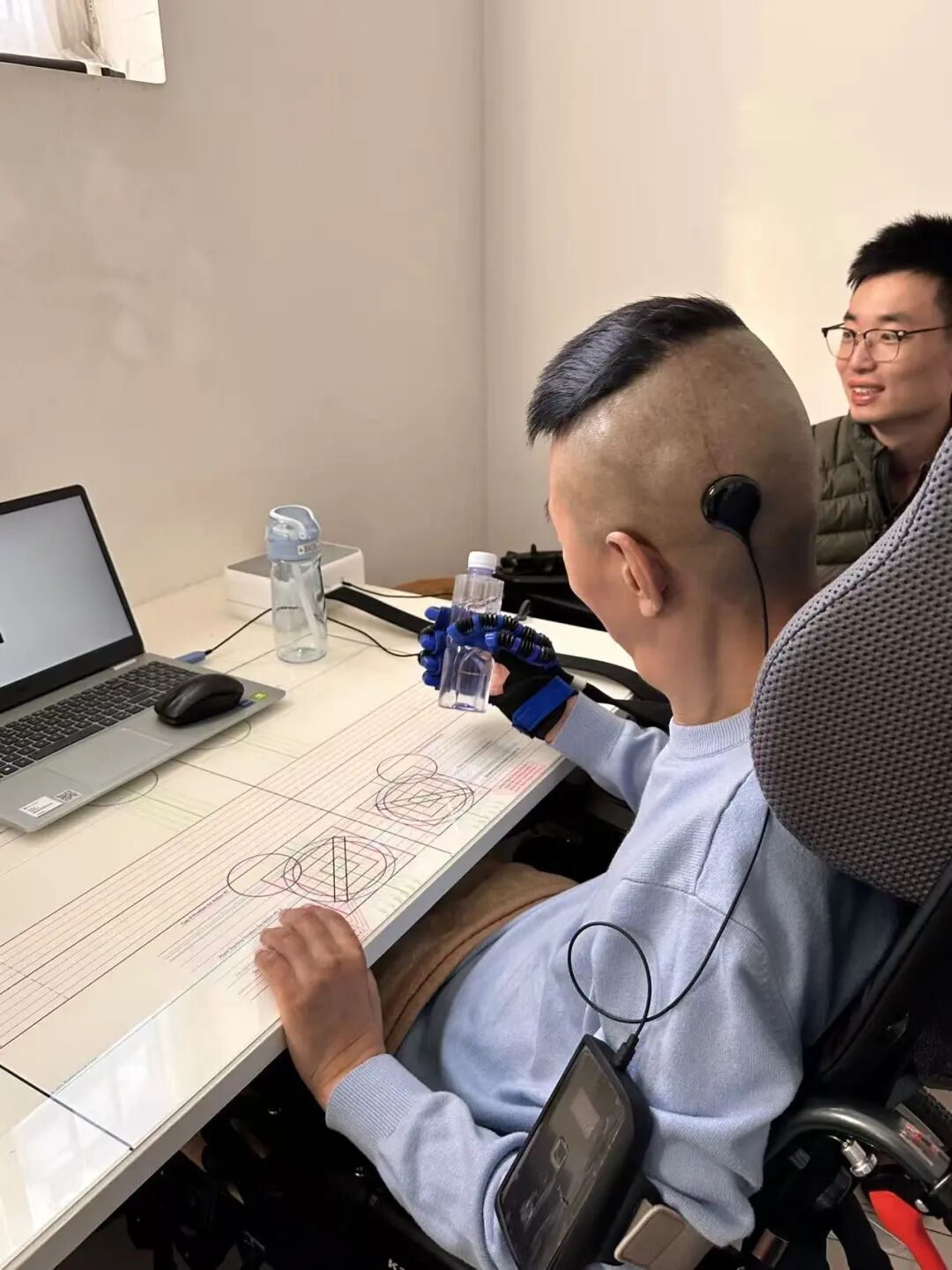
A paraplegic patient grasps a water bottle using the NEO system during a clinical trial. (Photo provided by Tsinghua University)
China has already completed dozens of clinical procedures. Trial data show that all participating patients experienced varying degrees of improvement in grasping ability, with some even exhibiting signs of neural remodeling and partial recovery of additional neural functions.
"The key clinical breakthrough lies in achieving stable acquisition of brain signals through minimally invasive implantation outside the dura mater, without contacting brain tissue or damaging neurons, while accurately decoding patients' motor intentions to enable grasping and drinking," said Mao Ying, president of Huashan Hospital affiliated to Fudan University in Shanghai.
In 2024, a clinical trial participant surnamed Dong was able, after training, to grasp a cup and drink independently using thought commands, assisted by a pneumatic glove controlled via the BCI system.
"These were actions he had been unable to perform since sustaining a high-level spinal cord injury," Mao recalled. With further rehabilitation, Dong not only managed to lift dumbbells using his mind, but also wrote the neatly formed Chinese characters for "thank you" by hand.
"Seeing BCI technology translated into clinical reality and genuinely improving patients' lives just touched me so much," Mao said.
Recently, Beijing Tiantan Hospital and Xuanwu Hospital, both affiliated to Capital Medical University, carried out implantation surgeries using the "Beinao No. 1" intelligent BCI system. An ultra-thin electrode array, feather-light and integrating 128 signal acquisition channels, was precisely placed in the brain region responsible for hand movement, helping patients with spinal cord injuries improve motor function.
"Clinical practice showed that BCIs are delivering tangible improvements for patients with spinal cord injuries, stroke, and other conditions," said Li Yuan, business development director at Beijing-based startup NeuCyber Neuro Tech.
BCI devices represent a complex integration of materials science, chip design, algorithms, and rehabilitation technologies. An expert noted that China has now largely established a full industrial chain covering both upstream and downstream segments, although the sector as a whole remains at an early stage. The approval of a complete device this time is expected to stimulate growth in both foundational components upstream and application development downstream.
In July 2025, China issued a set of guidelines aimed at promoting the innovative development of the BCI industry, calling for breakthroughs in core hardware and software, the development of high-performance products, and the acceleration of real-world applications. Beijing, Shanghai, Shandong, and other regions have also introduced supportive policies, helping to foster a favorable industrial ecosystem.
According to incomplete statistics, China is home to more than 3.7 million people living with spinal cord injuries, with approximately 90,000 new cases each year, underscoring the vast potential market for BCIs.
Some institutions predicted that by 2027, China's BCI market will reach 5.58 billion yuan ($818.46 million), with an average annual growth of 20 percent. It is also widely believed in the industry that the sector is poised to enter a phase of steady growth, with medical rehabilitation serving as the primary driver while applications gradually expand into broader fields.
"With strong policy support, continued technological development, declining costs, growing market awareness, and improving regulatory frameworks, BCIs are expected to achieve larger-scale commercial application within the next three to five years, bringing tangible benefits to more people," Li said.
Photos




Related Stories
- Chinese scientists shed light on how brain switches between thinking, perceiving
- China's brain-computer interface development shifts into high gear
- Innovative tech holds key to brain rehab
- Brain-computer interface technology sees broader application, benefiting patients
- Research establishes brain normative references for Chinese population
- Chinese researchers achieve progress in clinical trial of brain-computer interface
- Researchers in north China help reveal key brain spatiotemporal information processing mechanism
- China launches new magnetic resonance platform to support BCI technology
- Experts develop brain-computer interface technology to identify brain tumor boundaries
- Chinese scientists achieve breakthrough in deep-brain imaging
Copyright © 2026 People's Daily Online. All Rights Reserved.
