



Shipping containers find new use cases across China
China's shipping container industry is breaking new ground across an ever-expanding range of uses, from modular building blocks for urban spaces to core equipment in the new energy sector.
In 2024, China's total container output exceeded 8.1 million twenty-foot equivalent units, up 268.2 percent year on year, setting a new record. The country accounted for 96 percent of global container production and sales.
On the morning of April 8, more than 50 newly produced containers were neatly lined up at the yard of Dongfang International Container (Qidong) Co., Ltd. in Qidong, east China's Jiangsu Province. Within hours, they would be shipped to Yangshan Port in Shanghai and delivered to eagerly awaiting European clients.
"Today's container manufacturing is far more than just welding metal boxes," said Zhai Jianxing, a technical manager with years of industry experience. He noted that the rapid rise of the new energy industry has driven surging demand for energy storage containers.
"A standard shipping container typically comes with a two-year warranty, while an energy storage container is designed to last more than 20 years and must meet far more stringent standards for explosion prevention, fire safety, corrosion resistance and overall protection," said Zhai.
The challenge is further complicated by the need to meet varying international standards, he added.
Zhai's company is now focusing on breakthroughs in bio-based materials, exploring the use of corn stalks in container manufacturing.
These material breakthroughs have transformed simple welded metal boxes into high-tech products. The innovation has upgraded traditional shipping containers while expanding their use into new energy generation, energy storage, data centers and modular construction.
In an industrial park in Cixi, east China's Zhejiang Province, containers have been repurposed into mobile integrated energy stations.
Earlier this year, a State Grid-backed project in Cixi focused on compact renewable energy technology was put into operation. The system produces electricity, heat, and hydrogen, and what once spread across 12,000 square meters is now integrated into a single white container, reducing the footprint to just 14 square meters.
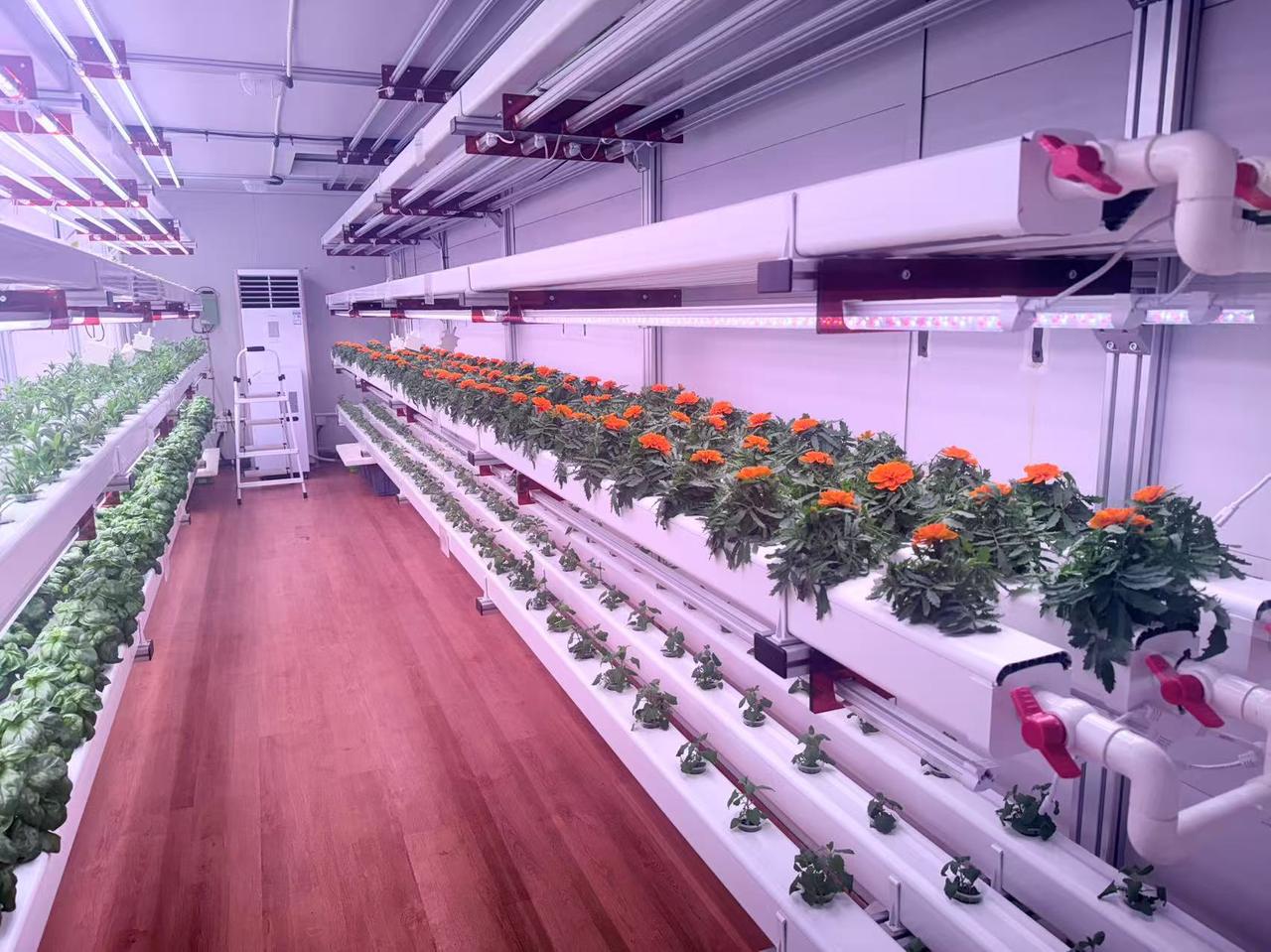
Plants thrive inside a container at the PUKU Smart Agriculture Park in Hangzhou, east China's Zhejiang Province. (Photo/zjnews.zjol.com.cn)
In Huanghu town, Yuhang district, Hangzhou, two stacked containers sit in an open area of the PUKU Smart Agriculture Park. Inside, lettuce grows on metal racks while tomatoes thrive under carefully controlled lighting.
"We use a precision environmental control system to tailor lighting, nutrient solutions, and temperature and humidity for each crop," said Lei Lina, head of the plant factory and senior partner at Zhejiang PUKU Agricultural Technology Co., Ltd.
"This compact, high-tech model turns industrial containers into micro plant factories that blend agricultural, industrial and digital technologies," she said, adding that container-based plant factories can be assembled and transported like building blocks, making it much easier to grow and deliver fresh produce locally.
At around 8 p.m. at Kaiyuan Square, Zhuangshi subdistrict, Zhenhai district, Ningbo, residents gathered around a renovated shipping container stage, clapping along to a live performance.
Although the stage area is only 27 square meters, it is fitted with projectors, speakers, microphones and lighting. Behind it is a small dressing room where performers prepare.
The smart shared stage is an initiative by the Bureau of Culture, Radio, Television, Tourism and Sports of Zhenhai District. Similar multifunctional spaces hosting performances, salons and lectures have already been set up in five public locations across the district.
"Such stages not only give more people a chance to step into the spotlight, but also bring art closer to everyday life," said an official from the bureau.
Through functional reconfiguration, containers have moved beyond logistics into urban development, energy systems and public services, becoming flexible, cross-sector platforms that enrich daily life and support industrial innovation.
Photos


Related Stories
- Efforts underway to refloat giant container vessel stuck in U.S. bay
- Ningbo-Zhoushan Port sees container throughput reach 20 mln TEUs
- China's major ports see surging container throughput
- Belt and Road brings Chinese containers to the world
- Shipper to order 9 container vessels made in China
- 'Container court' in Yunnan strives to spread legal awareness
- Container arts exhibition to open to public in E China
- Yangshan Port Container Terminal in Shanghai to expand capacity to 40 million TEU by 2017
- People living in containers
- Photo story: Life in containers
Copyright © 2026 People's Daily Online. All Rights Reserved.
