



How consumer demand is reshaping supply: lessons from China's washing machine market
At the start of the year, a resident surnamed Wang in Hefei, east China's Anhui province, planned to replace her home appliances during a renovation.
After comparing options both in stores and online, she chose a triple-drum washing machine. "The new model is stylish and much more energy-efficient," she said, adding that she saved nearly 1,000 yuan ($144.68) thanks to government subsidies and trade-in discounts.
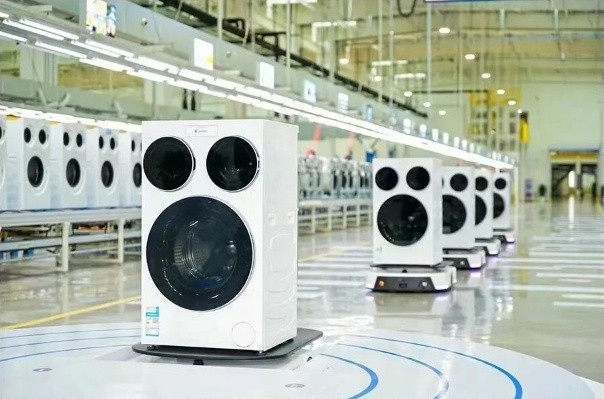
Photo shows triple-drum washing machines manufactured by Haier. (Photo provided by Haier)
Wang's choice reflects a broader trend. Spurred by government trade-in subsidies, growing numbers of Chinese households are upgrading to more environmentally friendly appliances. In 2025 alone, more than 129 million home appliances were purchased through the program, with over 90 percent meeting top-tier energy or water conservation standards.
Government incentives have fueled a green revolution in China's home appliance market. Since the trade-in program launched in 2024, consumers purchasing products rated Level 1 for energy or water efficiency have received an additional 5 percent subsidy. The policy, continuing into 2026, prioritizes high-efficiency goods and drives sustainable consumer upgrades.
As green consumption becomes mainstream, this demand is translating into new driver for industry innovation. The story of one particular washing machine offers a clear example.
At a Haier Smart Home experience center, a triple-drum washing machine stands out. Its sleek white body houses three drums -- one large and two small -- allowing separate washing of different garment types. Since its launch in June 2025, the product has sold over 400,000 units in just nine months, making it a bestseller in the home appliance market.
"It's not just popular; it's a model of green innovation," said Xu Sheng, general manager of advanced R&D at Haier Smart Home. He summed up its advantages in two phrases: "less material usage, higher efficiency."
On one hand, the machine combines three separate units into one, with highly integrated components such as circuit boards and chips. Through structural innovation, total material use has been reduced by more than half.
On the other hand, it achieves top-tier energy efficiency. Level 1 standards require electricity consumption of no more than 0.11 kWh and water usage below 6 liters per kilogram of laundry. This model reduces those figures to 0.06 kWh and 5 liters, while achieving a wash performance ratio of 1.22 -- delivering cleaner clothes with less water and energy.
According to Xu, the strong market performance of such products reflects how subsidies are encouraging consumers to choose higher-efficiency appliances.
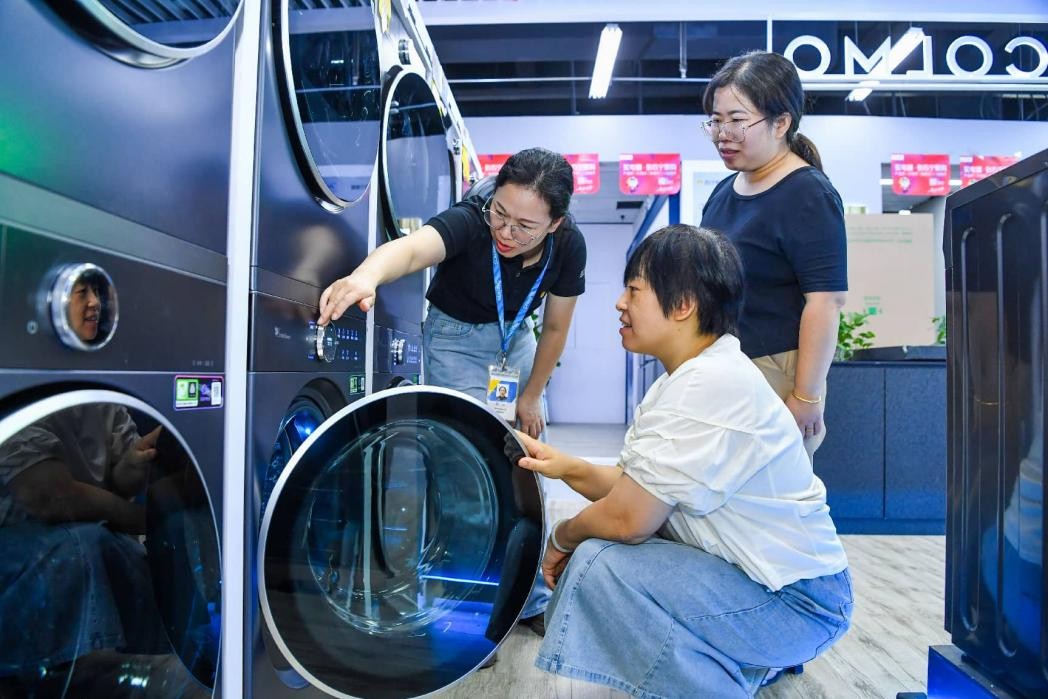
Consumers buy washing machines at a store in Yichun, east China's Jiangxi province. (Photo/Zhou Liang)
Behind these gains in energy efficiency lies robust technological innovation. Haier invests more than 10 billion yuan annually in R&D, with about 1/3 dedicated to green product development.
"As we enter the AI era, intelligent technologies are opening up new possibilities for improving green performance," Xu said.
Haier launched a new AI washing machine in March 2026. Powered by large-model algorithms, it can identify fabric types, automatically select optimal washing modes, and even adjust detergent use based on local water quality, further reducing energy and resource consumption.
The trade-in program's impact extends beyond individual companies to the entire industry. It lowers the threshold for purchasing high-efficiency products, expanding the market for green and smart appliances and enriching the overall supply. In 2025, more than 1,000 companies launched tens of thousands of new green and intelligent products, accelerating industry-wide transformation.
The program also drives low-carbon transformation across industrial and supply chains. Haier's global procurement committee collaborates with over 1,000 major suppliers worldwide. Producing a single triple-drum washing machine involves more than 400 of them.
"As a leading company, we work with key suppliers to build joint laboratories, integrating green concepts into material development from the start while sharing both technology and benefits," said Wang Zhaogui, the committee's general manager.
Take appliance controller -- the "brain" of a home appliance -- as an example. "Our jointly developed next-generation controller reduces standby power consumption to just 0.5 watts, which is almost negligible," said Dong Haiyong, general manager of Diehl Controls China. Driven by the higher green standards set by leading companies, suppliers are accelerating innovation. Over the past three years, collaborative efforts have enabled large-scale application of cutting-edge technologies, with the company's sales growing by more than 15 percent annually.
According to Xu Dongsheng, vice chairman of the China Household Electrical Appliances Association, as policy effects continue to unfold, green consumption is driving change upstream. The entire industrial chain -- from material R&D, and manufacturing to application testing -- is being revitalized, strengthening overall competitiveness.
"From this perspective, the trade-in program is not just about swapping old products for new ones -- it is reshaping the entire industrial ecosystem," Xu Dongsheng said.
Photos




Related Stories
- China reports vibrant consumption growth during Qingming Festival holiday
- China unveils plan to further boost service consumption
- Flower economy blossoms into China's spring consumption surge
- Gen Z-fueled Guochao trend drives new shift for Chinese manufacturers
- Global exhibitors drawn to 6th China Int'l Consumer Products Expo
Copyright © 2026 People's Daily Online. All Rights Reserved.
