China unveils new policies to promote travel service exports, expand inbound consumption
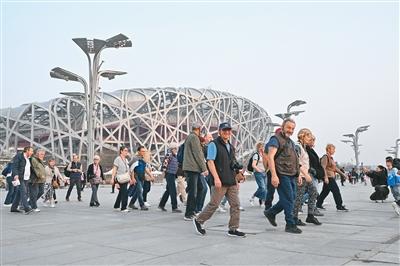
Foreign tourists visit the National Stadium, known as the Bird's Nest, in Beijing. (Photo/Hu Qingming)
China's Ministry of Commerce (MOFCOM) and eight other government departments recently rolled out a package of policy measures to boost travel service exports and expand inbound consumption.
The measures are not merely a short-term stimulus for consumer spending. They send a clear signal that China is serious about advancing high-quality development in the service sector and stepping up efforts to attract and better use foreign investment.
MOFCOM spokesperson He Yongqian said travel services — encompassing personal travel, overseas study, medical visits and various forms of business travel — constitute the largest share of China's services trade, accounting for more than a quarter of total services imports and exports.
In recent years, China has rolled out a series of measures to raise service standards, streamline visa procedures and broaden access to international payment options, steadily improving the consumption environment for foreign visitors and making the country a more compelling destination for inbound spending. The result has been rapid growth in inbound tourism.
Data from the National Bureau of Statistics show that China received 35.17 million foreign visits in 2025, up 30.5 percent year on year.
Spending by inbound tourists on dining, accommodation, transport, sightseeing, shopping and entertainment all counts toward China's travel service exports, which reached 393.98 billion yuan ($57 billion) in 2025, a 49.5 percent year-on-year increase and 1.6 times the 2019 level, according to MOFCOM data.
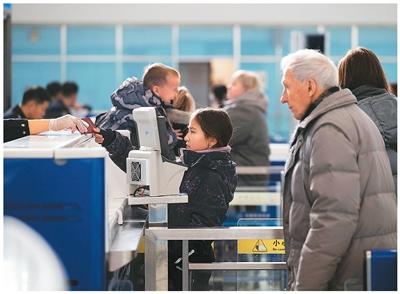
Inbound travelers queue for customs clearance at a joint inspection hall of the Suifenhe highway port in Suifenhe, northeast China's Heilongjiang Province. (Xinhua/Zhang Tao)
A string of facilitation measures has accompanied the surge in inbound tourism. At the end of 2024, China extended its visa-free transit stays to 240 hours and raised the number of eligible ports to 60. The country recorded 40.6 million inbound arrivals in the year since rolling out the 240-hour visa-free transit policy, with travelers using the visa-free scheme surging 60.8 percent year on year compared with pre-revision levels.
To date, China has granted unilateral visa exemption to 50 countries and established mutual visa-free entry arrangements with 29. Last year, as many as 73 percent of foreign visitors entered visa-free.
Xu Guangjian, a professor at Renmin University of China's School of Public Administration and Policy, said expanding exports of travel services is an integral part of China's drive toward high-standard opening up.
Travel services cover sectors including tourist attractions, hospitality, commodity procurement and cultural and entertainment activities, according to Xu.
"Expanding inbound consumption helps broaden the domestic consumer market, stimulates growth across related industries and sustains economic momentum," Xu said.

Foreign tourists browse a local specialty food stall on Qilou Old Street in Haikou, south China's Hainan Province. (Photo/Zhang Mao)
He added that spending by foreign visitors on cultural, health, educational and business activities also helps Chinese enterprises better understand overseas consumer preferences, raise service standards and strengthen their footholds in global value chains.
The measures outline steps to boost foreign visitor spending in key sectors including tourism, business activities, sports events, cultural and entertainment activities, health services and education and training.
An official from MOFCOM's Department of Trade in Services and Commercial Services said the measures aim to build a national tourism brand, sharpen China's global marketing presence and continue to improve visa policies to encourage more international travelers to visit.
At the same time, efforts will be made to remove bottlenecks in dining, accommodation, transport, sightseeing, shopping and entertainment, while further enhancing convenience across payment, tax refunds, communication, touring and ticketing.
Several experts said the measures carry particular weight as China transitions from being a tourist destination to becoming a services trade hub.
That transition is a profound shift, not just an expansion of market scale but a meaningful improvement in development quality, Xu said, adding that it requires coordinated development across multiple government departments, industries and sectors.
Xu noted that the upgrading process goes beyond high-quality development in culture and tourism. It also means broader opening up and competitiveness gains in high-value-added sectors such as finance, health care, education and digital trade.
"Going forward, we will work with relevant departments and local authorities to ensure these measures take effect as quickly as possible, optimize the environment for inbound consumption, expand exports of services and open up new space for services-based spending," He said.
(Web editor: Hongyu, Liang Jun)