



China turns apple industry into a global success story
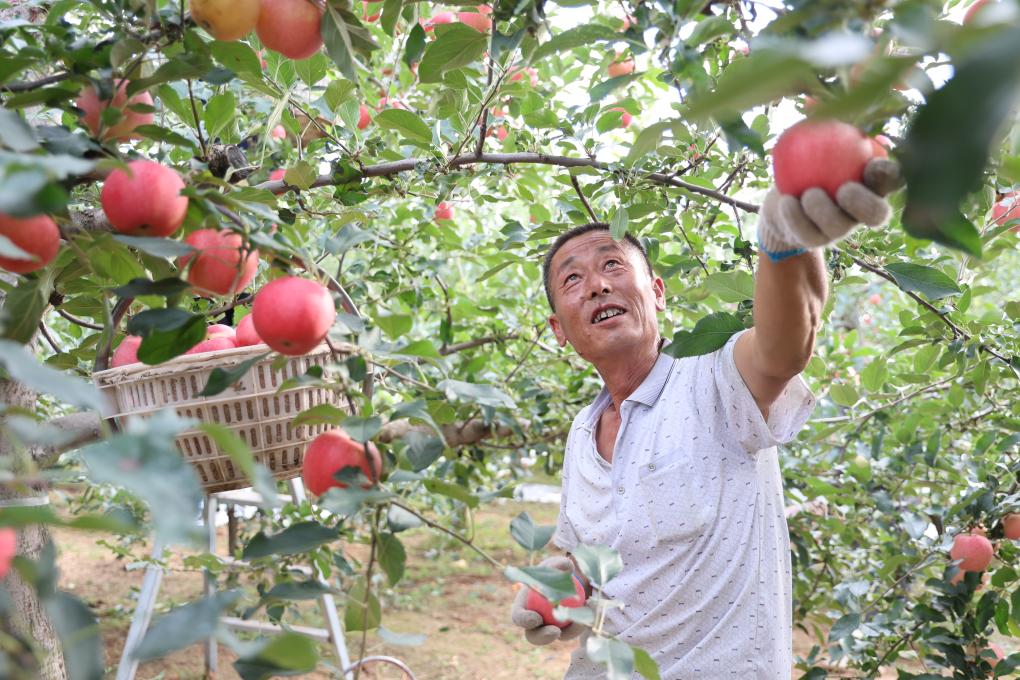
A farmer picks apples at an orchard in Luochuan County, northwest China's Shaanxi Province, Aug. 26, 2025. (Photo/Xinhua)
Chinese apples have been drawing growing attention on overseas social media. At the Paris International Agricultural Show held in Paris in February, apples from Gangu county in northwest China's Gansu Province turned heads with their striking appearance, sweet fragrance and well-balanced flavor, attracting crowds of French and international visitors.
One French vlogger, after sampling an apple from Gangu county, marveled on social media that its sweetness and crunch were absolutely incredible. The vlogger wondered how Chinese apples could be both delicious and produced in enormous quantities for exports. One of the vlogger's followers commented, asking how China manages to grow so many apples while maintaining such quality.
The answer lies in the sustained development of China's apple industry. Decades ago, apple growing in China was scattered and small-scale, with limited variety selection and output, and high-quality apples were hard to come by. Today, Chinese apples are available year-round and enjoyed by people across the country. China's annual apple output exceeds 51 million tonnes, while annual consumption surpasses 47 million tonnes, making it the world's largest apple producer and consumer. The country not only meets its own vast demand but also exports apples worldwide.
Central to this success has been consistent government support for the apple industry at the national level. Policy backing has covered the entire supply chain, with apple cultivation integrated into major national programs including the Three-North Shelterbelt Forest Program, the project of restoring farmland to forests, and all-round rural revitalization. These efforts have helped many regions achieve both ecological improvement and economic gains. The apple industry now spans more than 20 provincial-level regions, with key growing areas established across the cool highland areas of southwest China, northwest China's Xinjiang Uygur Autonomous Region, the Loess Plateau, the Bohai Rim, and northeast China.
Technology has been another driving force. In recent years, China's apple industry has achieved remarkable improvements in variety structure, production models, and technological support. The industry landscape has shifted from scattered planting to intensive and standardized production in key growing areas, while development has moved beyond reliance on weather conditions toward comprehensive technological empowerment. Technologies such as variety breeding, dwarf-rootstock intensive cultivation, water-saving irrigation, and intelligent sorting are now widely applied, highlighting the sector's ongoing upgrade.
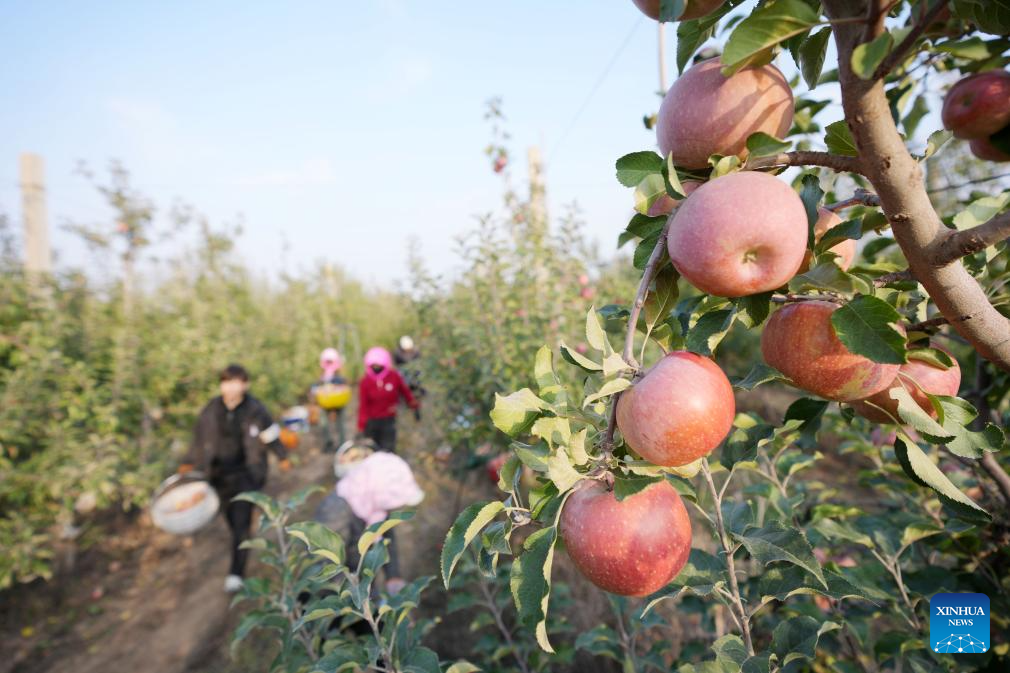
Farmers harvest apples at a plantation in Shapotou District of Zhongwei, northwest China's Ningxia Hui Autonomous Region, Oct. 25, 2025. (Xinhua/Wang Peng)
The strong rise of China's homegrown seed technology is an important step in this process. So far, China has developed 158 new apple varieties with independent intellectual property rights. About 70 percent of newly established orchards are planted with domestically developed varieties. These new varieties are tailored to the climate and soil conditions of different growing regions, and offer across-the-board improvements in sweetness, texture, cold tolerance and disease resistance.
Integrated models linking enterprises, cooperatives, and farmers have been adopted to ensure standardized and large-scale apple cultivation. In counties designated as apple production bases in Yan'an, northwest China's Shaanxi Province, apples contribute 61 percent of farmers' operational income, benefiting more than 2 million growers. In Tianshui city, Gansu Province, the harvest of the well-known Huaniu apple variety has seen both rising prices and strong market demand for years.
On the processing side, the industry has long moved beyond simply selling fresh fruit: over 10 product categories, including concentrated apple juice, apple chips, and apple vinegar, have emerged from deep-processing facilities nationwide. In 2024, exports of concentrated apple juice reached 5.88 billion yuan (about $853.4 million), up 89.06 percent year on year.
On the distribution side, an expanding cold chain network, the boom in e-commerce livestreaming and the growth of cross-border trade have facilitated apple sales both at home and abroad. In 2024, exports of fresh apples reached 980,900 tonnes, up 23.24 percent year on year.
China-Europe freight trains have brought Chinese apples to European dining tables, while cross-border logistics has delivered fresh Chinese apples to consumers across Southeast Asia. Notably, the launch of apple futures — the world's first fresh-fruit futures contract — has significantly boosted China's influence in global price discovery.
What overseas internet users see as a miracle of Chinese apples is a microcosm of China's broader success in high-quality agricultural development.
Photos




Related Stories
Copyright © 2026 People's Daily Online. All Rights Reserved.
