



China prioritizes water conservation industry for sustainable growth
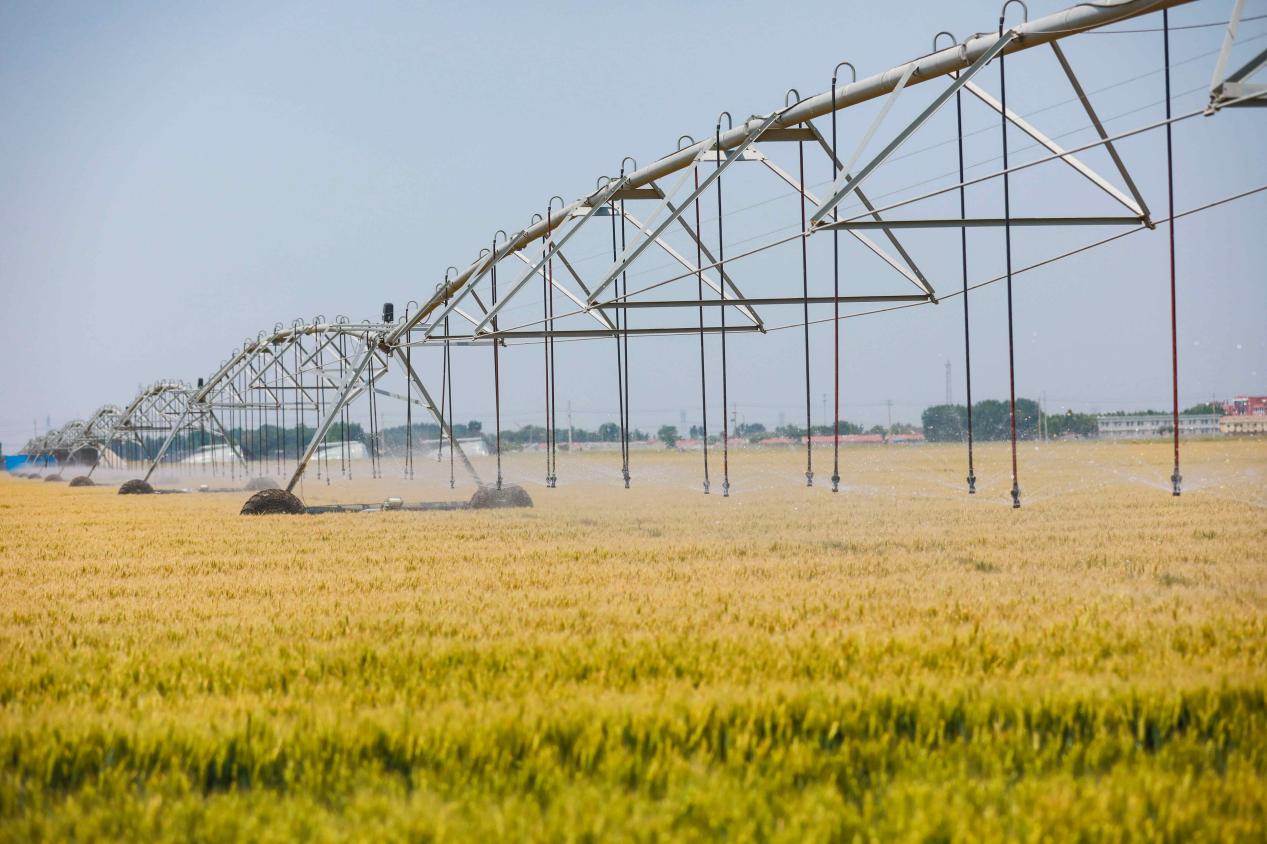
In a high-standard farmland in Lique township, Dongying, east China's Shandong province, a truss-type sprinkler irrigation system is watering wheat. (Photo/Liu Yunjie)
China faces significant water challenges, with per capita resources amounting to merely 35 percent of the global average and highly uneven distribution across seasons and regions. Under these conditions, conserving water is fundamental to achieving sustainable development, while fostering a water-saving industry has become a key pathway forward.
In recent years, regional authorities and government departments nationwide prioritized the water-saving industry as a key driver for green economic transformation.
Supported by targeted policies, market cultivation, industrial chain expansion, and innovation promotion, the sector has seen the emergence of leading enterprises, extension of supply chains, and diversification of water-saving products.
The domestic market size for this industry is now estimated to exceed 760 billion yuan ($109.41 billion), injecting strong momentum into green development.
Innovation is evident at companies like IEM GM in Yixing, east China's Jiangsu province, which has developed a high-efficiency rainwater collection and reuse system. The system utilizes modular underground storage tanks to capture and recycle rainwater. "By integrating underground modular storage with above-ground intelligent treatment, our system allows urban streets to 'breathe' freely," said Zhao Xing, a senior executive at the company.
The growth of the water-saving industry has been driven by the rapid emergence of an industrial cluster development model. Across the country, industrial funds have been established, industry associations formed, and leading enterprises encouraged to drive coordinated development along the supply chain.
The Beijing-Tianjin-Hebei region, the Yangtze River Delta, and the Guangdong-Hong Kong-Macao Greater Bay Area continue to lead as three major hubs. Meanwhile, emerging clusters focused on equipment manufacturing and scientific research in Chengdu-Chongqing region, Shandong, and Shaanxi are gaining momentum. This is fostering a diversified and synergistic industrial ecosystem.
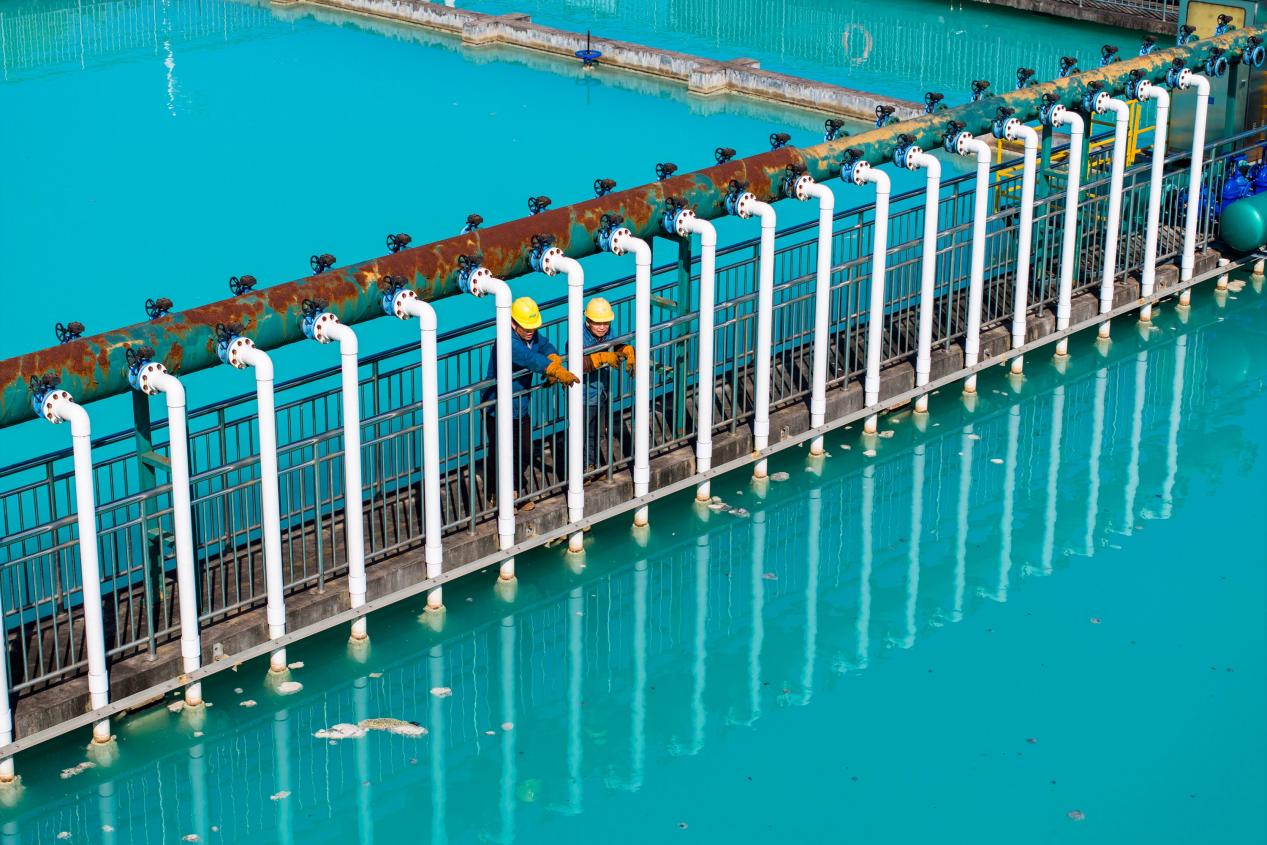
Staff members at a textile industrial park in Lu'an, east China's Anhui province inspect the operation of wastewater treatment facilities. (Photo/Xiao Benxiang)
As the quality of water-saving products improves, new supply is catalyzing new demand. At a production facility of Hegii, a Chinese sanitary ware manufacturer, in Foshan, south China's Guangdong province, assembly lines run in an orderly manner, producing more than 2 million sets of water-saving toilets each year for markets across the country.
"Each water-saving toilet reduces water consumption by 2.5 liters per flush, and market demand remains strong," said Xie Zhenwu, a company representative. Responding to the growing trend of green consumption, the company has developed a range of water-efficient products in recent years.
The expanded use of water‑saving products is accelerating the shift toward green lifestyles and unlocking new consumption potential. China has integrated water‑efficient products into its national green product certification system and has issued four catalogs listing products subject to mandatory water‑efficiency labeling -- covering over 110,000 models of household water‑using appliances.
With consumer trade-in programs and home renovation initiatives for kitchens and bathrooms, the replacement of household water-saving fixtures is also being actively encouraged. Meanwhile, measures such as the water conservation management regulation for public institutions have spurred the upgrade and replacement of water‑saving fittings in more than 1 million public institutions across the country.
According to studies, a family of three can save around 70 cubic meters of tap water annually simply by switching to water-saving fixtures, like toilets, showerheads, and washing machines meeting Level-2 or higher water-efficiency standards. "Popularizing water-efficient appliances improves both quality of life and water usage efficiency, putting real savings back into people's pockets," said Jiang Muchen, head of the Ministry of Water Resources' national water conservation office.
While advancing toward high-quality development itself, the water-saving industry is also driving deep transformation in traditional industries and opening up new development space.
At the production facility of Shaoxing Kerry Printing & Dyeing Co., Ltd. in Keqiao district, Shaoxing, east China's Zhejiang province, water is essential at every step--from plain fabric to finished printed textile--through processes like scouring, bleaching, printing, and washing.
"By introducing equipment such as high-efficiency hydraulic padders and energy-saving double-layer steam drying cylinders, we've reduced water use at each stage. This has cut our annual water consumption by more than 20 percent, saving over 1 million yuan in production costs," said Xu Shunyong, the company's general manager.
In the past, excessive water consumption and wastewater discharge constrained industrial development. "Prioritizing water conservation has forced industrial upgrading," said Qiu Jianping, an official with Keqiao district's agriculture and rural affairs bureau.
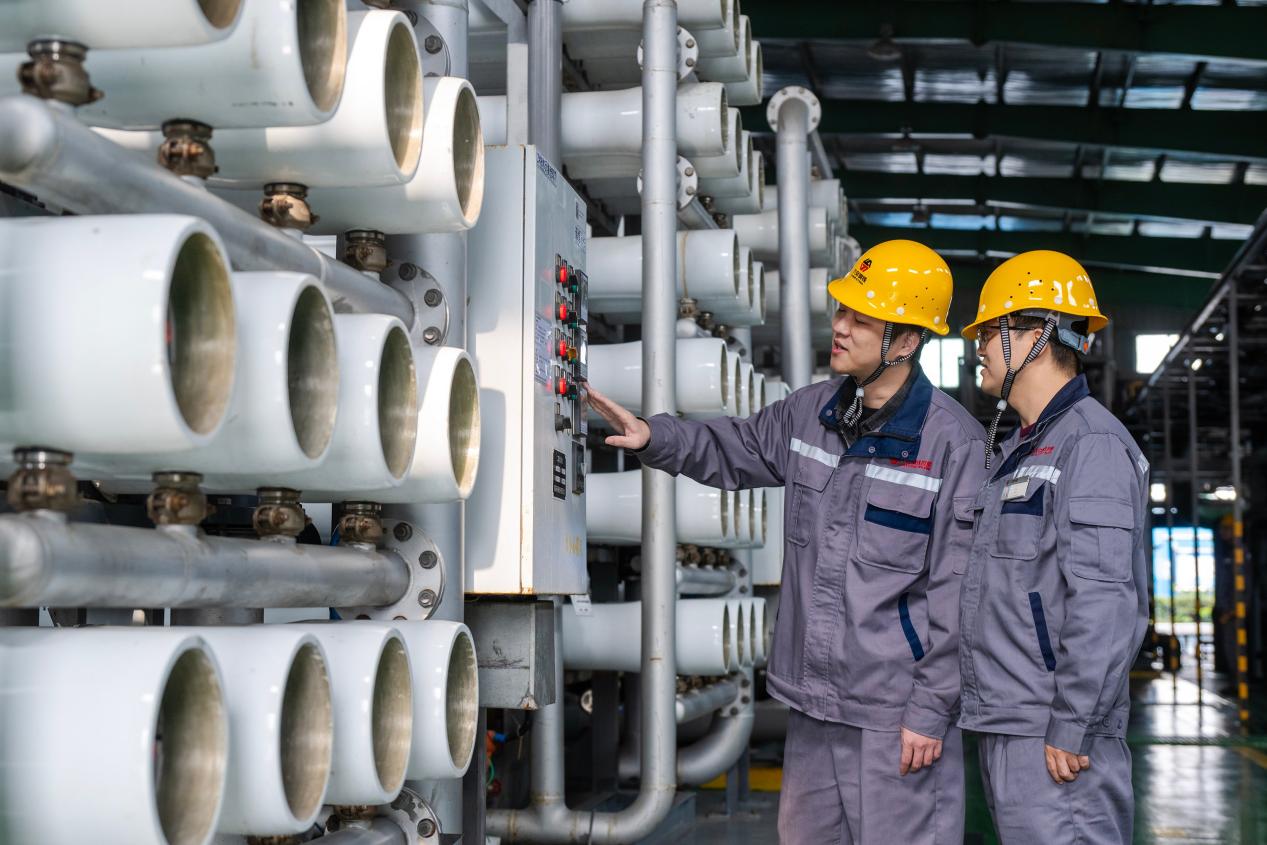
Workers of a company in east China's Anhui province inspect the operation of water treatment facilities. (Photo/Xiao Benxiang)
According to him, the district has guided printing and dyeing enterprises to carry out water-saving technological upgrades and established an integrated system combining industrial clustering, wastewater treatment, and reclaimed water reuse. Last year, the district's reclaimed water utilization rate reached 40.1 percent.
Water conservation means lower emissions, reduced pollution, and decreased carbon intensity. As an important component of green and low-carbon industries, the water-saving sector has played a vital role during the 14th Five-Year Plan period (2021-2025), when China's total water use achieved "zero growth."
In 2025, water consumption per 10,000 yuan of GDP and per 10,000 yuan of industrial value added had declined by 20 percent and 25 percent, respectively, compared with the end of the 13th Five-Year Plan period (2016-2020).
The immense potential of China's water-saving industry is mirrored in the value of every drop of water. By 2027, the sector is expected to grow into a trillion-yuan market.
Photos




Related Stories
- China aims to cut water use per 10,000 yuan of GDP by over 10 pct by 2030
- China steps up investment in water conservancy over past five years
- China's water conservancy investment exceeded 1.28 tln yuan in 2025
- Scientists estimate plateau's water reserves
- The Sanjiangyuan Region: Protecting China's "Water Tower"
- China's water conservancy investment to exceed 5.4 trln yuan during 2021-2025 period
- China makes strides in curbing groundwater overexploitation
- China reports improving water use efficiency in 2024
- China allocates 47.1 bln yuan to support water conservancy
- China's water conservancy investment up in first quarter
Copyright © 2026 People's Daily Online. All Rights Reserved.
