



China's foreign trade sector buzzes with activity
At the beginning of the year, foreign trade companies across China are bustling with activity — securing orders, setting up overseas warehouses, running cross-border e-commerce operations, strengthening existing markets, and exploring new ones.
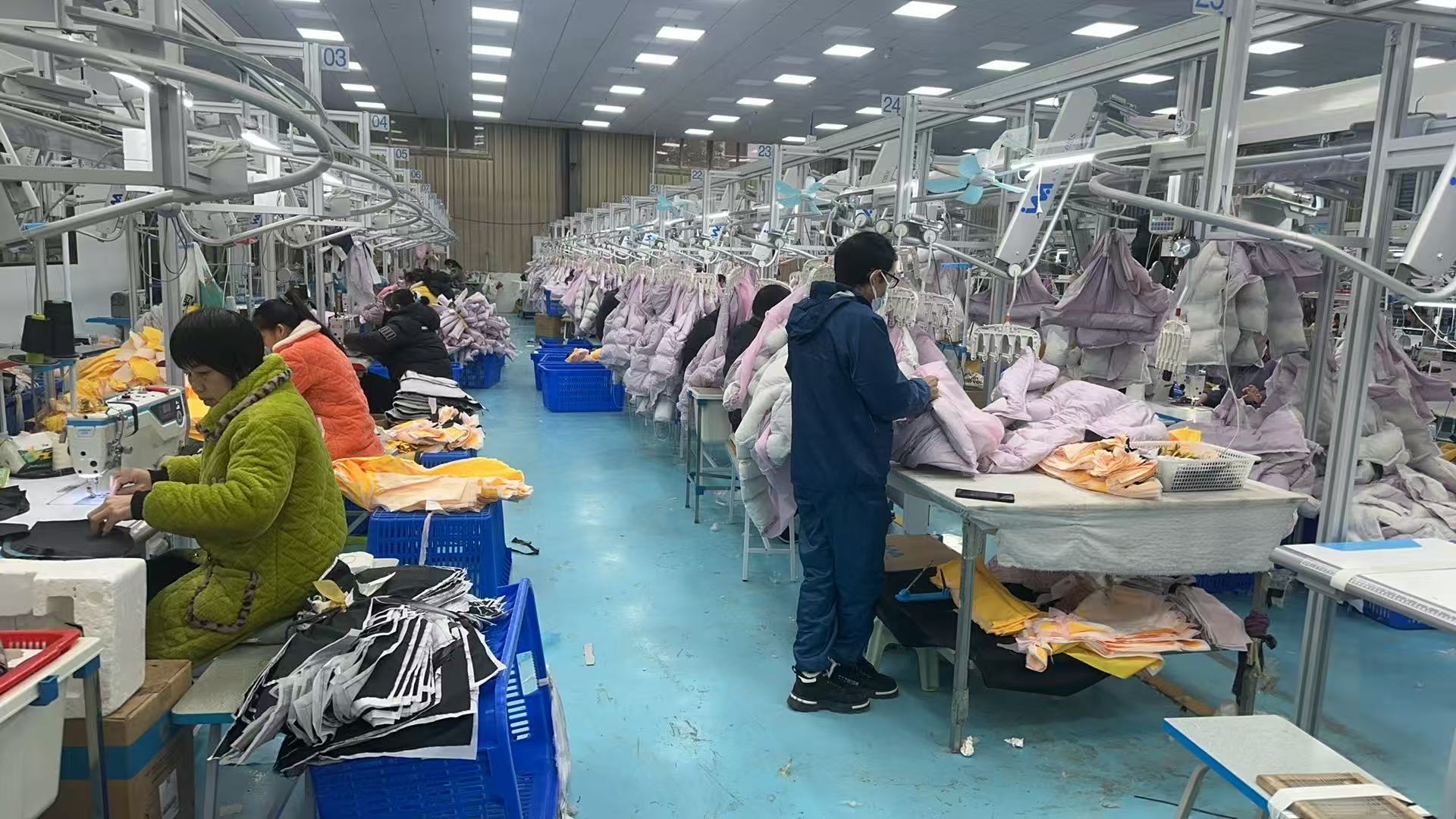
Workers assemble garments at a clothing company in Tianmen, central China's Hubei Province. (Photo courtesy of the interviewee)
In recent years, the garment industry in Tianmen city, central China's Hubei Province, has grown into an industrial cluster with an output value of over 10 billion yuan ($1.44 billion), attracting over 100,000 people back home for entrepreneurship and employment.
Fei Wen is one of them. Five years ago, after facing setbacks in his e-commerce business in Guangzhou, south China's Guangdong Province, he was drawn back to Tianmen by a series of support policies for returning entrepreneurs.
After returning to his hometown, Fei expanded his business from a dozen employees to 1,500 in just four years, with revenue soaring from tens of millions of yuan to over a billion.
"The profit margins in cross-border e-commerce still outperform domestic trade. We're planning to use overseas warehouses to expand into Southeast Asia, Japan and South Korea," he said, adding that he aims to establish six or seven overseas warehouses in Southeast Asia over the next two years.

Chen Jinbao and his colleagues communicate with a client from Türkiye at his store in Yiwu, east China's Zhejiang Province. (Photo courtesy of the interviewee)
At a store in Yiwu, east China's Zhejiang Province, Chen Jinbao, general manager of an artificial flower company, was meeting with a Turkish client.
"This client is a major prospect. They've selected over 50 samples and are likely to place large orders soon," Chen said.
Having started from scratch, Chen entered the artificial flower industry in 2011 and has spent 14 years in the field.
He believes that as China's international influence continues to grow, his company should invest more in foreign trade, focusing on small- and medium-sized sellers abroad. "We aim to set up overseas branches to push our products into broader international markets," he said.
Zhang Wei, deputy general manager of a supply chain management company in south China's Guangxi Zhuang Autonomous Region, has been particularly busy recently.
"Currently, we ship around 200,000 to 300,000 packages a day from China to Vietnam," Zhang said.
In 2020, Zhang moved to Pingxiang, a border city in Guangxi, where he began working in cross-border e-commerce and logistics, gradually growing his business.
"E-commerce was booming at the time. After identifying the right direction, we assembled a team and gradually expanded. Today, we have overseas warehouses in Hanoi and Ho Chi Minh City, Vietnam," he said.
Zhang is optimistic about the future. "Global demand for Chinese-made products remains strong. While the policy landscape is evolving, the overall outlook is positive. Our logistics operations are already active in Thailand and Cambodia, and we plan to expand further into other Southeast Asian countries."
Photos



Related Stories
- China's international trade promotion body pledges stronger support for foreign trade in 2026
- China's Jiangsu Province reports foreign trade growth in 2025
- China's Guangdong reports record foreign trade of 1.36 trln USD in 2025
- How China's robust foreign trade propels global prosperity?
- Record trade bodes well globally
- China's record-breaking 45-trillion-yuan foreign trade volume in 2025 offers a window gauging into the economy's resilience, competitiveness
- China's resilient foreign trade expands in 2025 amid global headwinds
- China Dynamics: China's foreign trade up 3.8 pct in 2025
- China's foreign trade hits new record high of 45.47 trillion yuan in 2025, demonstrating strong resilience and vitality
- China's foreign trade up 3.8 pct in 2025
Copyright © 2026 People's Daily Online. All Rights Reserved.
