



China's total power use exceeds 10 trillion kWh in 2025
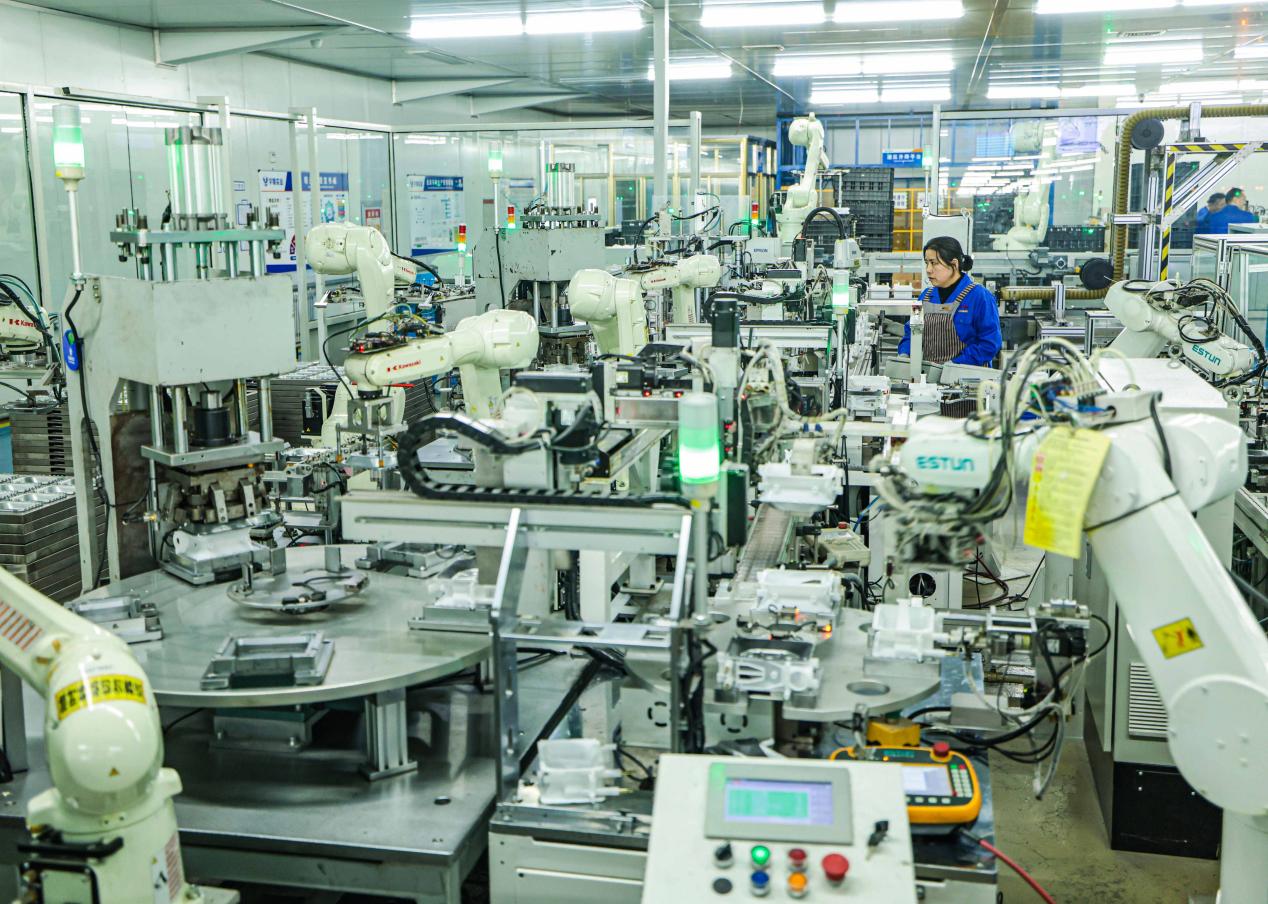
Products are manufactured in an intelligent workshop of a gas metering instrument manufacturer in Rongcheng, east China's Shandong province. (Photo/Li Xinjun)
China's total power use in 2025 reached 10.3682 trillion kWh, according to the latest data released by the National Energy Administration. The figure surpassed 10 trillion kWh for the first time, with China becoming the world's first country to reach that level.
What does the figure of 10 trillion kWh mean?
It is more than twice the annual electricity consumption of the United States and exceeds the combined total of the European Union, Russia, India and Japan. China's power use first surpassed 1 trillion kWh in 1996. It went on to become the world's largest electricity consumer in 2011 and achieved universal access to electricity in 2015. By 2025, the country's total power use had reached nearly twice the level of a decade earlier. Such growth ranks high compared with other major economies.
Power use is widely regarded as a "barometer" and "weather vane" of economic and social activities. Yang Kun, executive vice chairman of the China Electricity Council, noted that surpassing the 10-trillion-kWh mark reflects China's fundamental role as a manufacturing powerhouse and demonstrates the comprehensive upgrading of the country's energy supply capacity.
In 2025, power use by China's secondary industry reached nearly 6.6 trillion kWh, accounting for about 64 percent of total power consumption and remaining the mainstay of electricity demand.
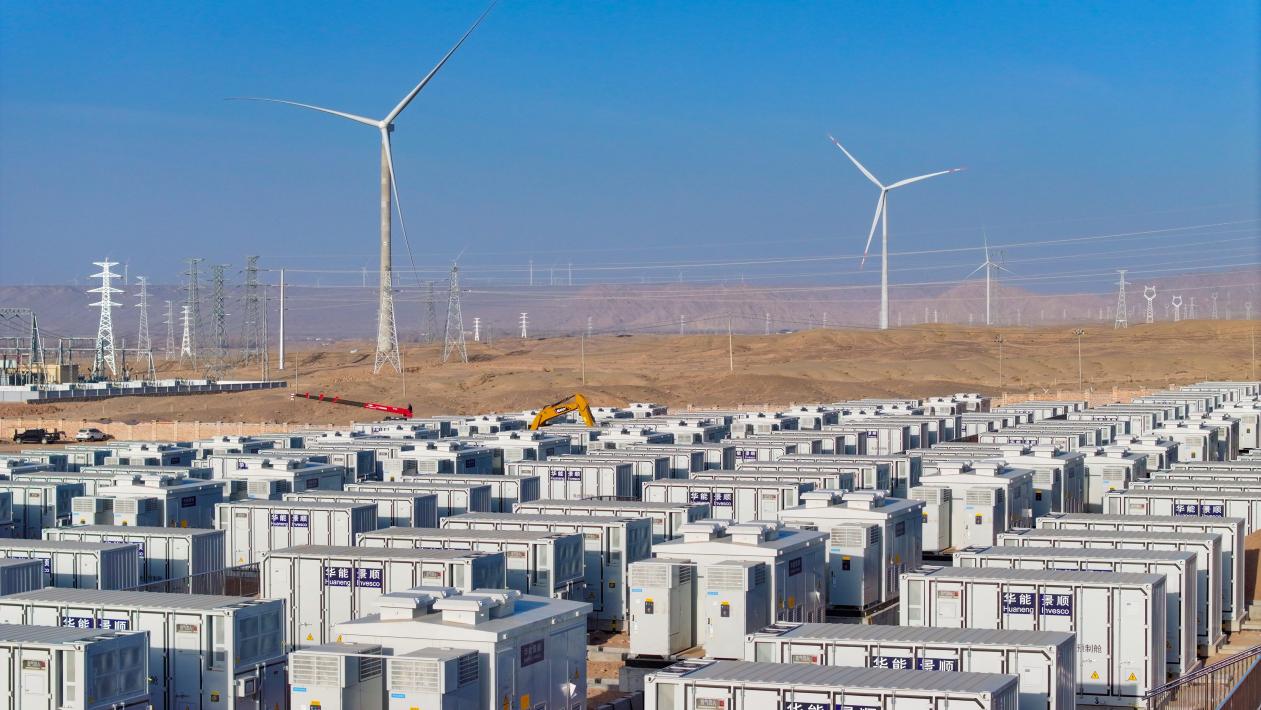
Photo shows a 300 MW/1200 MWh independent energy storage power station project in Beibutan, Gaotai county, Zhangye, northwest China's Gansu province. (Photo/Yin Xu)
At Fubao Robot, an intelligent technology company based in east China's Zhejiang province, technicians were upgrading intelligent eldercare robots.
"We focus on differentiated, customized research and development and have received orders from the United Kingdom, Germany, France and other countries," said Ye Ting, the company's vice president. The firm's electricity consumption has maintained rapid growth for 11 consecutive months, rising by more than 25 percent year on year in 2025.
The fast-growing artificial intelligence industry requires massive computing power, driving a sharp increase in electricity demand. In Hangzhou, capital of Zhejiang province, nearly 100 data centers are in operation, with electricity consumption rising 47.2 percent year on year in 2025.
In 2025, progress toward high-end, intelligent and green industrial development remained steady, with continuous optimization and upgrading of the economic structure. High-end manufacturing has emerged as a new driver of electricity demand, with growth rates in new energy vehicle manufacturing and wind power equipment manufacturing exceeding 20 percent and 30 percent, respectively.
"The leading role of 'new manufacturing' in industrial electricity consumption continues to strengthen, with incremental demand increasingly coming from high value-added, technology-intensive industries," Yang said.
The upgrading service sector has also become an important engine driving electricity consumption. In 2025, power use by the tertiary industry approached 2 trillion kWh, up 8.2 percent year on year and accounting for about 19.2 percent of total electricity consumption.
Nationwide, electricity consumption in EV charging and battery swapping services, as well as information transmission, software and IT services, grew by 48.8 percent and 17 percent, respectively, with new demand flowing more toward new scenarios and services.
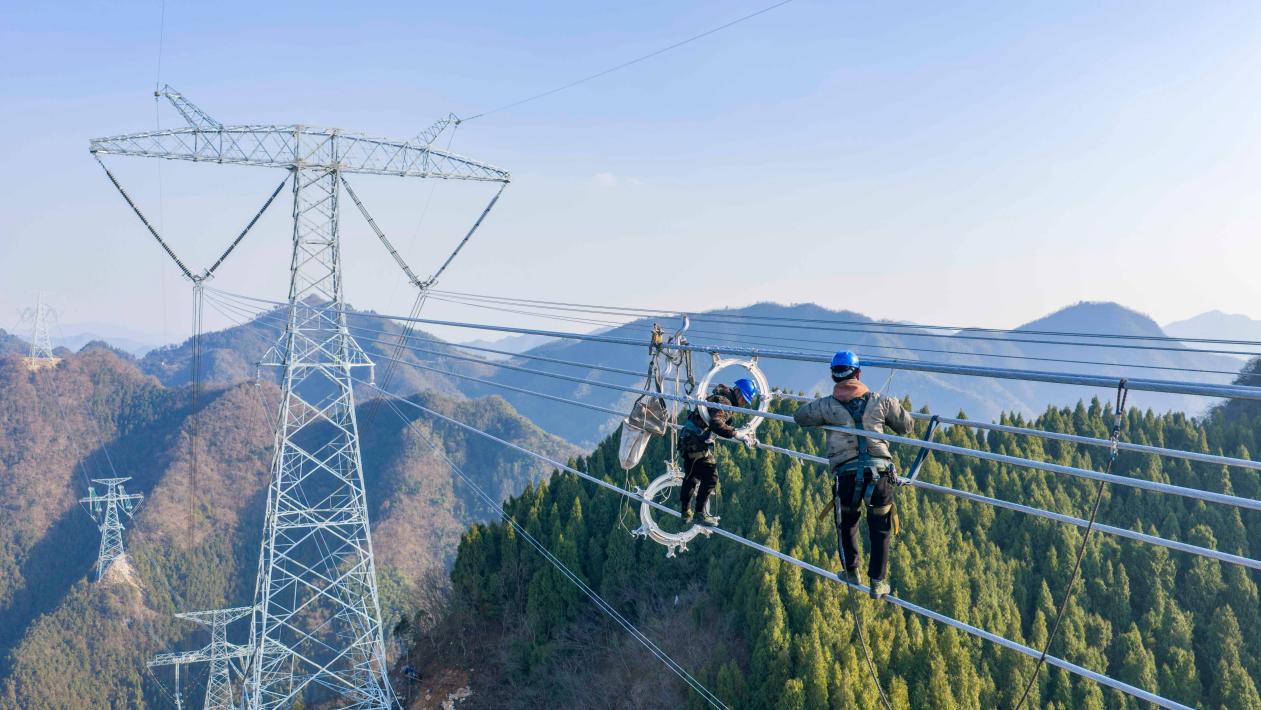
Construction workers carry out overhead line installation for the Gansu‒Zhejiang ±800 kV ultra-high-voltage direct current transmission project, Jan. 8, 2026. (Photo/Shi Jun)
China is seeing a clear trend toward electrification in both energy production and consumption. With about 30 percent of its end-use energy now being electric—a rate higher than that of most major developed economies—electricity demand continues to rise.
Citrus cultivation and processing is one of the pillar industries in Xinping Yi and Dai autonomous county in Yuxi, southwest China's Yunnan province.
"Last year, we invested 20 million yuan ($2.87 million) in building an intelligent micro-sprinkler irrigation system, achieving fully automated watering across the orchards and boosting efficiency by about 65 percent compared with traditional methods," said Zhang Yueqiang, a staff member at the technology center of a local orchard management company.
To meet the electricity needs of specialty agriculture, local power authorities built and upgraded nearly 82 kilometers of 10-kilovolt power lines and installed 69 distribution transformers, supporting electricity consumption growth of more than 15 percent in the county's citrus industry last year.
Across China, electrification is advancing rapidly across multiple fronts: from electric irrigation and smart greenhouses in rural areas, to the adoption of high-temperature heat pumps and electric heating for industrial energy substitution, and the growing use of "photovoltaic generation plus power storage" energy supply systems in buildings. Even ships and aircraft are increasingly turning to shore power while at berth. This rapid, multi-faceted electrification of end-use energy is accelerating the shift toward greener production and lifestyles.
Electricity demand keeps hitting record highs, and the scale is enormous -- what gives the system the confidence to keep supply secure?
China's world-leading power supply system and clean energy network underpin its ability to secure a massive power supply and sustain record-breaking electricity consumption levels.
China's installed power generation capacity accounts for 1/3 of the global total. For every three kWh of electricity consumed, more than one kWh comes from clean energy. In 2025, the combined installed capacity of wind and solar power surpassed that of thermal power for the first time in history. Installed capacity of new energy storage exceeded 100 million kilowatts, accounting for more than 40 percent of the global total. These giant "power banks" have made wind and solar power generation more stable.
China boasts the world's largest and most complex transmission and distribution network, which strengthens the grid.
Growth in power use relies on the grid's capacity for resource allocation and regulation. By 2025, the country had built 46 ultra-high-voltage transmission lines, enabling the rapid delivery of abundant clean energy from western and northern regions to major load centers in the central and eastern parts of the country. The networks for "west-to-east power transmission" and "north-to-south power supply" have been further consolidated.
China is also home to the world's largest "electricity marketplace."
The development of a unified national electricity market has accelerated, allowing electricity to serve as an effective resource allocator while enabling market-based pricing to guide energy distribution. Since the launch of the 14th Five-Year Plan in 2021, the volume of electricity traded in the market has more than doubled, rising from 10.7 trillion kWh during the 13th Five-Year Plan period (2016-2020) to 23.8 trillion kWh.
The power use of 10 trillion kWh represents the continuous upgrading of China's power supply capacity, the shift of China's economy toward higher quality and innovation, and the steady improvement of people's lives.
Photos




Related Stories
- China's installed power capacity sees steady expansion
- China's power consumption reaches new heights, goes greener
- China ramps up power trading to deliver greener, safer energy supply
- Giant energy storage facility takes shape in China's Kubuqi Desert
- Zhoushan in E China's Zhejiang advances development of tidal current power generation
- China puts 45 ultra-high-voltage projects into operation
- China's installed power generation capacity up 17.5 pct
- China's power use up 4.5 pct in September
- Large-scale smart microgrid project launched in east China
- China's power use surge amid heatwave, ongoing recovery
Copyright © 2026 People's Daily Online. All Rights Reserved.
