



Emotion-driven spending injects momentum into consumer market in China
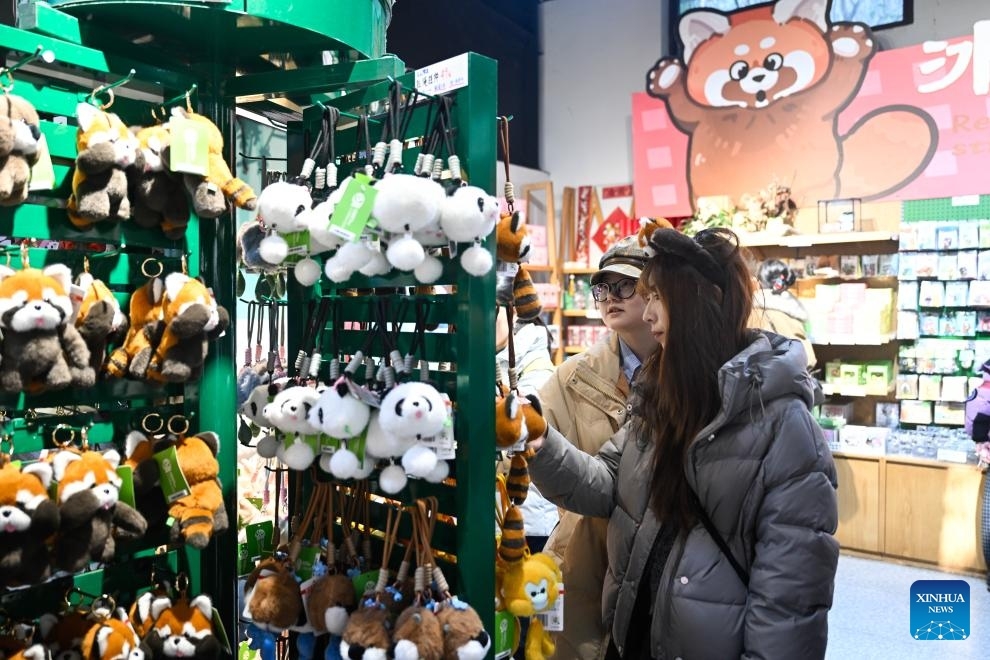
Tourists select souvenirs at Hongshan Forest Zoo in Nanjing, east China's Jiangsu Province, Jan. 3, 2026. People engaged in various leisure activities during the New Year's Day holiday. (Xinhua/Ji Chunpeng)
During the New Year holiday, emotional consumption gained momentum in China. Data from the Ministry of Culture and Tourism show that over the three-day break, a total of 142 million domestic travel trips were made, generating about 84.8 billion yuan (about $12.1 billion) in total tourism spending.
In Wuhan, central China's Hubei Province, an intangible cultural heritage market was packed with young visitors during the holiday. Unlike sightseeing, many chose to linger at stalls demonstrating lacquer art, velvet flowers, and leather carving, taking photos, trying on accessories, and engaging in in-depth conversations with artisans.
The rise of emotional consumption is also evident in China's tourism market, where clearly differentiated travel themes are taking shape. In north China, ice and snow tourism remains highly popular. Skiing, in particular, offers an example of straightforward, happiness-driven spending. In south China, winter-escape travel is gaining momentum, as warmer climates offer relaxation and respite, delivering a deeper sense of emotional comfort.
Data from online travel platforms show that young people have become the main driving force behind travel demand. Travelers born in the 1990s account for 40 percent of total bookings, while their average spending per order rose 17 percent year on year. This suggests a growing willingness among young travelers to pay for higher-quality services and experiences.
According to a report by iiMedia Research, China's emotional economy is expected to exceed 4.5 trillion yuan by 2029 and continue expanding rapidly.
"The fast pace and high pressure of modern life have created an unprecedented demand for emotional comfort," said Wang Peng, an associate research fellow at the Beijing Academy of Social Sciences.
Hong Yong, an expert of the digital-real economies integration Forum 50, analyzed the trend from three perspectives. First, people need outlets to release the emotional pressure accumulated through work, study, and daily life. Second, social media serves as a catalyst by amplifying the emotional value. Third, as consumption upgrades, consumers are increasingly willing to pay for experiences that generate positive emotions.
Today, this trend is reshaping the commercial landscape. Consumption is no longer about buying a single product, but about pursuing a journey of emotional fulfillment.
Artificial intelligence (AI) has emerged as a key enabler of this shift. In 2025, "AI companions" became a buzzword among young consumers, as apps offering personalized interaction and companionship attracted widespread attention. Nearly 70 percent of young consumers say the convenience and reassurance provided by AI-powered shopping recommendations and customer service are valuable forms of emotional support.
Photos



Related Stories
- China's commerce ministry to boost consumption, opening-up in 2026
- Consumption vouchers fuel China's ice-and-snow economy boom
- China's renewed trade-in program spurs activity, pursues quality
- China's Lanzhou launches new products, services to boost consumption
- Handcrafted gold market gaining increased luster
Copyright © 2026 People's Daily Online. All Rights Reserved.
