



China accelerates high-quality digital development in 2025
With the rapid growth of artificial intelligence and other digital technologies, China's digital economy evolved at an impressive pace in 2025. New applications kept emerging, the industry continued to expand steadily, and these innovations helped drive high-quality economic and social development.
Digital innovation gains steam
In 2025, many people were struck by just how thoroughly the DeepSeek large language model became embedded in everyday life. On Jan. 20, just over a year after its founding, DeepSeek officially launched DeepSeek-R1. According to third-party data, within just 21 days of its release, the model had already attracted over 22.15 million active users.
DeepSeek underwent several important updates throughout the year, securing its place among the world's leading AI models while keeping training costs below the international industry average. Today, hundreds of domestically developed large AI models are being integrated into various industries, with one in every three Chinese internet users now using them.
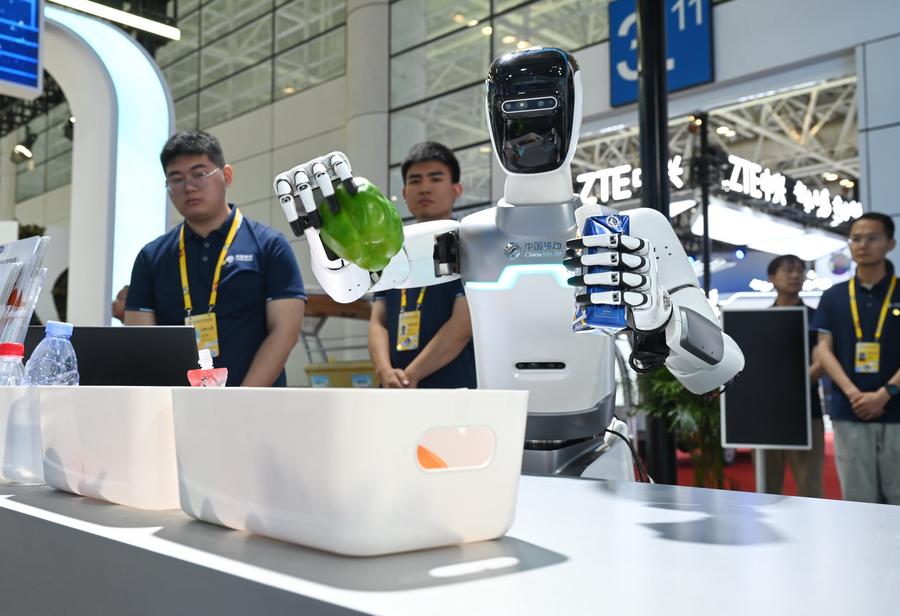
A robot is pictured at the 8th Digital China Summit in Fuzhou, southeast China's Fujian Province, April 29, 2025. (Xinhua/Lin Shanchuan)
The rapid progress in Digital China development has been driven by a strong and innovative digital foundation.
Over the past year, China's network infrastructure has continued to expand. By the end of November 2025, China had built 4.83 million 5G base stations nationwide, an increase of 579,000 from the end of the previous year.
Digital momentum across all industries
In 2025, digital industrialization and the digital transformation of industries reinforced each other, profoundly reshaping the landscape of high-quality economic development in China.
Wang Xingxing, founder and CEO of Unitree Robotics, recently disclosed that progress in robotics in 2025 far outpaced that of the previous two years, with tangible breakthroughs emerging almost every week.
According to the National Bureau of Statistics, the value-added output of high-tech manufacturing enterprises above designated size rose 9.2 percent year on year from January to November 2025.
"Powered by technological innovation and commercial applications, AI is rapidly integrating with the real economy, and smart products and services are constantly emerging," said Yu Xiaohui, president of the China Academy of Information and Communications Technology.
Data shows that China has built more than 7,000 advanced smart factories. The combined industrial scale of intelligent manufacturing equipment, industrial software and system solutions has surpassed 4.5 trillion yuan ($642.5 billion).
Digital services become more accessible
In 2025, digital upgrades in public services brought tangible benefits, continuously improving people's sense of gain.
In Chengdu, southwest China's Sichuan Province, Ms. Yang, who suffers from a sleep disorder, needed to transfer from a health center to a higher-level hospital. In the past, she would have had to carry a referral and go through a lengthy re-registration process at the hospital. However, since May 2025, the health center has been connected to a digital two-way referral platform, allowing the higher-level hospital to reserve 10 percent of its appointment slots for referred patients.
Currently, the two-way referral platform is operational in 64 pilot medical institutions in Chengdu, according to Yang Xiaotao, director of the Chengdu Municipal Health Commission.
To date, over 600 million cross-provincial medical bill settlements have been processed. More than 1.2 billion people are using the electronic medical insurance code, and telemedicine services now cover all cities and counties in China.
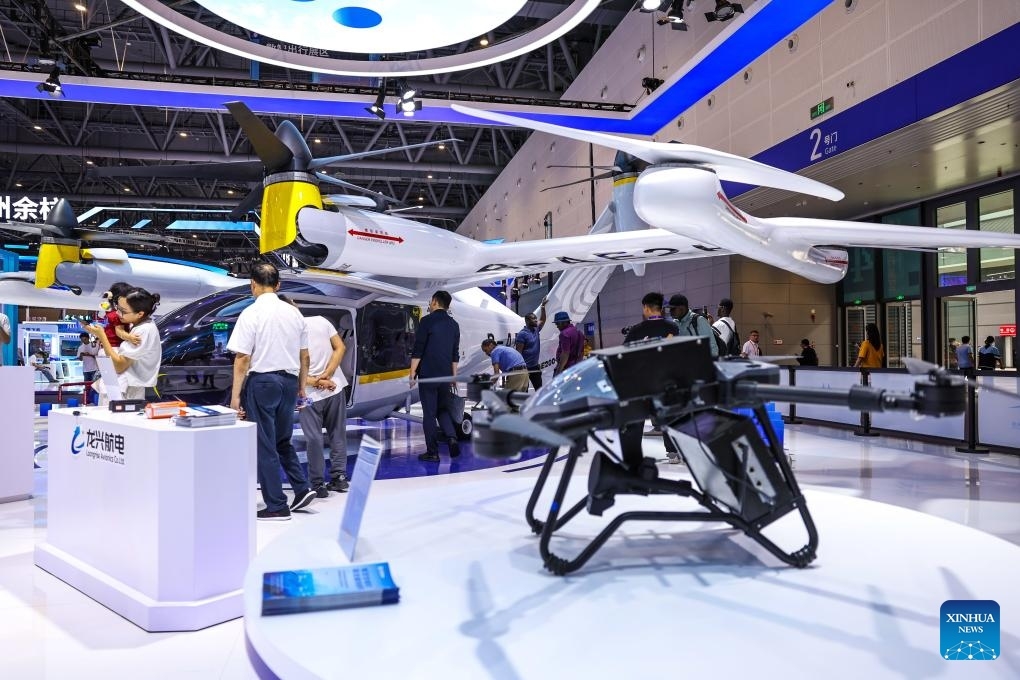
Visitors learn about drone exhibits at the 4th Global Digital Trade Expo in Hangzhou, east China's Zhejiang Province, Sept. 25, 2025. (Xinhua/Jiang Han)
Moreover, digital technology is reshaping everyday life and leisure activities.
All 5A-level tourist attractions nationwide have completed their digital transformation, and new technologies like digital twins and virtual reality are making ancient civilizations "tangible."
Sharing digital technology benefits globally
While strengthening its own capabilities, China is actively working to bring countries together to create a digital community of shared future, helping the world share the benefits of digital technology.
One example is the "SOHO Cloud" Silk Road e-commerce platform, launched in March 2025 — a key part of the China-Central Asia trade facilitation cooperation platform. By logging into "SOHO Cloud," nearly 30 buyers from Central Asia can connect with over 500 suppliers from east China's Jiangsu Province for business negotiations.
"We're speeding up the development of the Jiangsu Central Asia Center and a border warehouse in Horgos, northwest China's Xinjiang Uygur Autonomous Region, among other projects, to support cross-border e-commerce trade between businesses both within and beyond Jiangsu and Central Asia," said Wang Chong, assistant to the general manager of Jiangsu SOHO E-Commerce Co., Ltd., which established the "SOHO Cloud" Silk Road e-commerce platform.
Products made in Jiangsu, such as baby and maternal goods, toys and home furniture, are popular in Central Asia. From January to June 2025, the platform's cross-border e-commerce exports and imports surged by more than 220 percent year on year, said Wang.
"SOHO Cloud" is just one example of China's efforts to deepen international digital economic cooperation. To date, the Silk Road e-commerce cooperation has expanded to 36 partner countries. The initiative has developed numerous collaborative brands, built 120 online and offline national pavilions, and established 65 direct procurement bases across 19 countries.
Photos




Related Stories
Copyright © 2026 People's Daily Online. All Rights Reserved.
