



'China has become the center and focus of international attention'
Editor's Note:
To continuously observe how China is perceived by the world, the Global Times once again launched the "Global Survey on Impression and Understanding of China," covering 46 countries and about 51,700 respondents. The survey found that Xi Jinping Thought on Socialism with Chinese Characteristics for a New Era receives high international recognition. International community's favorability toward China continues to rise, with growing expectations for China to play a greater role. Following the release of the survey results, it sparked positive responses, with several Chinese and foreign scholars analyzing various factors contributing to the sustained improvement of China's international image.
'Xi Jinping Thought on Socialism with Chinese Characteristics for a New Era embodies advanced, shared aspirations of human society'
This survey has selected several key concepts from Xi Jinping Thought on Socialism with Chinese Characteristics for a New Era and asked foreign respondents for their views. "Building a community with a shared future for humanity" and "lucid waters and lush mountains are invaluable assets" received approval from nearly 80 percent of international respondents, while "advancing full and rigorous Party self-governance," "further deepening reform comprehensively," and "people-centered development philosophy" each receives over 70 percent recognition. Approval rate for the above five concepts exceeds 80 percent among respondents from developing countries, and surpasses 60 percent in developed countries. As for the Global Development Initiative, Global Security Initiative, Global Civilization Initiative (note: the Global Governance Initiative had not been announced when the survey began), and joint pursuit of the Belt and Road Initiative, over 70 percent of foreign respondents have indicated recognition, which is higher than that of 2024.
Wang Fan, Vice President of the China National Association for International Studies
From the perspective of recognition rates, more than 60 percent of respondents express approval of these concepts not only in developing countries but also in developed countries, indicating that these concepts hold significant value and embody the advanced, shared aspirations of human society. The current international community is rife with turmoil and disorder, with many countries in a state of confusion and actively seeking directions and answers. Some Western developed countries are mired in a development dilemma characterized by high welfare and high burdens, lacking clear judgement on the path forward; developing countries likewise need more explicit development approaches, models, and pathways. Concepts such as "building a community with a shared future for humanity" and the "two mountains" have garnered widespread resonance, grounded in clear practical logic and a contemporary context, and they align closely with the goals and approaches of human societal development.
Essam Sharaf, Former Egyptian Prime Minister
I appreciate China's wisdom and carefulness regarding global affairs, especially the concept of "building a community with a shared future for humanity." A people-centered approach and concrete actions will benefit the entire world. This is precisely what the Global Governance Initiative (GGI) is designed to address. The GGI focuses on actions that can bring change. The initiative is timely in responding to the fragile international environment. Actionable practices will first strengthen Global South countries' capacity-building and long-term governmental effectiveness. The Global South has learned the importance of cooperation among themselves. Global South countries should cooperate and pursue the best possible conflict-resolution mechanisms. This cooperation will foster peace, and peace will in turn lead to development.
Muhammad Asif Noor, Director of the Institute of Peace and Diplomatic Studies, Pakistan
Amid the intensifying international geopolitical conflicts, slowing economic growth, and the global challenges of climate crises and governance deficits, the concept of "building a community with a shared future for humanity" and related initiatives directly respond to interconnected crises that transcend borders, offering a future-oriented blueprint for collective action where traditional frameworks fall short. China actively promotes climate cooperation, technology sharing, and other initiatives, gradually being regarded as an important provider of international public goods. Especially amid the escalation of great power competition, Western countries are either shirking responsibilities and retreating, or sliding toward unilateralism and protectionism. China's proposal of these concepts fully embodies the responsibility of a responsible major power.
Liang Xue, Assistant Researcher with the China Institute of International Studies
An increasing number of countries recognize that "building a community with a shared future for humanity" is the path forward for the peoples of all nations. This major concept has been incorporated into UN General Assembly resolutions for consecutive several years, with its core implications included in the United Nations' "Pact for the Future," and it is increasingly becoming a significant international public good that serves as a hallmark of the contemporary world. The concept of "building a community with a shared future for humanity" highly aligns with the core values accumulated over the long term in the cultures of various countries, in terms of their spiritual essence. "Building a community with a shared future for humanity" clearly advocates the common values of all humanity, resonating and integrating with the core ideas of unity, coexistence, cooperation, and mutual benefit championed by various civilizations, thereby drawing the largest concentric circle encompassing the value pursuits of peoples from countries with diverse historical and cultural backgrounds.
Kin Phea, Director General of the International Relations Institute of the Royal Academy of Cambodia
The cross-regional recognition of China's vision of "building a community with a shared future for humanity" reflects a growing demand for inclusive cooperation amid global uncertainty. China's concept resonates because it prioritizes shared development, mutual respect, and collective security rather than ideological conformity. It accommodates diverse political systems while emphasizing practical cooperation in areas such as infrastructure, climate change, and public health. This flexible and non-exclusionary approach aligns with the realities of a multipolar world, enhancing its credibility and appeal across different regions.
Rafael Zerbetto, Brazilian expert at China International Publishing Group and a recipient of the Chinese Government Friendship Award
Now, for first time we will see an ancient civilization with other values (different from Western ones) and mindset starting to lead the world. The four global initiatives appear in this context, signaling essential values and guidelines that China wants to share with the world. These initiatives support and complement each other. They share the same spirit of promoting win-win cooperation, mutual understanding, mutually beneficial exchanges and common development. Altogether they can be regarded as a framework that allows other countries to better understand China's philosophy on global governance and what we can expect. A major secret behind China's development success lies in its long-term systematic planning and strong implementation capacity.
'A major secret behind China's development success lies in its long-term, systematic planning and strong executive force'
Survey results show that nearly 70 percent of foreign respondents hold a positive attitude toward the Communist Party of China's concepts and practices related to exercising full and rigorous Party self-governance, including implementation of the spirit of central Party leadership's eight-point decision on improving work conduct. They agree that "the ruling party members in all countries should be held to higher standards than ordinary citizens" or "strict standards for the ruling party members are essential." More than three-fourths of foreign respondents have an objective and positive understanding and evaluation of the formulation and implementation of five-year plans, agreeing that "this is an important mechanism in China's economic and social development" and "an approach" the government of their country would do well to adopt.
Huang Jing, Distinguished Professor of Shanghai International Studies University
The governance concepts and experience, such as implementing the spirit of the eight-point decision and formulating five-year plans, have won international acclaim, reflecting the international community's widespread expectations for China's development path and governance model. The international community's recognition of the practice of exercising full and rigorous Party self-governance demonstrates that the ruling party can maximize the containment of the breeding and spread of corruption through rigorous self-governance - a political courage rarely seen in the practices of political parties in other countries.
No country in the world, especially one with a population as large as China's, has been able to achieve the "two miracles" of rapid economic development and long-term social stability in over seven decades. To sum up, China's approach consists of two aspects: first, adhering to a consistent long-term strategy; second, advancing continuous reform and opening-up. It is precisely this practice of ensuring policy continuity amid stability and deepening reform amid continuity that has enabled China to form clear and stable expectations in its long-term development. Continuity begets stability; stability begets predictability; predictability begets trust. This fully explains why favorability and recognition ratings on China have been on the rise.
Wang Fan
In some countries, the ruling parties lack effective mechanisms for rigorous self-restraint and self-reform. They often make promises during election campaigns that are not matched by their actions once in office, and their governance efforts are geared more toward electoral goals rather than enhancing long-term governance capacity.
By contrast, the CPC has always maintained high standards for itself, and through constant self-reflection and self-improvement, it continuously strengthens its capacity for leadership and sustains its vitality. This has gained considerable recognition from the international community. Furthermore, under China's system, reforms can be advanced in a coordinated manner. This endows the comprehensive deepening of reforms with special significance, which has been positively evaluated by many countries.
Wu Xinbo, Dean of the Institute of International Studies of Fudan University
This year, international media have widely discussed and noted that a major secret behind China's development success lies in its long-term, systematic planning and strong executive force. The international community's high praise for the recommendations for the 15th Five-Year Plan (2026-30) also echoes this consensus: for a country to achieve sound development, it needs both rational, long-term and systematic planning, as well as robust execution to deliver on every item of the plan. The fact that China can fulfill its plans - even ahead of schedule or exceeding targets - is precisely the key to its development success.
Combating corruption is one of the top concerns of the general public worldwide. The spirit of the eight-point decision is not only crucial to improving China's social conduct, but also sends a positive message to other countries that China has always attached great importance to governance capacity and work conduct while pursuing development.
Da Wei, Director of Center for International Security and Strategy and Professor at Department of International Relations of Tsinghua University
For developing countries, China serves as a successful model in the fields of development and governance. The practical approaches it has adopted for economic development and social governance are instructive, and thus its growing recognition is expected. In particular, concepts such as exercising full and rigorous Party self-governance, comprehensively deepening reform, people-centered development, and combating corruption address the key areas where developing countries are generally deficient. It is for this reason that these countries all recognize the significant value of such concepts.
Warwick Powell, Adjunct Professor at the Queensland University of Technology
Results speak louder than words. China has for decades been consistent in its focus on deeds and outcomes, and as it became wealthier itself, it has worked to mobilize its resources, experiences and lessons to enable others in the global south to step out from the shadows of colonialism and begin their own pathways of modernization and development.
In essence, China's foreign policy has been framed by the idea of being a "great enabling power." Because of its constructive role, its willingness to contribute, partner and support to create mutually beneficial outcomes, it's hardly surprising that there's strong support for China to continue playing this kind of role. Additionally, China focused on building consensus to address problems and conflicts. This takes more time than effort but has the prospects of being sustainable, as conflict parties are part of the solution rather than simply having so-called "solutions" imposed for forced upon them from outside.
'The international community is broadly optimistic about China'; 'The rise in its international favorability rating comes as no surprise'
Nearly 80 percent (78 percent) of foreign respondents recognize that China's comprehensive national strength is increasing, marking an 8-percentage-point rise from 2024. Survey data shows that nearly 70 percent (69 percent) of foreign respondents have a favorable impression of China, up 6 percentage points from 2024. Over 90 percent of foreign respondents have expressed interest in China and the area of top interest is "culture" in developed countries, and "technology" in developing countries. More than 70 percent hope that future China-US relations will "tend to be eased" or "maintain status quo." In the comparison of "which country do you have a more favorable opinion of, China or the US?" the proportion of international public opinion choosing China is 39 percent, which is 1.5 times that of choosing the US (26 percent).
Wang Youming, Director of the Department for Developing Countries Studies at the China Institute of International Studies
The upward momentum of China's international image is distinct, and the rise in its international favorability rating comes as no surprise. The international community now has more convenient and diverse channels to learn about China, and the country's international image - both in terms of hard power and soft power - is fully consistent with what we observed during our field research abroad.
China's stance of actively mediating disputes and promoting dialogue on global hot-button and intractable issues, its opposition to unilateralism and trade protectionism, its efforts to actively expand opening-up, and its actions to promote win-win cooperation such as hosting of the China International Import Expo all align with the interests and aspirations of most countries in the world, especially developing nations.
As the world's two largest economies and permanent members of the United Nations Security Council, the stability of China-US relations bears on global stability, and cooperation between the two countries is vital to global development. China-US cooperation benefit both sides and confrontation hurt both sides. It is for this reason that the international community widely expects the two countries to maintain stable relations and boost global economic growth.
Wu Xinbo
China's achievements in development and governance are gaining growing recognition from the international community, and the distorted narratives about China once peddled by some Western media have now lost their appeal. Notably, since the start of this year, there has been a marked positive shift in perceptions of China among academic, political, business and student circles in the US. The "DeepSeek phenomenon" has prompted American society to rethink China's innovation capabilities, shattering long-held stereotypes. China's response to the reckless imposition of tariffs by the US has deepened American society's understanding of China's economic resilience, while also correcting the biased judgments of some US media outlets and analysts who have long been predicting China's economic decline.
Views on China's progress in development and governance have tend to be more objective. Although ideological and value-based prejudices still persist, they have diminished compared with the past. At a recent international conference, a former official of Japan's Ministry of Foreign Affairs stated: "China has become the center and focus of international attention."
Muhammad Asif Noor
In recent global surveys conducted throughout 2025, a discernible shift in public perceptions has favored China over the US in various metrics of international favorability. This shift is particularly pronounced in the Global South, including sub-Saharan Africa, the Middle East, and Latin America, where economic and geopolitical dynamics have amplified China's appeal. Key factors driving this change include the perceived fallout from US policies under the second Trump administration, particularly the escalation of tariff wars and an "America First" approach that has been viewed as isolationist and unpredictable.
In contrast, China's consistent emphasis on multilateralism, non-interference, and economic cooperation through initiatives like BRI has bolstered its image as a stable and beneficial partner, especially in developing regions where infrastructure investments and trade have delivered tangible gains without conditional demands. Additionally, China's growing economic clout, now seen by many as the world's leading power, and its neutral stances in global conflicts, such as in the Middle East, have contributed to perceptions of it as a counterbalance to US unilateralism. This trend, of course, does not mean that the international community is making a simplistic binary choice between China and the US. Rather, it reflects the relative judgments made by the public of various countries on the roles of different major powers, based on practical interests, stable expectations and governance outcomes, against the backdrop of accelerating multipolarity.
Wang Fan
China's development is reflected not only in its scale, but also in multiple dimensions such as speed and efficiency. As the world's largest manufacturing country, China has become a major trading partner for more than 150 countries and regions across the globe, boasting a vast market scale and a continuous unleashing of market vitality. Meanwhile, as a major representative of emerging market economies, China has been constantly exploring new development models in practice and put forward a series of innovative development concepts.
Like other countries in the world, China faces various challenges in the course of development. Yet what the international community pays greater attention to is the development potential and sustained innovation capacity that China has demonstrated, as well as its exploration of a more equitable and rational development model. More importantly, China's development is not merely focused on its own growth; instead, it has always emphasized common development with other countries. It is precisely for this reason that the international community is broadly optimistic about China and expects that China's development will bring about mutually beneficial opportunities for more countries.
'China's foreign policy is increasingly regarded as a force for stability'
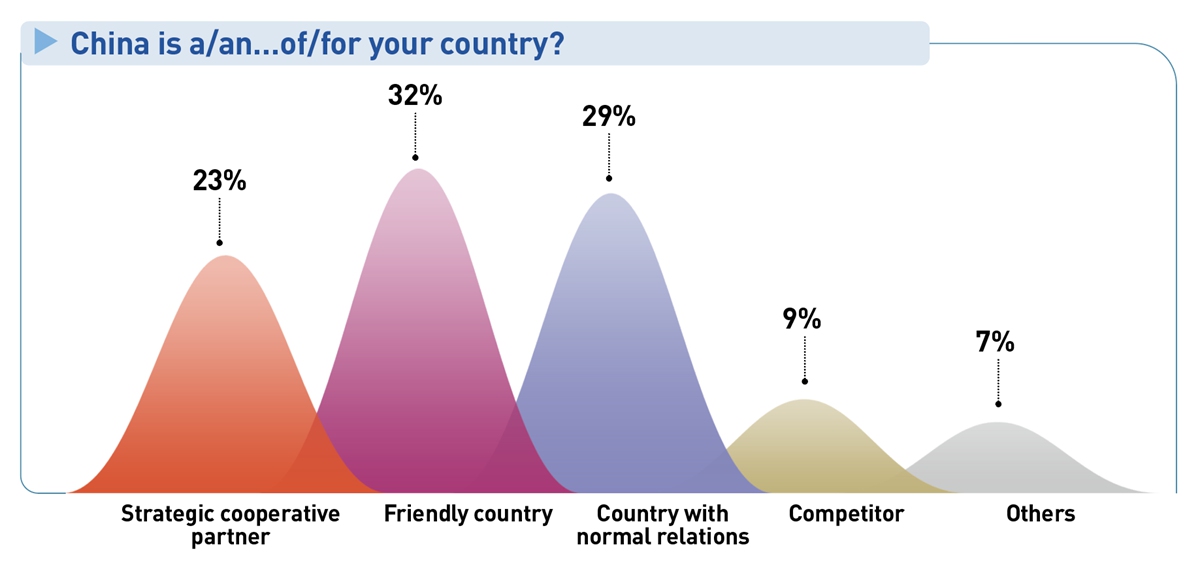
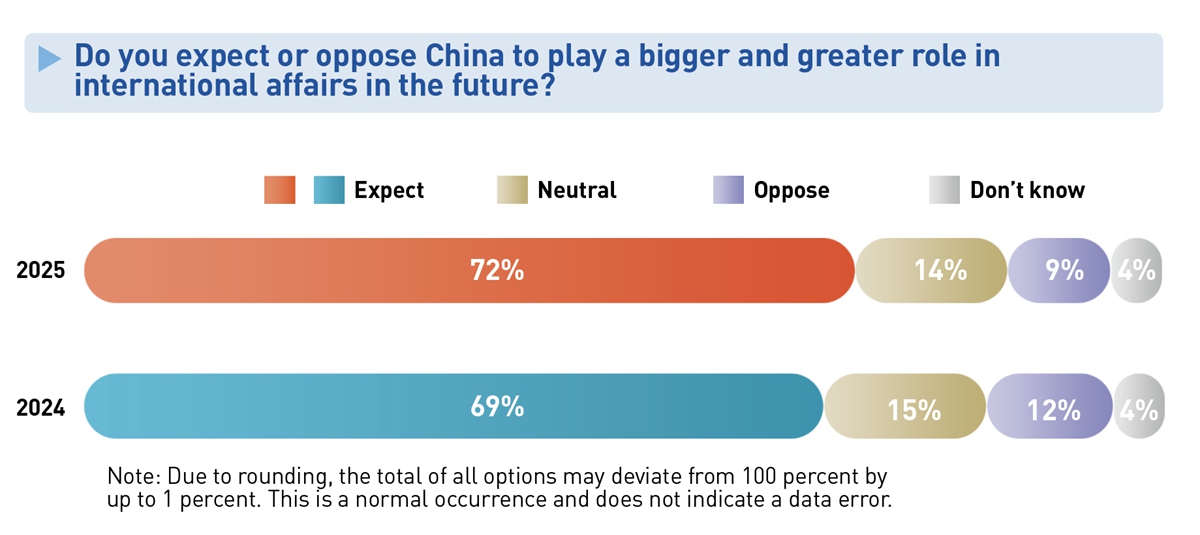
More than 70 percent of respondents expect China to participate more in international affairs or play a greater role in the future, an increase compared to previous years. In areas such as building a more equitable and just international order, mediating and coordinating on international and regional hotspot issues, and conducting economic, trade, and educational and cultural cooperation, around 80 percent expect China to take more actions. Over 80 percent of international respondents believe that their country has a normal, friendly, or strategic cooperative relationship with China, an increase compared to 2024. Over two-thirds of international respondents hope that their country's relationship with China will improve in the future. Over three-fourths of international respondents give positive and objective evaluations of China's neighborhood policy.
Abbas Jawad Kdaimy, one of the translators of the Arabian edition of the book series Xi Jinping: The Governance of China
The expectation for China to assume a more prominent and constructive role in addressing global challenges is met with a keen understanding of the distinct attributes of its foreign policy and international engagement. China's foreign policy is characterized by a strong advocacy for multilateralism and respect for the sovereignty of other nations. By prioritizing collaborative relationships over hegemonic ambitions, China distinguishes itself from other global powers.
China's proactive participation in global governance frameworks reflects its determination to contribute meaningfully to resolving international disputes. This multifaceted approach creates an environment in which the global public feels optimistic about China's potential contributions to tackling pressing global challenges.
Muhammad Asif Noor
China's foreign policy is increasingly regarded as a force for stability. In diplomatic practice, China places greater emphasis on mutual benefit and win-win outcomes, as well as collective problem-solving, rather than unilateral dominance. Developing countries remain wary of aid with strings attached and external interference, and China's long-standing adherence to the principle of non-interference in internal affairs - along with its opposition to politicizing development and cooperation - has garnered widespread resonance. By advocating for UN reforms and proposing and promoting a series of global initiatives, China positions itself as a supporter of inclusive decision-making, striving to amplify the voices of the Global South. At the same time, China integrates traditional cultural concepts into its contemporary diplomatic narrative, constructing a cultural framework that emphasizes peaceful coexistence and equal mutual benefit. In the current context of China's rapidly rising economic strength and increasing diplomatic activism, this fusion of ideas is reshaping the international community's perception of China, gradually establishing it as a reliable partner for resolving disputes through dialogue rather than confrontation, and as an important player in exercising constructive leadership in a multipolar world. Particularly among younger demographics, favorability toward China and recognition of its soft power are showing a steady and sustained upward trend.
Huang Jing
Both China and the US are major powers, and the words and deeds of the two countries will have a profound impact on the global situation, as well as significant spillover effects on their respective peripheries. Among China's neighboring countries, Southeast Asian countries serve as the most representative example. Over the past few decades, Southeast Asian countries have achieved coordinated development and mutual benefit and win-win outcomes in the process of continuously deepening economic and trade exchanges and industrial collaboration with China, demonstrating the driving and altruistic nature of China's development. When compared with the intervention approaches of certain major powers in various parts of the world after the end of the Cold War, these differences are particularly stark. In addressing relevant issues in the Asian region, China has consistently adopted an attitude of safeguarding peace, emphasizing dialogue and the management of differences, which reflects the unique path it adheres to in handling regional and international affairs.
Da Wei
Neighboring countries are of vital importance to China. These countries maintain extremely close economic ties with China; many share mountains and rivers with it, and are highly similar at the social and cultural levels, fostering natural bonds between them. Over the past few decades, China's rapid economic development has created numerous opportunities for its neighbors, driving the progress of the entire region. China has always attached great importance to relations with neighboring countries. While advancing its own development, China will continue to create space for the growth of these nations, achieving overall regional prosperity and long-term stability through mutually beneficial cooperation.
Wang Youming
Over 80 percent of international respondents believe that their country has a normal, friendly, or strategic cooperative relationship with China. This perception is highly correlated with the reality that China has become the main trading partner of more than 150 countries and regions. Economic ties, as an important foundational factor in interstate relations, to some extent, reflect the actual warmth and stability of bilateral relations between China and relevant countries. China's neighborhood diplomacy concepts, such as "amity, sincerity, mutual benefit and inclusiveness," are deeply welcomed by regional countries. The demeanor exhibited in China's diplomacy brings harmony, tranquility, and development to neighboring countries.
Maya Majueran, Director of BRISL, an independent &pioneering Sri Lankan-led organization, with expertise in BRI advice and support
China's approach appears markedly different: inclusive, cooperative, and rooted in the idea of a shared future. This perception is fueling a surge in global support for Beijing's vision. At the core of China's appeal is a principle that resonates deeply with many nations: non-interference in domestic affairs. Unlike models that tie engagement to political conditions, China positions itself as a development partner open to collaboration with countries of all sizes regardless of population, economic strength, or military power. For nations weary of external pressure, this is a refreshing alternative.
Photos




Related Stories
- Top 10 China news events of 2025
- China's initiatives distinguished by focus on each country's interests, says Kyrgyz expert
- Why China has become a 'forward-looking nation'
- China achieves fruitful results in high-quality development during 14th Five-Year Plan period
- A 76-year journey of China's complete transformation
Copyright © 2026 People's Daily Online. All Rights Reserved.
