



Key words reveal China's economic dynamism in 2025
As 2025 draws to a close, a series of keywords have highlighted emerging trends in China's market, reflecting the vitality of the Chinese economy.
Trade-in programs
Since the beginning of this year, the scope of China's large-scale equipment upgrade and consumer goods trade-in programs has been expanded, playing a crucial role in stabilizing investment, expanding consumption, driving transformation and improving people's livelihoods.
Data from the Ministry of Commerce show that from January to November, consumer goods trade-in programs generated sales exceeding 2.5 trillion yuan (about $355.69 billion), benefiting more than 360 million people. Purchases included more than 11.2 million cars, 128.44 million home appliances, 90.15 million subsidized smartphones and other digital devices, 12.91 million electric bicycles, and over 120 million home renovation and kitchen upgrades.
Trade-in programs for consumer goods have not only energized the consumer market but also driven sustained demand for upgraded consumption. Green, smart and high-quality products are increasingly entering ordinary households.
Ticket-stub economy
This year, the ticket-stub economy has injected fresh vitality into the Chinese market.
In Shanghai, an exhibition ticket contributes to billions of yuan in consumption across the Nanjing Road commercial district. In east China's Jiangsu Province, a ticket for the 2025 Jiangsu Football City League, dubbed the "Su Super League," extends into cross-city micro-vacations. In many other cities, ticket stubs from concerts, marathons and art exhibitions give event-goers discounts across commercial areas and tourist attractions.
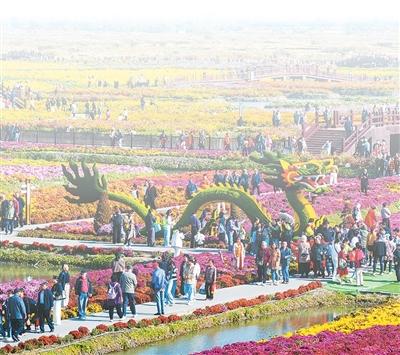
Photo shows tourists at a scenic zone in Taizhou, east China's Jiangsu Province. The city offered free admission to global tourists after the team of Taizhou claimed the championship of the Su Super League 2025. (Photo/Tang Dehong)
Once merely an entry pass for a single consumption experience, the ticket stub now connects dining, accommodation, transportation, tourism, shopping and entertainment, becoming an "invitation" to explore cities.
Many cities are exploring and promoting the ticket-stub economy. Shanghai, for example, has incorporated it into the city's action plan for boosting consumption, supporting shopping centers and attractions in offering discounts to consumers holding tickets or passes for festivals, exhibitions and sporting events.
Experts note that the ticket-stub economy reflects the robust growth of service consumption while linking different consumption scenarios and unlocking consumer potential.
New scenarios
Across the country, new consumption scenarios are emerging. Many places are cultivating "new commercial scenarios." Beijing, for instance, has explicitly proposed advancing the transformation of key commercial districts and fostering more new scenarios with broad reach and high visibility in leisure, fashion, waterfront, health and nighttime consumption.

Tourists ski at a ski resort in Hohhot, north China's Inner Mongolia Autonomous Region. (Photo/Ding Genhou)
Scenario innovation can optimize consumption supply and lead the trend of consumption upgrading, while injecting sustained momentum into high-quality urban development.
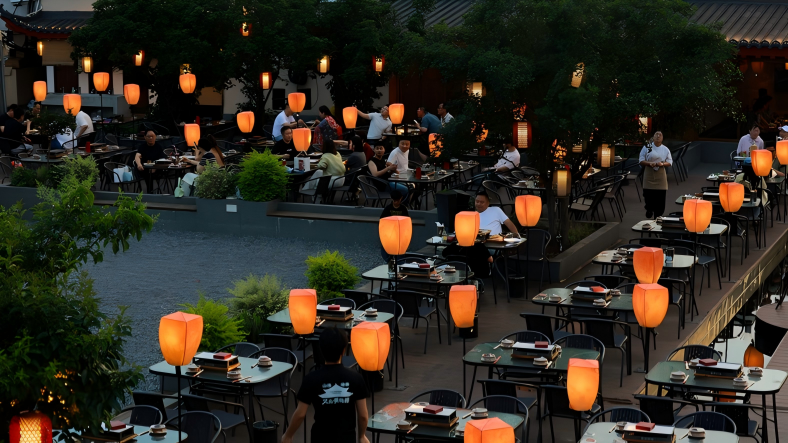
The nighttime economy, which has flourished in recent years, is transforming from traditional night markets focused on dining and shopping into nighttime cultural and tourism consumption zones that integrate culture, tourism, entertainment and other business forms. From barbecues and camping to stargazing, summer retreats, bonfires and music markets, the integration and innovation of scenarios give consumers more reasons to "go out."
The National Development and Reform Commission recently noted that scientific and technological products, digital technology and artificial intelligence are continuously creating new business forms, models and scenarios. Immersive and experiential consumption scenarios are being cultivated, with e-commerce, the livestreaming economy and online entertainment thriving. The enormous consumption potential will continue to be released in the coming period.
Robots
The 2025 World Humanoid Robot Games demonstrated the appeal of combining technology with sports. Experts predict that humanoid robots may become another disruptive product, following smartphones and new energy vehicles, playing important roles in household services, manufacturing, warehousing and logistics.
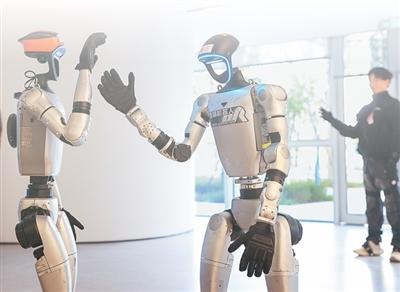
Robots receive training in a simulated environment at the Yangtze River Delta (Deqing) Embodied AI Data Collection and Training Facility in Huzhou, east China's Zhejiang Province. (Photo/Zhao Ning)
Leveraging China's industrial strengths and fertile soil for innovation, the country's robot industry has developed rapidly. National Bureau of Statistics data show that from 2020 to 2024, the industry's operating revenue grew from 106.1 billion yuan to 237.89 billion yuan, with an average annual growth rate of 22.4 percent. Industrial robot output increased from 212,000 units to 556,000 units, with an average annual growth rate of 27.3 percent. China has secured its position as the world's largest robot producer.
Rural cultural and sports activities
Rural cultural and sports activities — including the Village Basketball League and Village Super League, "village fashion shows," "village songs," "village galas," and "village volleyball games" — showcase an increasingly vibrant and diverse rural China while injecting new momentum into county-level economic development.
A report on China's rural cultural and sports activities shows that in 2024, more than 2,200 such activities with over 100,000 online views generated economic benefits of 13.09 billion yuan.
Behind the surge in rural cultural and sports activities lies the enormous development potential of China's county-level markets. From January to November this year, retail sales of consumer goods in counties and townships accounted for 38.7 percent of the national total.
Senior-friendly tourism trains
Early this year, the Ministry of Commerce and eight other departments issued an action plan to expand and improve senior-friendly tourism train services. Subsequently, tourist trains were launched nationwide with flexible itineraries and thoughtful services to meet seniors' travel needs. In particular, a series of age-friendly upgrades were made to lighting, handrails, seats and restrooms, making trains more suitable and convenient for elderly passengers.

A staff member serves food for passengers onboard Train Y783, a senior-friendly tourism train. (Photo/Xu Shuai)
Senior-friendly tourism trains are of great significance for promoting consumption, stabilizing growth and improving people's livelihoods, said an official.
Currently, senior tourists account for more than 20 percent of China's total tourist numbers. Silver tourism is no longer a niche market. Regions across the country are actively developing themed travel routes and products tailored to seniors, further unlocking the potential of the silver tourism market.
Touring and shopping in China
Currently, China's 240-hour visa-free transit policy applies to citizens of 55 eligible countries, covering 65 ports nationwide. Simplified visa procedures, extended visa-free stays and optimized customs clearance efficiency have made trips to China smoother for foreign tourists.

Foreign tourists take selfies at the Palace Museum in Beijing. (Photo/Du Jianpo)
Since the policy's implementation through Dec. 16, China recorded 40.6 million foreign entries, a 27.2 percent year-on-year increase, according to the National Immigration Administration. Notably, the number of travelers using the 240-hour visa-free transit policy surged 60.8 percent compared with the period before the optimization.
By the end of August, the number of tax refund shops nationwide had exceeded 10,000, triple the figure at the end of 2024, with the scale of departure tax refunds in the first three quarters rising substantially year on year.
"Make sure to bring an empty suitcase to China!" This tongue-in-cheek travel tip has gone viral on overseas social media platforms. What visitors are buying is not just traditional souvenirs. From smart glasses and VR devices to drones, competitively priced, high-quality Chinese-made products have attracted growing numbers of foreign tourists.
Touring and shopping in China are fostering new consumption growth and allowing more people to experience a China that is open, inclusive, prosperous, stable and full of vitality.
Photos



Related Stories
- China's steady progress: a beacon of certainty in an uncertain world
- China's steady, sustained growth continues to boost global economic confidence
- Second-hand economy gains traction in China
- Decoding China's new blueprint | Roadmap anchor of expectations, confidence for global investors: UBS economist
- China's economy sustains momentum in October, solidifying confidence in hitting annual targets
- Goldman Sachs sees global success driving China's economic shift
- Hong Kong's economy expands 3.8 pct in Q3
- Stay confident and forge ahead with determination
- China's economic transformation presents global opportunities
- Holiday travel boom reflects resilience and vitality of Chinese economy
Copyright © 2026 People's Daily Online. All Rights Reserved.
