



China's culture, tourism sectors gain traction
Since the beginning of this year, China's culture and tourism sectors have embraced innovation, creating a range of new business models and consumption scenarios that cater to diverse consumer demands, unlock consumption potential, and fuel robust market growth.
In Xi'an, northwest China's Shaanxi Province, visitors to the immersive extended reality experience space at the Emperor Qinshihuang's Mausoleum Site can wear headsets and instantly "step into" the underground palace, engaging in dialogue with the iconic Terracotta Warriors.
In Jingmen, central China's Hubei Province, the Shengjing Mountain scenic area has introduced a model that integrates paragliding with eco-tourism. The area now offers paragliding experiences, high-altitude viewing platforms and themed cafes that give tourists multiple ways to enjoy the natural landscape.
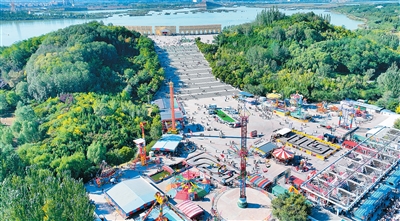
Photo shows Lanshan Park in Yinchuan, northwest China's Ningxia Hui Autonomous Region. (Xinhua/Wang Peng)
Digital and immersive innovations are enriching cultural and tourism scenarios, reshaping visitor engagement, and driving consumption upgrades.
Recently, the Zhejiang Provincial Department of Culture, Radio, Television and Tourism released 15 exemplary cases of consumption promotion through culture and tourism. The cases highlight innovative practices and notable achievements across the province in expanding consumption scenarios, enriching product offerings, and optimizing the consumer environment.
The provincial capital, Hangzhou, has vigorously developed its performance economy, using ticketed events to boost cultural and tourism consumption. By the end of September, the city had hosted 87 large-scale commercial concerts and music festivals, generating ticket revenues of 1.18 billion yuan ($168 million) and driving approximately 7.1 billion yuan in total consumption.
By leveraging the Wuzhen Theater Festival to connect traditional attractions with emerging business models, Tongxiang city in the province received nearly 15.19 million tourist visits from January to October.
Cultural and tourism innovation has satisfied visitors while delivering tangible benefits to industry stakeholders. Innovative business models are enabling venues and operators to gradually break free from their reliance on ticket sales and broaden their income channels.
In Yinchuan, northwest China's Ningxia Hui Autonomous Region, Lanshan Park has emerged as a new cultural and tourism landmark, renowned for its stunning sunset views.
The park upgraded its facilities, including restrooms, walkways and viewing platforms, in October 2024. Moving away from ticket-dependent and rental-only models, it adopted a "free admission plus market-oriented operation" approach, developing consumption scenarios such as night markets, cultural and creative products, and water activities. Through branded events like "sunset chorus" and the "Lanshan music season," the park has transformed into a cultural tourism magnet.
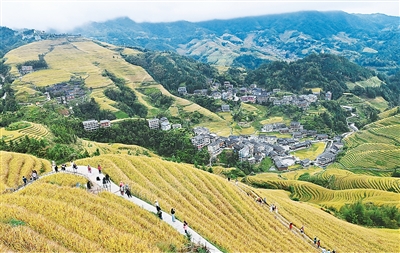
Tourists enjoy the scenery at the Longji Rice Terraces in Longsheng, an autonomous county home to various ethnic groups in south China's Guangxi Zhuang Autonomous Region. (Xinhua/Lu Boan)
Lanshan Park now receives over 3 million visitors annually. The 2025 Lanshan music season attracted more than 150,000 visits and directly generated 124 million yuan in local dining and retail consumption, promoting broader sharing of the benefits brought by cultural and tourism development.
In rural areas, consumption growth driven by cultural and tourism innovation is making development dividends more sustainable. The Longji Rice Terraces in Longsheng, an autonomous county home to various ethnic groups in south China's Guangxi Zhuang Autonomous Region, are a well-known cultural tourism attraction.
To expand beyond traditional sightseeing, the county has invited representative inheritors of intangible cultural heritage to offer on-site courses, attracting entrepreneurs to learn embroidery and silver jewelry-making.
It has also established village livestream e-commerce centers, training over 80 villagers as hosts to promote local products through livestreams from settings such as stilted houses and terrace viewing platforms. Expanded employment opportunities and additional business revenue have increased villagers' annual per capita income by 15,000 yuan.
Recently, the Ministry of Industry and Information Technology (MIIT), along with five other departments, released an implementation plan to better align the supply and demand of consumer goods and further stimulate consumption.
By 2027, the supply structure of consumer goods is expected to be significantly optimized, creating three trillion-yuan consumption sectors and 10 100-billion-yuan consumption hotspots, encompassing outdoor products, trend toys, and Guochao (China-chic) apparel, according to the plan.
Miao Muyang, director of the industrial development department of the Ministry of Culture and Tourism, said consumption of Guochao, cultural and creative products, and intangible cultural heritage goods continues to gain momentum. The growing number of products offering strong compatibility, excellent experiential value, and broad consumer appeal has met evolving consumption needs while strengthening cultural identity and spiritual fulfillment.
An official from the MIIT stated that in recent years, Chinese products featuring cultural elements, such as floral headwear, Guochao beauty products, and new Chinese-style home furnishings, have sold well both domestically and internationally, becoming new drivers of consumption growth.
Photos




Related Stories
- "Cultural ferrymen" reshape how int'l visitors experience China
- Xing'an League in Inner Mongolia provides tourists with unique winter experiences
- 9th Jilin Int'l Ice and Snow Tourism Industry Exposition kicks off in Changchun
- From Hanfu to heritage, immersive travel grips global tourists in China
- Global Tourism Economy Forum opens in Harbin, China's Heilongjiang
Copyright © 2026 People's Daily Online. All Rights Reserved.
