



History unfolded through historical relics: To remember the Nanjing Massacre
Editor's note:
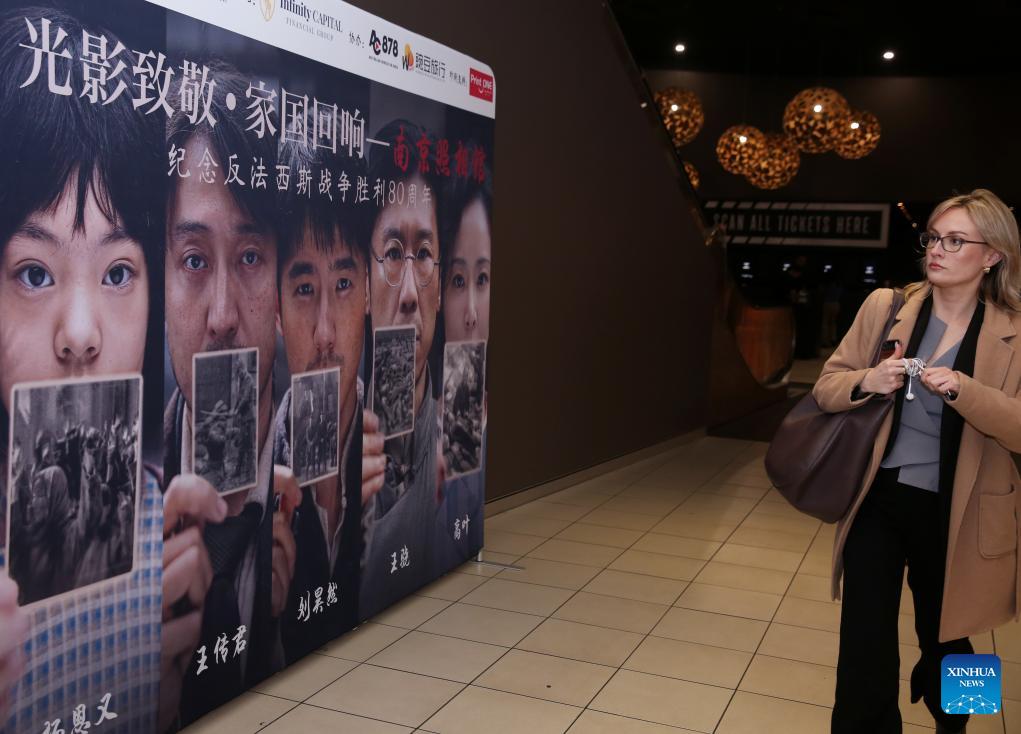
A woman looks at a promotional display for the film "Dead to Rights" at a cinema in Sydney, Australia, Aug. 8, 2025. The film, which depicts the Nanjing Massacre during World War II, was released in Australia on Aug. 7. (Xinhua/Ma Ping)
China will observe its 12th national memorial day for the victims of the Nanjing Massacre on Dec. 13, commemorating the day in 1937 when invading Japanese troops captured Nanjing — then the Chinese capital — and began six weeks of slaughter that claimed the lives of more than 300,000 Chinese civilians and unarmed soldiers.
Eight survivors have passed away since the beginning of 2025, reducing the number of living registered survivors to 24, according to the Memorial Hall of the Victims in Nanjing Massacre by Japanese Invaders in Nanjing, the capital of east China's Jiangsu Province.
This year commemorates the 80th anniversary of the victory in the Chinese People's War of Resistance Against Japanese Aggression and the World Anti-Fascist War. The only way to move on with hope for a peaceful future is to remember this tragic past.
In Beijing's Museum of the War of Chinese People's Resistance Against Japanese Aggression, visitors can see an original edition of The New York Times from Dec. 2, 1943, which prominently features the Cairo Declaration that was jointly released by China, the U.S., and the U.K.
The Cairo Declaration issued in 1943 stated clearly that all the territories Japan had stolen from China, such as Taiwan, should be restored to China, giving the Chinese people a solid promise that their territorial integrity would be maintained.
The Second Historical Archives of China in Nanjing houses a photo album that serves as tangible testimony of the cruelty of the Nanjing Massacre. This series of photographs, documenting the horrors perpetrated by the Japanese army, served as the foundation for the plot of the critically acclaimed Chinese film "Dead to Rights." The album captures the nation's painful memories in the most authentic way possible, bearing witness to the Chinese people's unbreakable spirit.
These two artifacts, one representing historical justice and the other marking national wounds, both convey the same message: remembering history is not about perpetuating hatred but about defending peace and justice. Only by fully comprehending the weight of the past can we work together to establish a peaceful, dignified and just future.
Historical album of Huadong Photo Studio: Frozen time and city memories
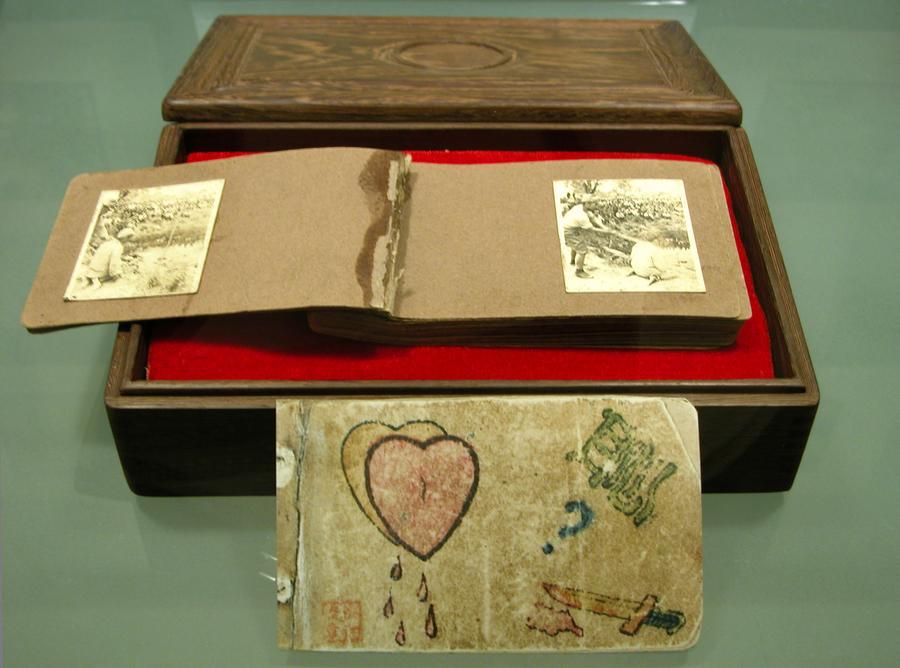
At Nanjing's Second Historical Archives of China, a photo album documenting crimes committed by the Japanese troops during the Nanjing Massacre is stored in a box. The movie "Dead to Rights" is based on the evidence of atrocities captured in this photo album. (Photo/Xinhua)
After breaking summer box office records and receiving favorable reactions from audiences around the world, "Dead to Rights" has raised awareness of a dark chapter in China's history and the fortitude of unsung heroes who stood up to fascism and brutality.
The film follows a group of Nanjing residents as they take shelter in a photo studio following the city's occupation by Japanese invaders. Forced to develop film for a Japanese military photographer, they discover photographic evidence of war crimes and risk their lives to smuggle the negatives out.
In Nanjing's Second Historical Archives of China, a photo album documenting crimes committed by the Japanese troops during the Nanjing Massacre is stored in a box. The movie "Dead to Rights" is based on the real-life proof of the massacre's atrocities captured in this album. By taking turns protecting it, two young Chinese custodians helped draw global attention to the crimes of the Japanese invaders and made sure that history was not forgotten.
Public records show that 15-year-old Luo Jin was an apprentice at Huadong Photo Studio when Japanese troops captured Nanjing.
One day in January 1938, a Japanese officer brought two film rolls to be developed. As the negatives were processed, Luo was shocked to see images of Japanese troops killing, raping and brutalizing Chinese civilians.
Outraged, he secretly made copies of over 30 photos, compiling 16 into an album to preserve evidence of these crimes.
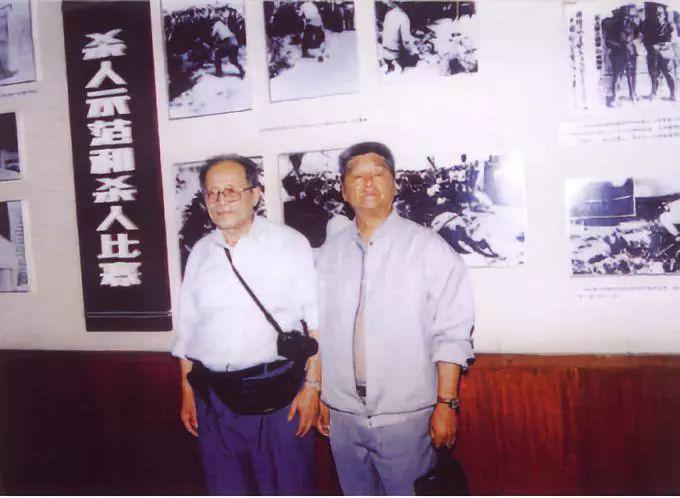
Luo Jin and Wu Xuan reunite in Nanjing in 1995. It was their first meeting in over half a century. (Photo/Xinhua)
In 1941, Luo lost the album while hiding it during a search by Japanese troops. Wu Xuan, who was attending the same training program with Luo at the time, found it but did not know who owned it. The Chinese character for "shame" on its cover convinced Wu that the owner shared his patriotic fury.
Wu guarded the album at great personal risk and turned it over to the authorities after Japan's defeat. The album ultimately became key evidence in the war crimes trial of Hisao Tani, a Class-B war criminal.
Luo and Wu reunited in Nanjing in 1995. It was their first meeting in over half a century.
Original New York Times coverage: A historical record and legal foundation
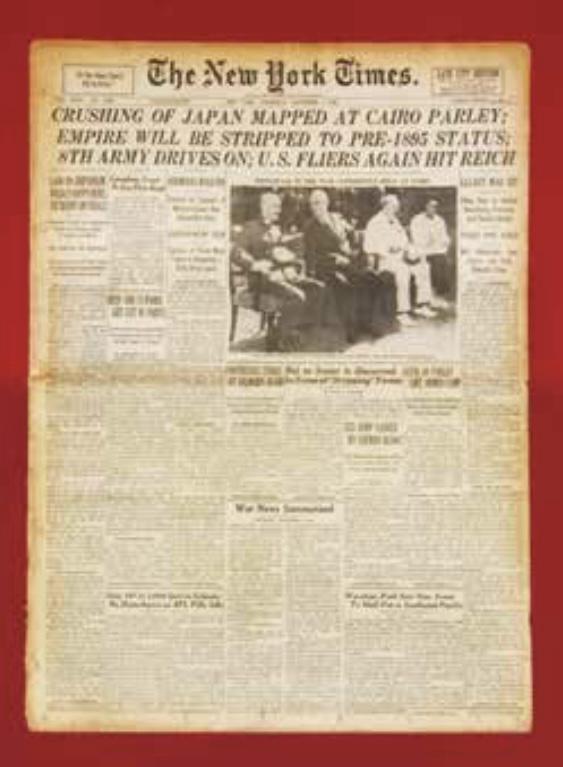
An original copy of the Dec. 2, 1943, edition of The New York Times, which includes the Cairo Declaration released jointly by China, Britain and the United States. The copy is now on display at the Museum of the War of Chinese People's Resistance Against Japanese Aggression, Beijing. (Photo/The Museum of the War of Chinese People's Resistance Against Japanese Aggression)
The Museum of the War of Chinese People's Resistance Against Japanese Aggression in Beijing houses a valuable newspaper: an original copy of the Dec. 2, 1943, edition of The New York Times, which includes the Cairo Declaration released jointly by China, Britain and the United States.
Released on Dec. 1, 1943, the Cairo Declaration affirmed that territories Japan had stolen from China, including Taiwan and the Penghu Islands, were to be restored to China after the war.
The declaration was reinforced two years later by the Potsdam Proclamation, issued by China, the United States and Britain and later endorsed by the Soviet Union. Japan accepted those terms when it signed the Instrument of Surrender in September 1945, pledging to fulfil the obligations laid out in the Potsdam terms.
Together, these documents formed the international legal basis for China's recovery of territories taken by Japan, and, more broadly, were seen as essential elements of the postwar order in the Asia-Pacific.
The publication of the Cairo Declaration provided a major boost to morale in China, and the world's most prominent newspapers and magazines covered the Cairo Conference extensively. The day after the declaration was announced, the New York Times' front page featured the Cairo Conference, with the headline in strong black letters: "CRUSHING OF JAPAN MAPPED AT CAIRO PARLEY; EMPIRE WILL BE STRIPPED TO PRE-1895 STATUS." On the second page, the newspaper published the full text of the Cairo Declaration.
The Cairo Declaration, a significant achievement of the conference, became one of the pillars of the postwar international order. It affirmed China's territorial sovereignty over Taiwan, establishing an international legal basis for China's postwar reclamation of Japanese-occupied territory.
Photos



Related Stories
- China memorial hall collects new evidence of Nanjing Massacre
- Feature: Families remember Nanjing Massacre victims as national memorial day approaches
- Number of registered Nanjing Massacre survivors falls to 25
- Chinese film on Nanjing Massacre resonates with audience in Tokyo
- Nanjing Massacre film "Dead To Rights" overwhelms Russian audience
- Chinese film on Nanjing Massacre screened in Britain
- Chinese film on Nanjing Massacre highlights history, peace message in Tanzania
Copyright © 2026 People's Daily Online. All Rights Reserved.
