



Chinese researchers dedicated to developing eco-friendly, socially impactful printing technology
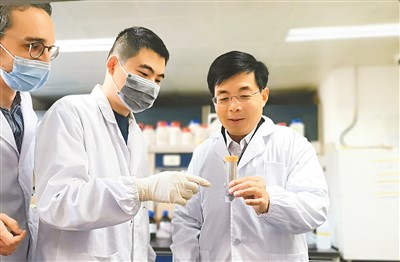
Song Yanlin (right) and his colleagues work in the lab. (Photo courtesy of the interviewee)
Song Yanlin, a researcher at the Institute of Chemistry of the Chinese Academy of Sciences (CAS), has led his team to pioneer an eco-friendly printing method that can make the world more beautiful through the power of printing.
The traditional printing industry faces pollution challenges. As Song explains, from the earliest woodblock printing to movable type printing, and then to modern digital printing techniques, the industry has relied heavily on environmentally harmful methods. For instance, laser phototypesetting causes the discharge of hazardous waste liquids and overconsumption of photosensitive supplies.
How can printing sustainability be improved? Song proposed a bold idea: printing oil-loving patterns on hydrophilic printing plates.
"The patterns can absorb ink, while the blank areas do not. This enables printing to be done directly," Song explained.
Song initiated this innovative concept based on his previous research on information storage.
"Information storage and display can be transformed into simple 0s and 1s. The inked areas are '1' and the blank areas are ‘0.' Next comes exploring what materials can physically realize this."
The way water droplets freely roll around on the surface of a lotus leaf, which has a micro-nano structure, inspired Song to explore nano-material coatings for printing.
"We relied on nano-materials to enhance the contrast between the plate's hydrophilicity and lipophilicity, and used nano-particle composites to enhance durability, directly printing graphic areas that absorb ink," Song said.
Initially, when Song's team proposed "nano-printing," it encountered skepticism. At that time, printing precision was still at the micrometer scale. Achieving nanometer-scale precision meant increasing it 1,000 times. To achieve this breakthrough, they must confront challenges from fundamental scientific issues, as Song frankly stated.
Through research on droplet-surface interactions and precise control, the team broke through the limitations of traditional ink droplet sizes. This enabled nanometer-scale precision of printed dots. They could even precisely control the number of nanoparticles in each ink droplet, printing patterns at the limits of perception.
Subsequently, Song's team resolved many fundamental scientific difficulties, advancing printing technology from the micrometer to nanometer scale.
This prompted researchers to consider an application to aid the blind. Song turned his focus to tactile Braille printing.
Traditional Braille production by metal plate stamping is cumbersome and costly. Braille text wears down easily. Braille books are expensive, costing 15 to 20 times more than mass-printed books, severely restricting blind children's access to literature and knowledge.
"With precise control over the formation of each ink droplet, we can manipulate every single droplet to form a micro-protruding structure that represents a basic Braille character," said Song.
Based on prior research results, Song's team transformed molded Braille into affordable and mass-printed Braille, greatly reducing costs.
The technique can also produce tactile graphics, not just literary texts. For instance, the team printed different tactile patterns on each side of a Rubik's Cube, enabling blind children to develop intelligence and imagination by playing with it.
In 2018, Song and his colleagues donated printed Braille books and teaching aids to a school for blind children in Beijing. In a group photo, a young blind student was seen happily holding a tactile Rubik's Cube, engrossed in playing with it. This heartwarming scene stuck with Song, which further motivated him.
"Scientists are not detached and science should uplift humanity," Song said. He believes scientists must maintain a humanistic orientation, using research to better the world for all.
Photos

Copyright © 2023 People's Daily Online. All Rights Reserved.
