
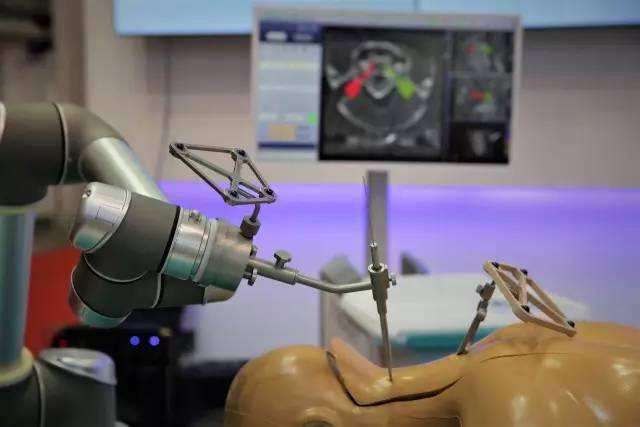
Imagine you are being put on an operating table only with a silent and chill-feeling robot surgeon by your side.
Will you be afraid? Will you trust the robot to operate surgery?
No matter how scared you may feel with those cold hands and arms inside your body, surgical robots (medical robots includes surgical and assistant robots) will embrace a stunning 30% growth by 2021, accounting for 60% of the total increase of medical robots which are expected to hit $20.7 billion, according to report from Research & Markets, world’s largest market research institute.
The data of growth skews in Asia, especially in China.
The atmosphere of congruency that pervaded on second international forum on innovation and development of medical robot on May 26 was practically palpable. Experts from the US, Switzerland and Japan consistently ratchet up the consent optimism towards China’s political and financial support of medical robots innovation.
Tianji, a China’s self-developed surgical robot, is said to be world’s only robot to help perform orthopedic surgeries. The robot is able to shorten 2/3 operation time in spine surgery, whose developer, TINAVI, a Beijing-based producer of the robot, becomes world’s second profitable company aside Intuitive Surgical, a US medical firm, who developed the world’s dominant da Vinci surgical system, Zhang Songgen, chairman of the company said at the forum.
Surgical reality and autonomy of surgical robots are two of the most significant aspect of human-robot interaction under the trending AI, AR and 5G technology, as surgeons pursue more acute medical treatment and smaller cut for patients, Stefan Weber, director of ARTORG center of biomedical engineering research noted at the forum.
In addition, establishment of a modern science and technology research method system for traditional Chinese medicine is a long-term trajectory. Digital devices has been applied on the objectification of pulse diagnosis of traditional Chinese medicine and the modernization of pulse detection.
Xima pulse monitor, a Shanghai-developed pulse diagnosis system, can constantly monitor human’s organ condition, pulse, and sleep via a wearable ring or a bracelet. The data is simultaneously processed to reflect the health condition on different platforms, such as mini-programs on WeChat, a popular Chinese social media platform and its self-developed app.
The combination of eastern and western medical science is of great importance to enhance technical research on medical robots and explore possibilities of human-robot interaction, said Masakatsu Fujie, tenured professor of Waseda University in his presentation on the forum.
Through detailed market categorization, production of medical robots is no longer shelved in college’s lab and floating in medical scientists’ minds. China’s sprint-like development of medical robots in the last 20 years was benefited from the continuous effort on systematic innovation and adaptable standardization in the medical robot industry.
The lab-to-operating-table venture that medical robots experienced witnessed the rapid growth of China’s commitment on providing better medical service for public, as China’s food and drug administration in 2017 began to encourage pharmaceutical medical device innovation. Moreover, information transparency is set to support the fundamental R&D projects in a bid to promote the medical market welfare in general.

 Chinese leaf carving gets international attention
 Glass bridge at Huaxi World Adventure Park in Jiangsu
 Performers dance to welcome the Beijing Horticultural Exhibition 2019
 Tourists visit ice cave in Luyashan scenic area, north China's Shanxi
 Two giant pandas at Taipei Zoo attract tourists
 World Taiji Day celebrated in Valletta, Malta
 Visitors see miniature capital at Beijing Expo 2019
 China-CEEC Culture & Art Carnival concludes in Beijing
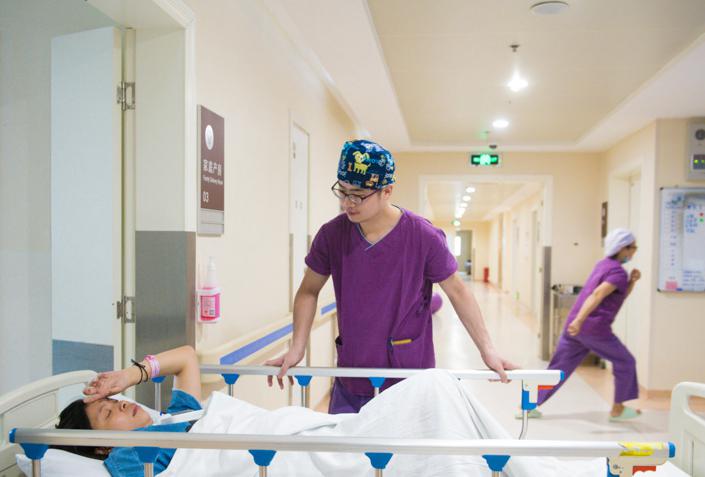 Male midwife delivers over 600 babies in SW China
 "Hainan is China's Hawaii" - An Australian boy in Hainan Province


