
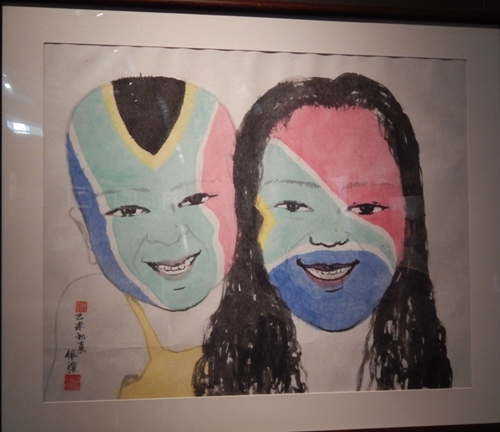
Xu Qiping is awell-established Chinese painter and arts teacher. Her paintings reflect skilful use of Chinese traditional brush strokes and ink techniques dating thousands of years.
In 2015, Xu was a resident artist and trainer at the University of Dar es Salaam’s Department of Fine and Performing Arts, where she taught art and interacted with African artists.
After her two months stay in Tanzania, Xu put her reflections on life in Africa on ink and paper, in a series of paintings recently showcased at the Museum of Women and Art in Beijing.
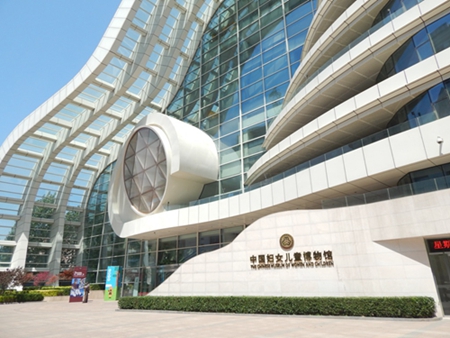
Chinese Museum of Women and Art in Beijing
Her paintings, featuring ornate shades and outlines of her subjects are as expressive as they are revealing. They depict emotion and interaction between African people and their environment.
The figures in her paintings reflect raw appeal and curious expressionism, rather than stone-faced, death-defying faces bereft of hope.
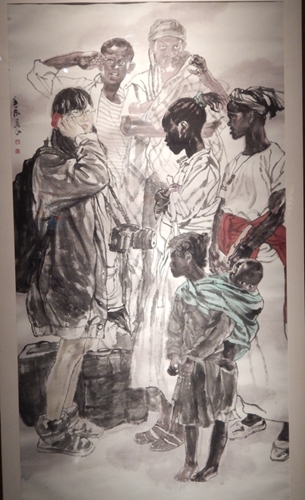
Hello Teacher, a painting by Xu Qiping
Hello, Teacher is perhaps her most vivid tale of her journey into Africa. A visiting Chinese teacher is trying to make contact on phone when she is met by an inquisitive African community.
What follows are curious stares, mild gestures and a child carrying a baby, all held up in one loosely-shaded painting with outlines that tell of an artist’s penchant for moderation and balance
Art meets art
Xu’s journey to Tanzania took her closer to the famous Tinga Tinga painting style developed in the 1960s, featuring radiant multi-colored images and subjects often humorously caricatured.
The painting style has been showcased across the world and remains one of the most popular attractions on Tanzania’s art scene, with thousands of artists now earning a living from the talent.
Xu recalls her Tanzanian art students being very enthusiastic about learning new concepts. “They are very talented were always eager to learn new techniques,” Xu said in an interview.
Her own works at the Beijing exhibition featured alongside her students’ paintings as well as masterpieces from established artists including Mustapha Abdallah and Mohamed Augustino.
Besides Xu, several other Chinese artists shared peek into Africa through paintings exhibited in a corner dubbed ‘Into Africa: Chinese Artists’ Impressions.
There were paintings by Liu Hongpei, Li Dingcheng, Yang Xiaoyang, Wang Lixing, Luo Fan and Lu Jia, described as pioneers of the ‘urban ink painting’ technique.
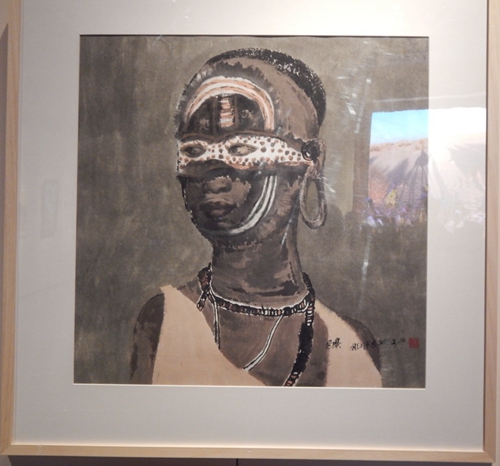
Masai Girl, a painting by Li Dingcheng
The relatively new form of painting grants poetic license to artists to explore the use of Chinese traditional brush and ink to depict foreign, contemporary scenes and objects.
The brush strokes in some of the exhibited paintings are vivid and thick, and art enthusiasts would describe them as candid, animated and quite forgiving.
Liu Hongpei’s painting ‘Indegenous Dance’ speaks of free-spirit and abandon for African women while Li Dingcheng’s ‘Masai Girl’ extols elegance and unique sense of style for the nomadic tribe.
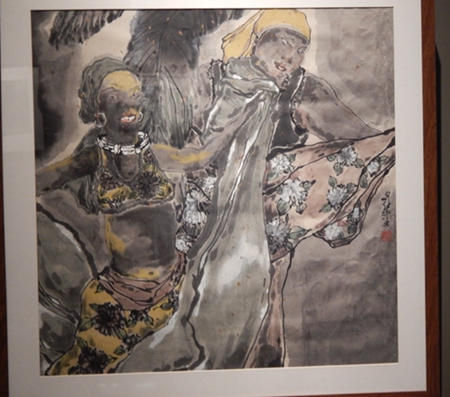
Indegenous Dance by Liu Hongpei
And then Mustapha Abdullah’s ‘Sumu’ painting about a wrestling contest between two primates, with all wildlife creatures as spectators, is no less than entertaining in its bright colour patterns.
Boosting ties through art
The exhibition of Chinese and African artists was part of the African Cultures in Focus, a program of the Chinese Ministry of Culture to promote cultural cooperation between China and Africa.
The unwritten theme of the exhibition would perhaps be ‘contact’ or ‘communication,’ in which a series of works by artists across space and time can speak to one another or to oneself.
People-to-people contact is an important element for China-Africa relations that have flourished rapidly in recent years across the diplomatic, trade and political space.
Cultural exchange is envisioned as one of the core areas of cooperation between and China under a new comprehensive strategic partnership meant to promote even stronger ties.
Cultural troupes from the two sides have grown in number and form, with regular performances, movie screenings and exhibitions between Chinese and African talents.
As stated by Ding Wei, vice minister of culture during the Beijing art exhibition, cultural exchanges can serve as an ‘effective bridge for communication’ among the two friends.
 World's fastest bullet train to start operating next month
 Huangluo: China's 'long hair village'
 Spectacular bridge with one of the tallest piers in the world
 Magnificent view of Hukou Waterfall
 A glimpse of Stride 2016 Zhurihe B military drill
 US Navy chief tours Liaoning aircraft carrier
 Chinese American woman wins Miss Michigan
 Centenarian couple takes first wedding photos
 Traditional Tibetan costumes presented during fashion show
 Top 10 livable Chinese cities
 Top 20 hottest women in the world in 2014
 Top 10 hardest languages to learn
 China’s Top 10 Unique Bridges, Highways and Roads
 Beijing International Book Fair trends show future directionof Chinese publishing
 Expats sharing their skills with locals gains popularity andcreates social ties
 Popular Q&A platform shuts down amid illegal infocrackdown
 Holiday from hardship
Day|Week


