
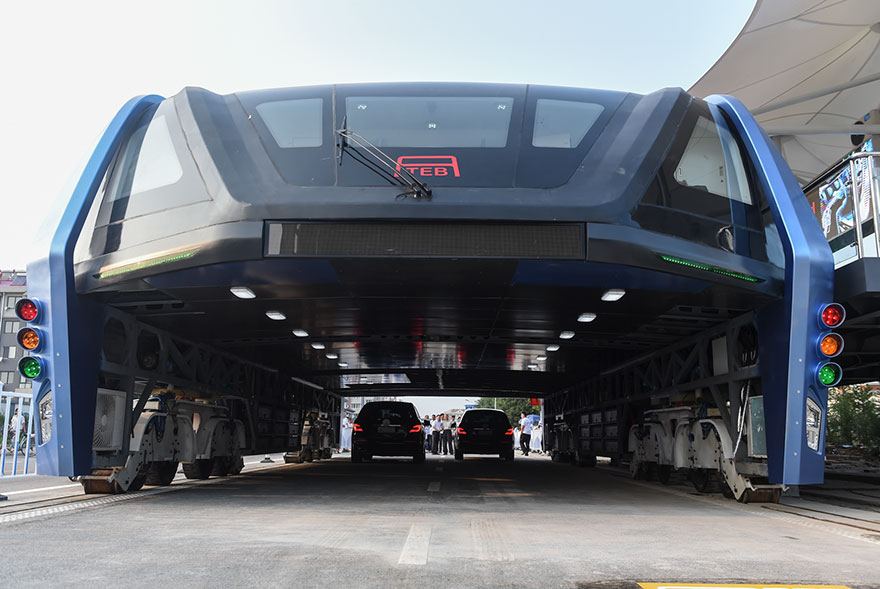
BEIJING, Aug. 8 -- The feasibility of China's straddling bus project is in doubt, with media outlets suggesting it was nothing more than a publicity stunt.
A spate of recent reports have questioned the technical feasibility, commercial prospect of the project, known as the Transit Elevated Bus (TEB), as well as its way of financing.
The TEB has been promoted as a way help ease traffic congestion. Its design features an elevated passenger compartment that straddles the road below, allowing vehicles to pass underneath.
A high-profiled test was conducted on Aug. 2 in Beidaihe District, Qinhuangdao City, in north China's Hebei Province, to evaluate the braking system, drag and power consumption of the bus.
According Beidaihe District Information Center, TEB Technology Co. Ltd., will solely manage investment and construction of the project, and was required to return the 300-meter section of road used for the test to its original state, according to a strategic cooperation agreement signed in April by the company and the city government.
The agreement will expire on Aug. 31, with the possibility of being extended should both parties agree, the center said in an email to Xinhua on Friday.
In Zhoukou City, central China's Henan Province, an agreement was inked by Zhoukou logistics and industrial zone and Huaying Group, the parent company of TEB Tech., on an R&D and production base at the zone. The first bus is expected to roll off the assembly line in 2017.
A ground-breaking ceremony was held here last month, but there has yet to be any sign of construction.
"Obviously the project is behind schedule. We are waiting for some approvals, such as the environment assessment, to be cleared before construction can proceed," said Du Guangxian, a Party official with the zone.
Cheng Shidong, a transport official with the National Development and Reform Commission said that TEB's commercial application faces hurdles because of its weight, height and maneuverability restrictions.
Cheng said there was a real danger that the bus could tip over because of its weight and high center of gravity, and, as the space underneath is only two meters high, many vehicles would actually be unable to drive under it.
"Most urban bridges are also not high enough for the elevated bus to pass under them," he said.
Bai Zhiming, who counts TEB Tech. among his investment interests, said the company has secured investment of 104.7 million yuan, including his own share of 40 million yuan, which should cover labor, vehicle manufacturing and road construction. By releasing private equities via an entrusted company, TEB Tech. offered investors 12 percent interest rates annually.
Li Hongji, a partner with Beijing Tongshang Law Firm, said the promise of 12 percent return is questionable and might be misleading, as TED is still being tested and far away from actual application.
 Spectacular bridge with one of the tallest piers in the world
 Magnificent view of Hukou Waterfall
 A glimpse of Stride 2016 Zhurihe B military drill
 US Navy chief tours Liaoning aircraft carrier
 Chinese American woman wins Miss Michigan
 Centenarian couple takes first wedding photos
 Traditional Tibetan costumes presented during fashion show
 How did ancient people escape the summer heat
 Breathtaking scenery of Hulun Buir grassland
 Top 10 livable Chinese cities
 Top 20 hottest women in the world in 2014
 Top 10 hardest languages to learn
 China’s Top 10 Unique Bridges, Highways and Roads
 Risk management key to peace at sea
  Wannabe actors in China's Hollywood
  Horton displays no goodwill in remarks over his rival
  China’s athletes in Brazil only dine on meals prepared by Chinese chefs
 Day|Week


