
An enormous black hole has been spotted in the sun - but do not fear, it doesn't spell the end of our solar system.
Instead the giant dark spot is a gap in the sun's corona - its scorching hot atmosphere.
Holes in the sun's atmosphere are a regular feature and Nasa's Solar Dynamics Observatory (SDO) has detected a particularly large one covering the northern hemisphere of our star.
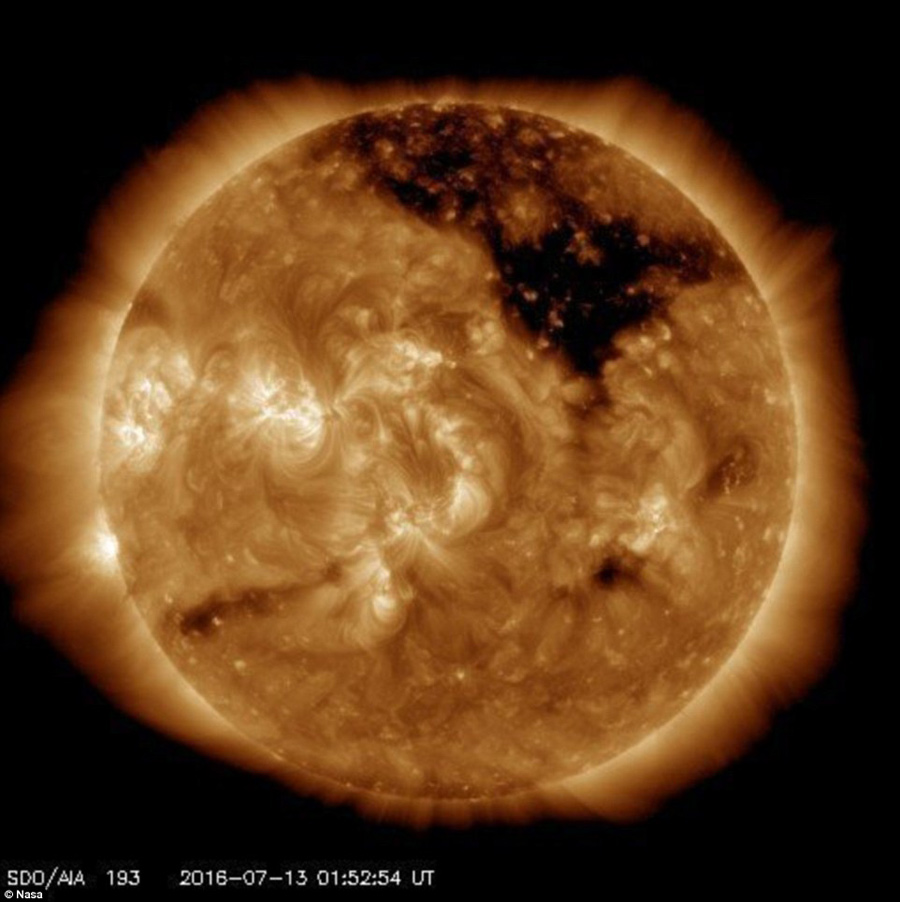
The giant dark spot is a gap in the sun's corona - its scorching hot atmosphere where the magnetic field reaches out into space rather than looping back down onto the surface. Here, the Sun is seen in extreme ultraviolet light. This highlights the atmosphere —the Sun’s corona. Hot, active regions are bright. The dark coronal hole is an area where very little radiation is being emitted.
The coronal hole was spotted using the orbiting telescope, which stares constantly at the sun to monitor its activity, earlier this month.
Coronal holes are regions of the corona - the aura of plasma surrounding the sun - where the magnetic field reaches out into space rather than looping back down onto the sun's surface.
This results in solar material speeding out in a high-speed stream of solar wind.
Footage captured by the Solar Dynamics Observatory shows parts of the corona where the particles leave the sun, causing the glow to be much dimmer, so the coronal hole looks dark.
These fast solar winds can interact with Earth's magnetic field, creating a geomagnetic storm - a type of energy which acts like a large battery around the planet and causes magnetic energy to vary.
Geomagnetic storms also cause the Northern Lights to appear.
This video was captured in extreme ultraviolet wavelengths of 193 angstroms – a type of light that is typically invisible to our eyes, but can here be seen as purple.
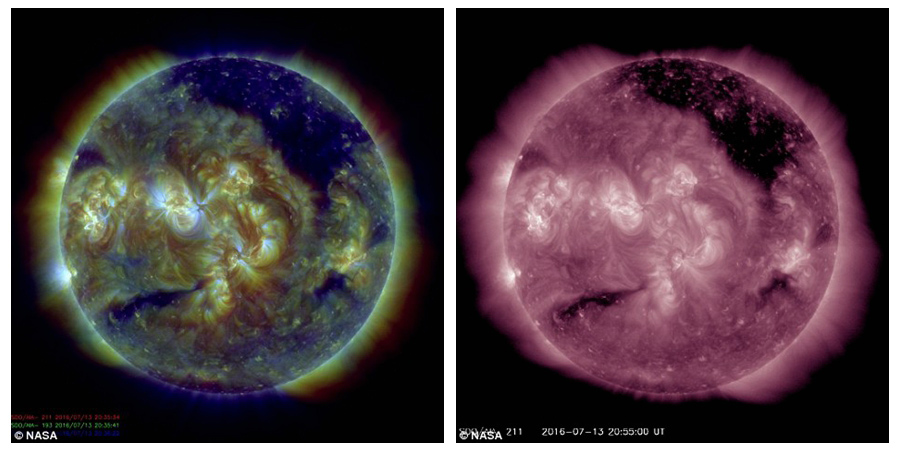
Nasa captures images in different wavelengths using the SDO. Left, Right, extreme ultraviolet wavelengths of 193 angstroms – a type of light that is typically invisible to our eyes, but can here be seen as purple.
The SDO is a spacecraft that was launched by Nasa in the hopes of understanding the causes of solar variability and its impacts on Earth.
The goal of the SDO is to determine how the Sun's magnetic field is generated and stored, and how this stored magnetic energy is converted and released.
It is hoped that results from the SDO could give us clues on how solar winds can affect communications or satellites near Earth.
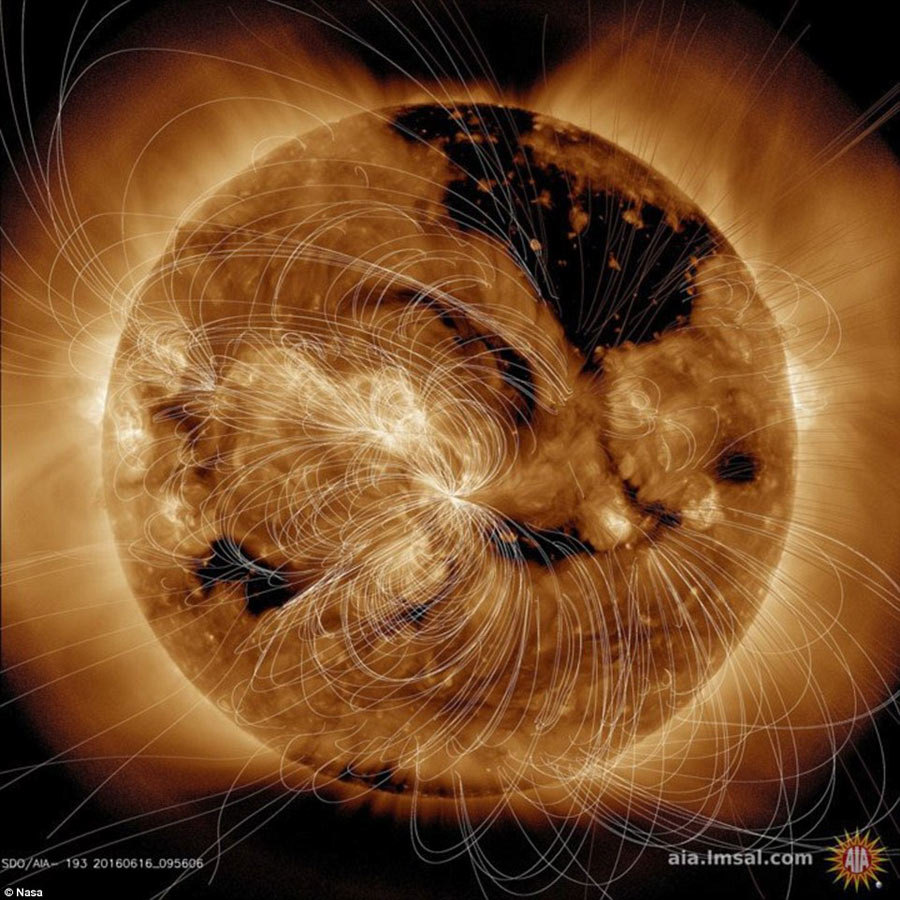
This view shows the magnetic fields on the sun's surface.
Day|Week

 Thai most beautiful transgender Nong Poy release new photos
 Top 10 livable Chinese cities
 The last primitive tribe in China
 China's first intelligent security robot debuts in Chongqing
 A Total of 3,552 Subscribers Vanish In Two Days; YouTube Closes All Doors to Users’ Inquiries
 Out of this world! Futuristic UFO-shaped yacht has its own garden and a stunning underwater viewing deck
 An old tea house in Chengdu
 Furious Customer Crushes All the Buns from Vendor Just Because He Was Given the Wrong Flavor
 20 post-90s couples hold ’naked marriage‘ in E. China
 Female official wearing traditional Han costume to promote local tourism


