
 |
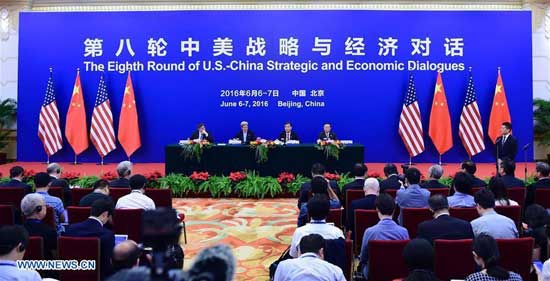
| The closing ceremony and press conference of the Eighth Round of China-U.S. Strategic and Economic Dialogues, in Beijing, capital of China, June 7, 2016. (Xinhua Photo) |
China and the United States concluded their annual high-level dialogue on Tuesday, demonstrating their mutual will for broadening cooperation and managing differences between the two nations.
The major economic achievements from the eighth China-U.S. Strategic and Economic Dialogues on Monday and Tuesday in Beijing include, among the other things, four main items, according to the official Weibo of the CCTV financial channel, quoting Vice-Minister of Finance Zhu Guangyao.
First is the exchange of the negative list of the Sino-U.S. bilateral investment treaty (BIT).
Second, China will grant the United States 250 billion yuan ($38 billion) under the country's Renminbi Qualified Foreign Institutional Investor (RQFII).
Third is boosting the economy and avoiding competitive devaluations.
Fourth, China will eliminate 100 to 150 million metric tons of steel capacity and strictly prohibit the expansion of crude steelmaking capacity over the next five years.
When asked about why China gave the U.S. such a high quota to invest in China's capital market through offshore yuan, Yi Gang, Deputy Governor of the People's Bank of China, said it is mainly out of consideration for the size of the U.S. market.
China has granted more than 10 countries and regions over 1 trillion yuan in RQFII quota; the quota is an important tool to promote the internationalization of the RMB. The U.S. received the second-largest quota of 250 billion yuan, coming only after Hong Kong (270 billion yuan), and before Singapore (100 billion yuan), London and Paris (both 80 billion yuan)
It is generally believed that the central bank's move is a prelude to supporting the establishment of an RMB trading center in the U.S. The U.S. Department of Treasury revealed before the dialogue that setting up an RMB trading center in the U.S. would be one of the key topics.
One big reason why the U.S. has frequently launched anti-dumping and anti-subsidiary investigations against China is that the country’s economic recovery “[did not go as] smoothly as expected, and its trade deficit is currently expanding rapidly, especially from last year to the first quarter of this year, which led to Obama's plan to double exports," explained Liu Yuanchun, Executive Dean of the National Academy of Development and Strategy under Renmin University.
 French girl ties the knot with Chinese boy
 Beijing Style: Hot pants
 Century-old station sees railyway evolution
 Enthusiasts perform Kung Fu at Wudang Mountain
 Students take stylish bikini graduations photos
 Charming dancing students pose for graduation photos
 China opens its first combined transport service to Nepal
 Naked models transformed into landscapes, birds and even DRAGONS by body painting artist
 China's first interactive robot looks like a beauty
 Top 20 hottest women in the world in 2014
 Top 10 hardest languages to learn
 10 Chinese female stars with most beautiful faces
 China’s Top 10 Unique Bridges, Highways and Roads
 Mainland market power sways Lancôme
 China encourages commercialization of museums
 Beijing parents protest against ‘favorable treatment’ of ethnic students in gaokao
  Young Chinese are finding a new way of paying tribute to their favorite stars charity
Day|Week


