
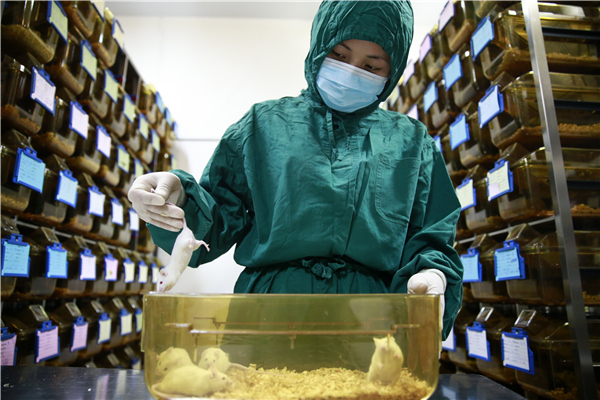
A researcher checks the conditions of rats used for laboratory tests at the National Institute of Biological Sciences in Beijing. [Photo/China Daily]
About 20 million laboratory animals, mainly mice, are used annually for testing in China, according to Yue Bingfei, director of the Laboratory Animal Monitoring Center at the National Institutes for Food and Drug Control.
Sun said that although China is a major producer and user of laboratory animals, there is hardly any legislation on their welfare, and no specific government department supervises animal welfare.
In one recent case, Xi'an Medical University in Shaanxi province suspended surgeries on animals in December after it was found that some dogs had been abused and their carcasses mishandled during research.
An anonymous microblog that posted photos of more than 10 dogs bleeding on the roof of a university building went viral, drawing criticism and concern.
Qin said the lack of welfare and ethics standards affects the health of laboratory animals, which in turn affects the results of scientific experiments and the quality of products.
She said it also leads to some Chinese academic achievements being rejected by leading international institutions and also prevents some Chinese products, such as cosmetics, from being sold in international markets.
Mark Prescott, head of research management and communications at independent scientific organization NC3Rs in the UK, said promoting animal welfare in China can help Chinese scientists to collaborate internationally. It will also benefit companies, as they can produce products safely and efficiently and market them better.
China is making progress in promoting the welfare of laboratory animals.
Lin Qingbin, an engineer at the Drug and Cosmetics Registration Management Department at the China Food and Drug Administration, said domestic producers, for example, have been allowed to market commonly used items, such as shampoos and perfumes, without animal testing since 2014.
But according to scientists, China is weak in the research of alternative methods to using laboratory animals, making the abandonment of animal testing impossible in the near future.
More than 300,000 people are employed in industries that use animals for testing.
 |
 Thai most beautiful transgender Nong Poy release new photos
 Now and then photos of Shanghai Jiaotong University
 Is this what air travel will look like in 2050?
 Aerial view of watermelon terraces in S China's Baise
 Traditional wedding of a post-80s Tibetan couple
 Models in cheongsams present classical oriental beauty
 Second commissioned C28A corvette made by China enters Algerian Navy
 Intoxicating Wuyuan in spring
 Gold and silver wares of Qing Dynasty exhibited in Shenyang Imperial Palace
 Top 20 hottest women in the world in 2014
 Top 10 hardest languages to learn
 10 Chinese female stars with most beautiful faces
 China’s Top 10 Unique Bridges, Highways and Roads
 Not a child’s play: Kids working as adults to make a living
 Chinese town on North Korean border faces bleak business prospects
 China set to boost access for US investors
 Premier mollifies fears over economy
Day|Week


