
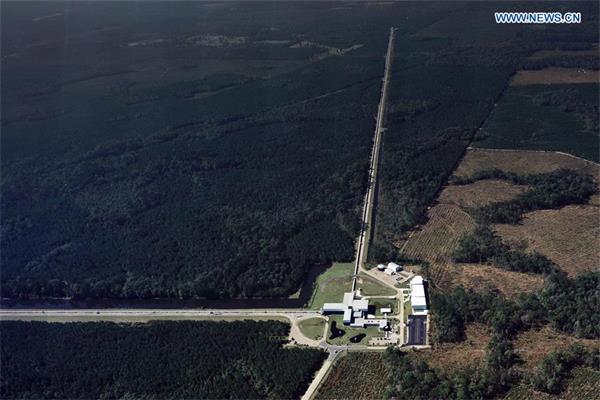
File photo shows the Laser Interferometer Gravitational-wave Observatory (LIGO) in Livingston, Louisiana, the United States. U.S. scientists said Thursday they have detected the existence of gravitational waves, which were predicted by Albert Einstein's theory of general relativity 100 years ago. (Xinhua/Caltech/MIT/LIGO Lab)
BEIJING -- The discovery of gravitational waves in the United States on Thursday by the Laser Interferometer Gravitational-wave Observatory (LIGO) has encouraged scientists around the world, with China set to accelerate research.
China's domestic gravitational wave research project "Tianqin," at Sun Yat-sen University has been awaiting government approval since July, according to Li Miao, dean of the University's institute of astronomy and space science in south China's Guangdong Province.
At an estimated cost of 15 billion yuan ($2.3 billion) Tianqin will be carried out in four stages over the next 15 to 20 years, ultimately launching three high-orbit satellites to detect the waves.
Chen Yanbei of LIGO, said Tianqin is different from the research by the U.S. ground-based observatory in that it will observe the waves from space.
"Tianqin is likely to collect better information, as a larger black hole may be detected from space than the one detected from the ground," said Chen.
Sun Yat-sen University is willing to cooperate with other institutions,and has plans for 15,000 square meters of observatory and laboratory on Fenghuang Mountain in Zhuhai City, Guangdong.
Another domestic gravitational wave project "Ali," named after the Chinese Academy of Sciences (CAS) observatory in Ali, Tibet, and led by the CAS institute of high energy physics, has totally different objectives -- detecting the first tremors of the Big Bang, primordial gravitational waves.
According to Zhang Xinmin of CAS, at high altitude and with good weather, Ali is regarded as the fourth best site on the globe to detect primordial waves.
"Ali will be much cheaper. The first phase will cost around 100 million yuan and results are expected in five years," he said.
China lags behind in gravitational wave research and the team is seeking international cooperation and foreign specialists, said Wang Yifang, head of the CAS high-energy physics institute.
 Have you ever taken these beautiful subways in China?
 Chinese beauties, foreign models meet in Chengdu
 Awesome! Aerial pictures taken on J-11 fighter
 A foreign girl explains what China should be proud of
 Chinese navy's air-cushioned landing craft in pictures
 Chinese pole dancing master opens class in Tianjin
 Splendid Sichuan after snow
 College girl of Vancouver crowned Miss Chinese Int'l 2016
 Pentagonal Mart becomes the largest vacant building in Shanghai
 Top 20 hottest women in the world in 2014
 Top 10 hardest languages to learn
 10 Chinese female stars with most beautiful faces
 China’s Top 10 Unique Bridges, Highways and Roads
 I heart you!
 Real kung fu pandas
 Young Chinese feeling trapped by pressure to marry
 Monks rebuff allegations that religion is under tighter control
Day|Week


