Tue,Aug 5,2014
 The 4th Chinese National Pole Dance Championship held in Tianjin
 Chinese navy commandos debut at 2014 RIMPAC
 Guangxi impression: scenic countryside
 World's largest aquatic insect found in Sichuan
 Ceremony volunteers for Youth Olympics make public appearance
 A glimpse of female crew of Liaoning aircraft carrier
 Stills from "Dad, where are we going?"
 Legless man's happy life
 Top ten most beautiful islands in China
 Aerial view of Hong Kong
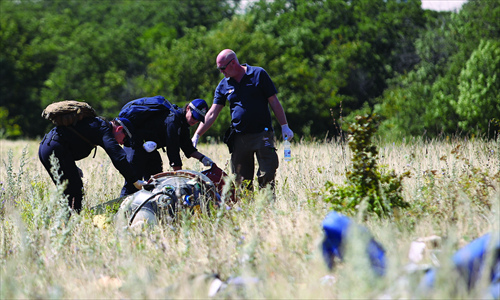 |
| Police officers from a joint Dutch-Australian search and recovery mission examine debris from MH17 at the plane’s main crash site in eastern Ukraine on Friday, in an effort to recover remains of victims. (Photo: Cui Meng/GT) |
The decision by the US and the EU to launch a further series of sanctions against Russia in the aftermath of the MH17 incident has dramatically escalated this conflict in both real and rhetorical terms.
Russia has warned that these sanctions will backfire, while US and European politicians have taken to referring to Russia and its leadership in terms not heard of since the Cold War.
Indeed, it is difficult to recall any other case where a sitting head of a major state was called "thuggish, dishonest and reckless," as the British ambassador to Washington named President Vladimir Putin.
Unless there are dramatic policy changes on all sides, it is likely that this conflict will continue to escalate.
The world is waiting to see whether US and European sanctions will choke off Russian support to Ukrainian rebels. Unfortunately for those hoping for sanctions' success, relying on sanctions as a tool of persuasion, especially when confronting a nation that is acting in what it sees as its own vital interests, has a very mixed record of success.
The first factor to consider is that, while these sanctions will hurt Russia's economy, Russia is far too large to be economically isolated in the same way Iran has been.
In addition, Russia has a number of ways to hit back against the US and the EU. The countermeasures could range from seizing foreign assets in Russia to refusing to provide natural gas supplies to Europe.
For an EU that is only just starting to recover from its economic tribulations, the risk of a sanctions-fueled recession is a serious one.
More importantly, at the very moment when the US government is sanctioning parts of the Russian economy, it is also dependent on Russia's support in numerous other areas.
For example, Russia's cooperation will be vital in continuing to maintain pressure on Iran in order to secure a long-term nuclear agreement. A hostile Russia could also challenge US and European interests in Syria and Iraq.
It is unwise to assume that Putin will continue to avoid using these tools in the face of severe economic damage to his nation's economy.
The second question is whether or not such sanctions will lead to a popular backlash against Putin. So far, it appears that this has not been the case, with Putin retaining the support of the great majority of the Russian people.
Moreover, history seems to indicate that the most common domestic response to sanctions is for the people to rally around their national leadership. This is especially true given the way the Putin administration has focused on developing a narrative of an aggressive NATO seeking to expand eastward.
Both Putin and the majority of Russians see the successful resolution of the Ukrainian situation as vital to Russia's long-term security.
For Putin, this is a case of attempting to avoid further Western encroachment into a traditionally Russian sphere. This is especially true when one considers the vital role Ukraine played in WWII. The specter of Ukraine joining NATO is one that many Russians find completely unacceptable.
In this case, the pain of the sanctions will have to be measured against what Putin sees as a long-term and existential threat to Russia's interests in Eastern Europe.
Unfortunately, the decision to enhance the sanctions facing Russia has placed all parties in something of a bind.
US President Barack Obama and his fellow leaders in the EU cannot relax the sanctions without being able to claim victory in this matter.
For his part, Putin cannot be seen to have surrendered Russia's vital interests in the face of these sanctions. The worst-case scenario could see an ever more vicious cycle of economic and political sanctions being unleashed by all parties, as they attempt to advance their respective national priorities.
In this case, the path of increased sanctions will merely lead to a hardening of positions on all sides, with little chance of actually resolving this unfortunate situation.
Ultimately, these sanctions will make it far more difficult for the various involved parties to undertake the meaningful negotiations needed to end the Ukrainian crisis.
 Blockbuster? No, it’s firefighters’ posters
 Special 'gifts' for IT men for Chinese Qixi Festival
 Foreign students' colorful life in China
 French photographer‘s work 'China 2050' goes viral online
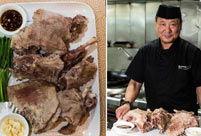 A bite of Halal Food
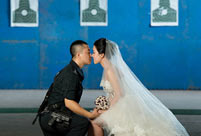 Dressed in uniforms to marry you
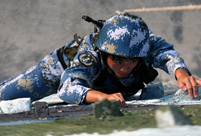 Female soldier in Chinese special force
 Zhujiang ambassadors attend lotus lanterns activity
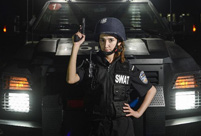 From girly girl to tough special police officer
 22-year-old veteran travels around China
 Night scenery of pagoda forests
 China suffers from hot summer
 48 hours after super Typhoon Rammasun
 German pianist plays mid-air ‘magic carpet’ show over Munich Airport
 China's manned deep-sea submersible conducts dive in Pacific Ocean
Day|Week|Month