



Commentary: For APEC, the answer lies in action
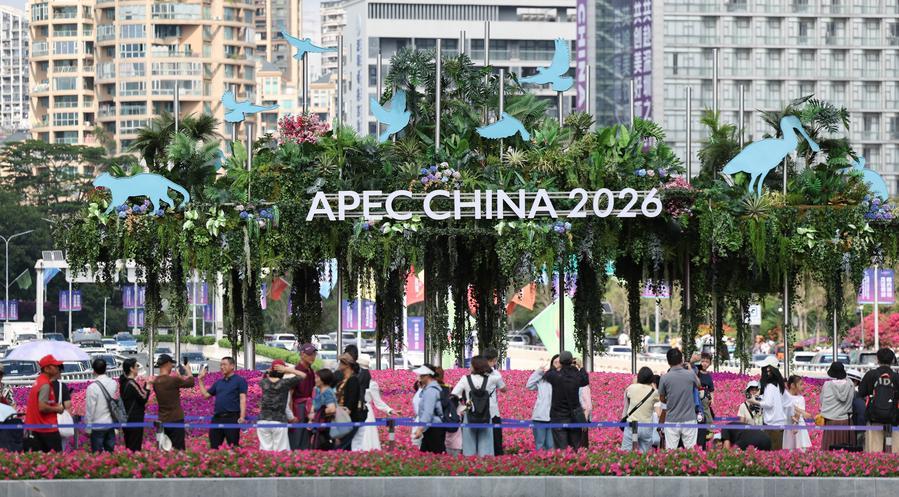
An APEC-themed installation is seen on Xiangmihu road in Shenzhen, south China's Guangdong Province, Nov. 15, 2026. The 33rd Asia-Pacific Economic Cooperation (APEC) Economic Leaders' Meeting will be held in Shenzhen from Nov. 18 to 19. The city has been adorned with flowers and lush greenery, with APEC elements integrated into the cityscape. (Xinhua/Deng Hua)
SHENZHEN, Nov. 17 (Xinhua) -- Twelve years after last hosting APEC, China is once again taking the helm, with a clear mission to turn the long-standing vision of an Asia-Pacific community into concrete action.
That mission has become more pressing as geopolitical tensions mount, protectionism surges, and global economic cooperation faces growing headwinds. Against this backdrop, the 33rd APEC Economic Leaders' Meeting, scheduled for Nov. 18-19 in the southern Chinese city of Shenzhen, will bring together the 21 member economies to address common challenges, deepen regional cooperation and chart a path toward prospering together. It offers an opportunity to inject much-needed certainty and confidence into the global economy.
For decades, the Asia-Pacific has been one of the world's most dynamic engines of growth, fueled by expanding trade, investment, industrial cooperation and cross-border connectivity. Today, the 21 APEC member economies are home to about 40 percent of the world's population, and account for more than 60 percent of global GDP and nearly half of global trade, underscoring the region's central role in the global economy.
The deeper the economic ties, the greater the need for cooperation and a shared vision for the future. APEC has consistently championed the vision of an Asia-Pacific community, recognizing that the region's future lies in openness, integration and mutual benefit.
But the foundations of this prosperity are now under strain. Unilateralism, trade barriers and attempts to fragment industrial and supply chains are threatening to reverse the trend of economic integration. In an interconnected global economy, decoupling and confrontation will only drive up costs, erode confidence and constrain opportunities.
This makes the vision of an Asia-Pacific community more relevant than ever. But a shared vision, however compelling, cannot sustain itself on rhetoric. For decades, the goal of building an Asia-Pacific community has been reiterated time and again, yet translating it into action remains a formidable task.
Against this backdrop, three priorities for the 2026 APEC "China Year" -- openness, innovation and cooperation -- speak directly to the challenges facing the Asia-Pacific. These are not slogans but imperatives for sustaining growth in the region.
Openness is the lifeblood of Asia-Pacific prosperity. More than three decades ago, APEC was born amid a new wave of economic globalization. Since its inception, the group has championed the liberalization and facilitation of trade and investment, helping transform the Asia-Pacific into one of the world's major engines of economic growth.
By opening markets, removing barriers, aligning rules and building platforms for cooperation, China has become the largest trading partner of 13 APEC economies. Eight APEC members are among China's top 10 trading partners, while China contributes more than 60 percent of the region's economic growth.
Innovation is the driving force behind Asia-Pacific prosperity. AI and the digital economy have been among the most widely discussed topics at events throughout China's APEC host year. The fruits of technological innovation, however, should be shared, not walled off or monopolized for the benefit of a select few. China has consistently taken concrete steps to ensure that the benefits of innovation deliver tangible results throughout the region.
Cooperation is the bedrock of Asia-Pacific prosperity. APEC economies differ in their resource endowments and level of development, but by turning these differences into complementary strengths and shared opportunities, APEC can help developing economies build capacity for sustainable growth and ensure that no economy is left behind.
The real test of the Shenzhen meeting will be whether the vision of an Asia-Pacific community translates into real action, from shaping non-binding rules and standards to advancing the Free Trade Area of the Asia-Pacific, strengthening supply chain connectivity, and bridging the digital divide.
Turning vision into reality requires sustained efforts from every APEC member. Over the past year, China has turned this shared vision into initiatives open to all economies. More than 300 meetings and activities, including senior officials' meetings and ministerial meetings, have been held across the country. These events covered issues ranging from the digital economy and green transition to supply chain resilience and the development of small and medium-sized enterprises.
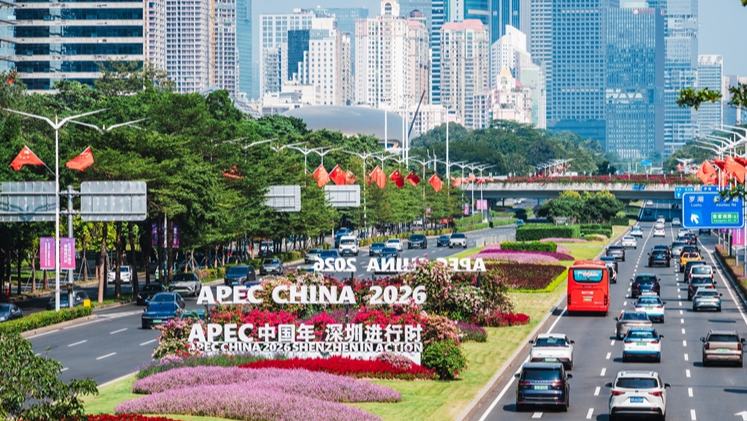
Shenzhen is a fitting venue for such a grand gathering. Once a small fishing village, it has grown into a global powerhouse in technology and advanced manufacturing, standing at the forefront of the Guangdong-Hong Kong-Macao Greater Bay Area. The city's trade with other APEC economies has grown more than tenfold in nearly three decades, surging from 267.5 billion yuan (about 40 billion U.S. dollars) in 1996 to 3.13 trillion yuan in 2025. With its GDP nearing 4 trillion yuan, Shenzhen is poised to become the third Chinese city to cross that threshold.
Shenzhen's journey -- from embracing the international division of labor in the early days of reform and opening up, to becoming deeply integrated into global industrial and supply chains today -- is also testament to the Asia-Pacific's growth through exchanges, mutual learning and win-win cooperation. The transformation offers compelling evidence of how openness, innovation and cooperation can unlock tremendous potential.
Amid deepening geopolitical rivalries and growing global divisions, China's third hosting of the APEC Economic Leaders' Meeting, 35 years after joining the organization, sends a clear signal that great-power competition need not be a zero-sum game, and that one country's development need not come at the expense of another.
Over the past three decades, APEC has served as a "regulator" of international relations, a "stabilizer" of the regional economic order and an "incubator" of new approaches to economic governance. One of APEC's greatest strengths is its ability to bridge differences and build consensus on thorny issues through dialogue and consultation.
The Asia-Pacific region's experience demonstrates that integration and cooperation can generate opportunities far beyond what individual economies can achieve on their own. That experience should not be discarded at a time when the world needs it most.
The more turbulent the waves, the greater the need for economies to row together. One meeting may not resolve all differences, but it can help build new consensus and set direction for future cooperation.
As China enters its 15th Five-Year Plan period (2026-2030), its commitment to high-standard opening up carries far-reaching implications for the region. With APEC leaders gathering in Shenzhen, the world expects not just a shared vision, but also feasible measures that will be taken by all, benefit everyone, and ultimately stand the test of time.
Photos



Related Stories
- Vietnam's top leader arrives in Shenzhen for APEC meeting
- Commentary: As barriers rise, the Asia-Pacific must open wider
- Emerging technologies showcased at media center of APEC Economic Leaders' Meeting
- Papua New Guinean PM arrives in Shenzhen for APEC meeting
- China, other APEC economies reach nearly 50 practical economic, trade outcomes this year
Copyright © 2026 People's Daily Online. All Rights Reserved.
