The metamorphosis of Snow Town: How ice and snow lifted the black soil's 'prosperity scorecard'
Editor's Note:
Ice-and-snow tourism is activating local resources. Ethnic cultures are stepping out from the mountains. Ecological governance is renewing the land.
Follow Xi, a video column produced by People's Daily Online, has launched the documentary series "China's Answer to Global Poverty Reduction", chronicling China's efforts to reduce poverty through development — tailored, in each place, to local conditions. The transformation of ordinary people's lives is the most convincing proof. China's exploration also offers lessons for global poverty reduction.
The Shuangfeng Forest Farm in Mudanjiang City, northeast China's Heilongjiang Province, is known for its heavy snowfall, with the snow season lasting up to seven months and snow accumulation reaching a depth of 2 meters.
Zhang Wei was once an ordinary worker at the Shuangfeng Forest Farm. In the past, snow reached his waist, and he had to use both hands and feet to make his way along forest trails — this was his daily winter routine. At that time, the severe cold and deep snow were a burden, yet they also marked the most humble years of labor for workers in northeast China's forestry regions.
In the 1980s, the unique snowscapes of Shuangfeng Forest Farm were captured in photographs, and the name "Snow Town" began to spread beyond the region.
In 2014, commercial logging was halted to protect the ecosystem. Forestry workers who had relied on logging faced the challenge of transforming their livelihoods. Zhang transitioned from a forestry worker to a staff member at the Snow Town, participating in ice and snow sculpture construction, parade floats and scenic area safety management, turning the region's ice and snow resources into a new driver of eco-tourism. His hands sculpted ice and snow, but they also carved a new chapter in his own life.
Former forestry tractor operators, chainsaw operators and timber transport drivers have all found new roles in the ice and snow industry: Some opened family guesthouses, others drive sightseeing vehicles. The ice and snow economy has become a new engine for local prosperity.
Today, Snow Town hosts more than 200 businesses, receives more than 800,000 visitors each winter, provides employment for more than 1,000 former forestry workers and has more than 5,500 people employed in the scenic area. Ice and snow not only illuminate the integration of culture and tourism but also drive industrial upgrading, serving as a key pillar for rural revitalization in northeast China.
As Chinese President Xi Jinping has said, "Ice and snow have become valuable assets for people to get rich and for rural revitalization." The transformation of Snow Town is a vivid example of China's green poverty alleviation in practice: leveraging natural resources, prioritizing ecological protection and converting scenic beauty into improved livelihoods. This experience benefits local communities and demonstrates to the world China's approach to combining green development, rural revitalization and poverty alleviation.
The harsh cold and heavy snow have become valuable assets for economic growth. With sweat and ingenuity, Zhang and his colleagues have turned the forest's "wooden bowl" into a "treasure basin," enabling the black soil to gather strength in the ice and snow, welcoming a spring full of hope and writing a global chapter in China's poverty alleviation story.
(Web editor: Peng Yukai, Wu Chengliang)




 Redeveloped port opens for easier cross-border travel between China's Shenzhen, Hong Kong
 Xi'an-Ankang high-speed railway boosts tourism in Ankang, China's Shaanxi
 Tourists enjoy sunrise at Mount Tai in China's Shandong
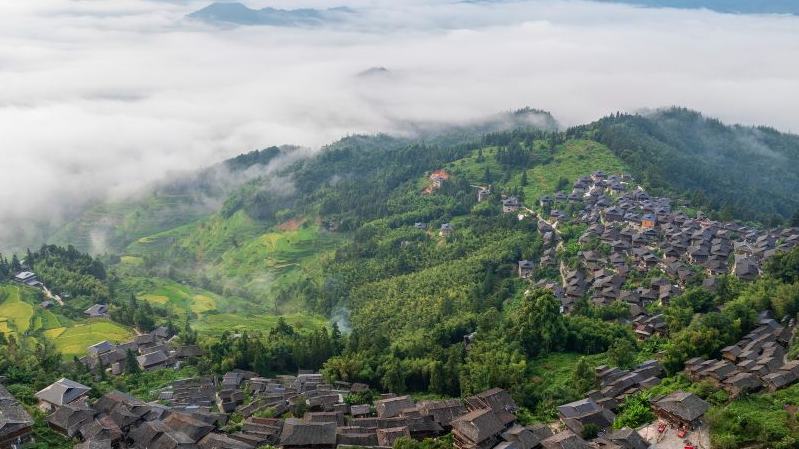 Basha Village in China's Guizhou draws tourists with charming scenery and folk customs