



Golden monkeys thrive in Shennongjia
Deep in the forests of Shennongjia Forestry District, central China's Hubei Province, a group of golden monkeys leaps down from the treetops at the researchers' call, takes peanuts from their hands and sits down to eat.
Shennongjia golden monkeys are found only in Shennongjia Forestry District and the surrounding area. Unlike other golden monkey populations, they do not migrate north or south, said Yao Hui, deputy director of the Science Research Institute of Shennongjia National Park.

Two golden monkeys rest in Shennongjia Forestry District, central China's Hubei Province. (Photo courtesy of the integrated media center of Shennongjia Forestry District)
Since a survey team collected just two specimens in 1978, decades of conservation work have helped the Shennongjia golden monkey population grow steadily. It now numbers 11 groups and 1,618 individuals across 401 square kilometers of habitat — six more groups, 1,117 more monkeys and 237 more square kilometers than in 1990.
Researchers once struggled to spot the monkeys at all, catching only glimpses of footprints, fur and gnawed bark. That began to change in 1995, when Yang Jingyuan, now the research institute's director, rescued an injured monkey and named it "Yangyang" — the start of closer contact between researchers and the species.
As roads cut through the mountains, they fragmented the monkeys' habitat. Shy and wary, Shennongjia golden monkeys travel through the treetops and treat roads as barriers, Yao said, warning that isolation raises the risks of inbreeding and food shortages.
To reconnect the groups, park staff built elevated corridors at key crossing points and planted trees the monkeys favor along roadsides, creating natural canopy bridges.
In 2017, Shennongjia National Park's management bureau formed an alliance with nine neighboring nature reserves across three provincial-level regions, sharing data, conducting joint patrols and coordinating law enforcement.
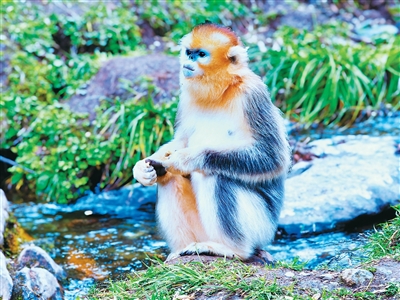
A golden monkey feeds at the Dalongtan Golden Monkey Field Research Base in Shennongjia Forestry District, central China's Hubei Province. (People's Daily Overseas Edition/Wu Jun)
Shennongjia Forestry District has since built 35 wildlife corridors and restored more than 2,000 hectares of degraded habitat. Neighboring districts and counties have added 25 more, linking once-isolated patches into a single ecological network.
Conservation efforts extend beyond habitat restoration. At the Dalongtan Golden Monkey Field Research Base, a zero-carbon microgrid powered by solar roof tiles — built by State Grid Shennongjia Power Supply Company in late 2024 — replaced wood-burning heaters that once released smoke harmful to the surrounding habitat. The system meets more than 90 percent of the base's power needs and cuts carbon emissions by an estimated 29 tonnes a year, said Wang Mingtao, an employee of the company.
Local governments have also moved to protect farmers' livelihoods. Since 2018, Shennongjia Forestry District has funded commercial insurance covering wildlife damage to crops, paying out nearly 16 million yuan (about $2.4 million) to roughly 3,000 households, according to Yao.
Institutional reform has kept pace. Feng Wei, deputy director at the park's management bureau, said four agencies and 11 types of protected areas have been consolidated under a single management system.

Photo shows the picturesque Dajiuhu Wetland in Shennongjia Forestry District, central China's Hubei Province. (Photo/Xu Zheng)
Technology has also transformed wildlife monitoring, including the tracking of golden monkeys. A smart species recognition system now processes hundreds of thousands of camera-trap images and videos, flagging the ones containing animals and improving monitoring efficiency by more than 100 times. According to Yao, it can also distinguish adults from juveniles and assess their health with over 90 percent accuracy.
Using the system, researchers have gathered more than 640,000 photos and videos of Shennongjia golden monkeys and identified 118 species, solving the misidentification and data-quality problems that plagued traditional monitoring.
Researchers can now assess the monkeys' genetic diversity without disturbing them, using DNA from fecal samples. That work has let them map the population and reconstruct family relationships across the groups.
This year, 11 golden monkeys were born at the Dalongtan base. "Each new birth is the best reward for our conservation work," Yao said, describing Shennongjia's approach as a model for endangered-species conservation worldwide.
Photos
 Redeveloped port opens for easier cross-border travel between China's Shenzhen, Hong Kong
 Xi'an-Ankang high-speed railway boosts tourism in Ankang, China's Shaanxi
 Tourists enjoy sunrise at Mount Tai in China's Shandong
 Basha Village in China's Guizhou draws tourists with charming scenery and folk customs
Related Stories
- Sika deer pictured at nature reserve in Qiqihar, China's Heilongjiang
- Learning to survive: How China's wildlife caretakers prepare young animals for the wild
- Male Lady Amherst's pheasant tries to woo a female, gets ignored
- Moose spotted at Nanweng River National Nature Reserve in NE China's Heilongjiang
- A glimpse of sika deer in Heilongjiang's nature reserve
- Wild Asian elephant population in China rises to nearly 400
- In pics: red-crowned cranes at Red-crowned Crane Wetland Ecological Tourism Zone in E China
- Wild Siberian tiger, leopard populations see significant growth in China
- Population of milu deer exceeds 8,800 in Dafeng Milu National Nature Reserve
- In China's wild elephant sanctuary, coexistence becomes a way of life
Copyright © 2026 People's Daily Online. All Rights Reserved.
