



Homegrown Huaxi cattle breed scores strong performance in China
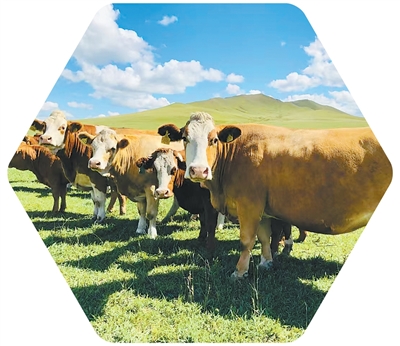
Photo shows a Huaxi cattle breeding herd on the Ulgai Grassland in Xilingol League, north China's Inner Mongolia Autonomous Region. (Photo courtesy of the Institute of Animal Sciences under the Chinese Academy of Agricultural Sciences)
"Going once, twice, sold for 480,000 yuan (about $71,530)!" At a recent national breeding bull auction in the Ulgai Management Area of Xilingol League in north China's Inner Mongolia Autonomous Region, two Huaxi breeding bulls fetched the top bid of 480,000 yuan each, beating out Angus, Simmental and other prized breeds -- the fourth straight year that Huaxi breeding bulls have topped the sale.
Developed over decades by the Chinese Academy of Agricultural Sciences (CAAS), Huaxi cattle are China's first homegrown specialized beef breed. Its appeal lies in their performance: an adult bull weighs about 900 kilograms, gains 1.52 kilograms a day during fattening, and has a 61.3 percent slaughter rate. Huaxi cattle lead the world in key production performance indicators.
"The breeding goals we set more than two decades ago are steadily being realized," said Li Junya, deputy head of the Institute of Animal Sciences (IAS) under the CAAS and chief scientist of the National Beef Cattle and Yak Industry Technology System.
For most of its history, cattle in China were raised mainly as working cattle. As the industry shifted toward beef production, China relied heavily on crossbreeding with imported stock. Simmental crossbreds once made up 65 percent of the country's beef cattle. Yet productivity gains stalled: in 2011, the average carcass weight of Chinese beef cattle was just 257 kilograms, compared with more than 380 kilograms in developed countries.
Breaking the deadlock required achieving full domestic control over beef cattle breeding stock. Between 2002 and 2003, Li and his team searched for cattle populations suitable for developing a new beef cattle breed, eventually settling on the Ulgai Grassland, where local breeding efforts dated back to 1978. In 1993, high-quality genetic resources such as beef-type Simmental cattle were introduced, and systematic germplasm innovation helped build a breeding population with strong genetic potential.
After 2003, Li led the IAS' beef cattle team to take over the effort, assembling a core Huaxi cattle breeding population in Ulgai. "Beef cattle have a low reproductive efficiency, with each generation taking three to five years," Li said.
To improve breeding efficiency, the team combined conventional breeding with genomic selection technology, building China's first genomic selection reference population for Huaxi cattle.
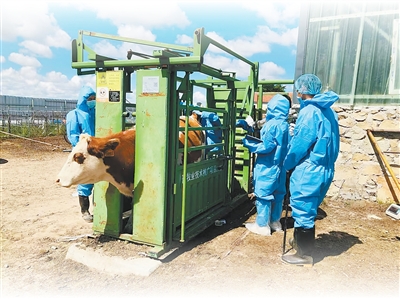
Researchers measure body-type traits of Huaxi cattle. (Photo courtesy of the Institute of Animal Sciences under the Chinese Academy of Agricultural Sciences)
After four generations of selection, Huaxi cattle received national approval as a new breed in December 2021, resolving China's long-standing bottleneck in securing core genetic resources for high-quality beef cattle and capping a 43-year effort spanning several generations of scientists.
Breeding Huaxi cattle was only the first step. The bigger challenge lay in promoting the breed widely while maintaining its quality. Other domestically bred cattle varieties had struggled to scale up due to small breeding populations, limiting their reach to local markets.
Li's team concluded that broad industry collaboration was needed to build a breeding population large enough for reliable genomic evaluation.
In 2015, the team launched progeny testing at 14 bull stations. In 2017, the team began working on a nationwide joint breeding program, and later teamed up with more than 40 breeding companies across the country to launch the federation of Huaxi cattle breeding.
The federation coordinates breed registration, performance testing, selection and mating, genetic evaluation, and breeding bull marketing, said Gao Huijiang, a member of Li's team and secretary general of the federation.
To date, 31,600 Huaxi cattle have been bred across 14 Chinese provincial-level regions. Frozen semen from the Huaxi breed has captured a 25 percent domestic market share, and the breed has been used to improve more than 7 million cattle nationwide. Huaxi cattle were exported for the first time to Laos.
After years of concerted research, Li's team developed Cattle110K, a whole-genome breeding chip containing 110,000 genetic markers for China's beef cattle. Completed at the end of 2022, it became the country's first commercialized gene chip for beef cattle.
Thanks to its strong performance and high cost-effectiveness, the gene chip quickly gained market recognition after its launch in 2023 and now holds an 85 percent share of the domestic market.
Compared with conventional breeding techniques, advanced genomic selection has shortened Huaxi cattle's generation interval by 40 percent and increased genetic progress by 20 percent, bringing greater efficiency and precision to beef cattle breeding.
As a national core supply base for beef cattle breeding stock, the Ulgai Management Area is working with the IAS to accelerate the establishment of a national innovation center for the conservation and use of beef cattle genetic resources.
The IAS aims to raise the core population's annual genetic progress by a further 3 percent or more and build the world's first genomic reference database for Huaxi cattle.
"The state's support for the seed industry is our strongest backing," Li said. In 2021, China issued a seed industry revitalization plan. The same year, China's Beef Cattle Genetic Improvement Plan (2021-2035) was released, with a focus on comprehensively raising the innovation level and international competitiveness of China's beef cattle seed industry.
Photos


Related Stories
- FAO helps Lao farmers boost cattle export to China
- U.S. cattle producer sees great opportunity in China's beef market
- Scene of cattle moving across river attracts tourists in SW China
- Cattle are good swimmers
- People take part in "spring cattle" dance in S China
- Cattle anthrax outbreak reported in NE China
- Australia signs live cattle export deal with China
- Moving to fresh pastures
- Japan bans Fukushima cattle shipments amid contamination fears
- Mixed reactions to Australian gov't decision to resume cattle export
Copyright © 2026 People's Daily Online. All Rights Reserved.
