



A century-old bond between an American family and NW China's Qinghai
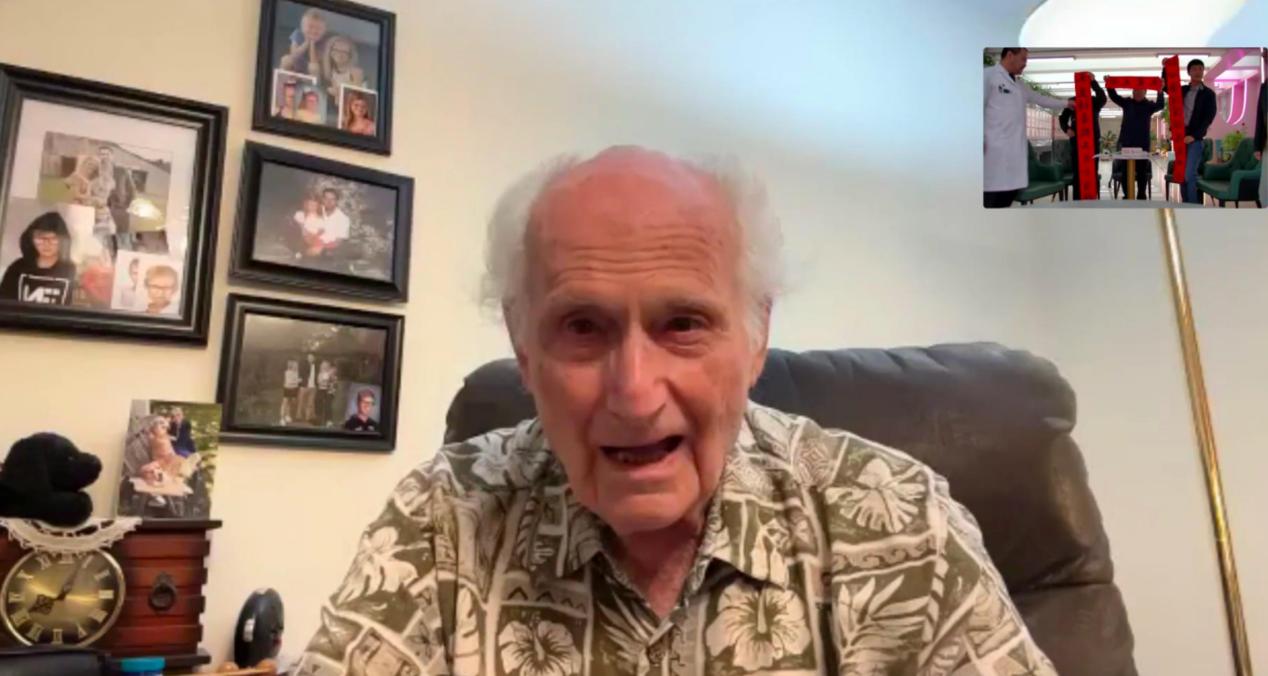
David Victor Plymire chats with Huang Jiong, the current director of Huangyuan county people's hospital via video link. (Photo courtesy of the media center of Huangyuan county)
On Sept. 10, inside his home in Springfield, Missouri, 95-year-old David Victor Plymire carefully opened Imprints, a cherished photo album. One image, captured in 1942, depicted a sweeping vista of Dangar Ancient Town in Huangyuan county, northwest China's Qinghai province, with six children standing on a hillside.
"That's me." David recalled during a video call, effortlessly switching into the local Huangyuan dialect. "I was just a teenager then. No matter where life takes me, I'll always consider myself a son of Huangyuan."
On the other end of the screen lay Huangyuan, Qinghai. Wang Shikang, former president of Huangyuan county people's hospital, greeted him warmly in the local dialect: "Brother David, the mutton is all set for your return."
David's eyes softened, and his voice caught. "Every quiet moment reminds me of everyone here. I miss you all deeply."
In Huangyuan, David is a beloved local figure, affectionately known as "Mr. Big-Nose." His story has endured across generations, even inspiring a children's rhyme that residents still sing today.
The nickname belies a deeper truth: a cross-cultural friendship spanning more than a century and two generations of an American family.
The story began in 1932, when one-year-old David crossed the Pacific with his father, Victor Plymire, arriving in Huangyuan. Victor had first come to China in 1908. After years spent across Gansu and Qinghai provinces, he ultimately chose Huangyuan as his permanent home.
To the residents of Huangyuan, Victor was never seen as an outsider. Modest and genuine, he embraced local customs, diligently learned both Mandarin and the Tibetan language, applied his training in Western medicine to offer free healthcare to communities of diverse ethnic backgrounds.
David spent his formative years in Huangyuan. Its landscapes, flora, streets, and hills were etched into his memory like second nature.
Decades later, he relocated with his family, living in Hong Kong and other parts of China for over thirty years before finally settling in Missouri in the United States.
Yet for David, the eastern foothills of the Qinghai-Xizang Plateau, where the Huangshui River originates, have always been home. The farther he drifted, the stronger his sense of belonging grew.
In 1987, after 38 years abroad, David returned to Huangyuan. Walking familiar streets and reuniting with old neighbors and friends, he felt an immediate urge to give back to the place that shaped him.
"He toured numerous facilities and quickly focused on hospitals desperately in need of modern medical equipment," recalled Li Lin, former head of Huangyuan health bureau.
In March 1989, David and his sister, Mary Ann, purchased an ultrasound machine in Hong Kong for HK$ 150,000 (about $19,100), a critical gap for the county hospital. With commercial shipping unavailable at the time, David personally transported the unit, flying it from Hong Kong to Xi'an, Shaanxi province, and then on to Huangyuan.
Over the next three decades, David crossed the Pacific more than twenty times. Whenever he had funds to spare, his thoughts invariably turned to supporting the hospital.
"Contrary to what some might assume, David was never wealthy," Wang noted. "Every dollar he donated was raised through personal networks, charitable foundations, and private contributions".
By 1999, David funded a $350,000 CT scanner for the county hospital -- a significant luxury for a facility of its level at the time.
"We urgently needed one, but the cost was so prohibitive that we hesitated to even ask," Li admitted. Once aware of the hospital's needs, David embarked on a fundraising campaign. By June 2000, the CT scanner had arrived in Huangyuan, making the county hospital one of only a handful of regional facilities equipped with such technology.
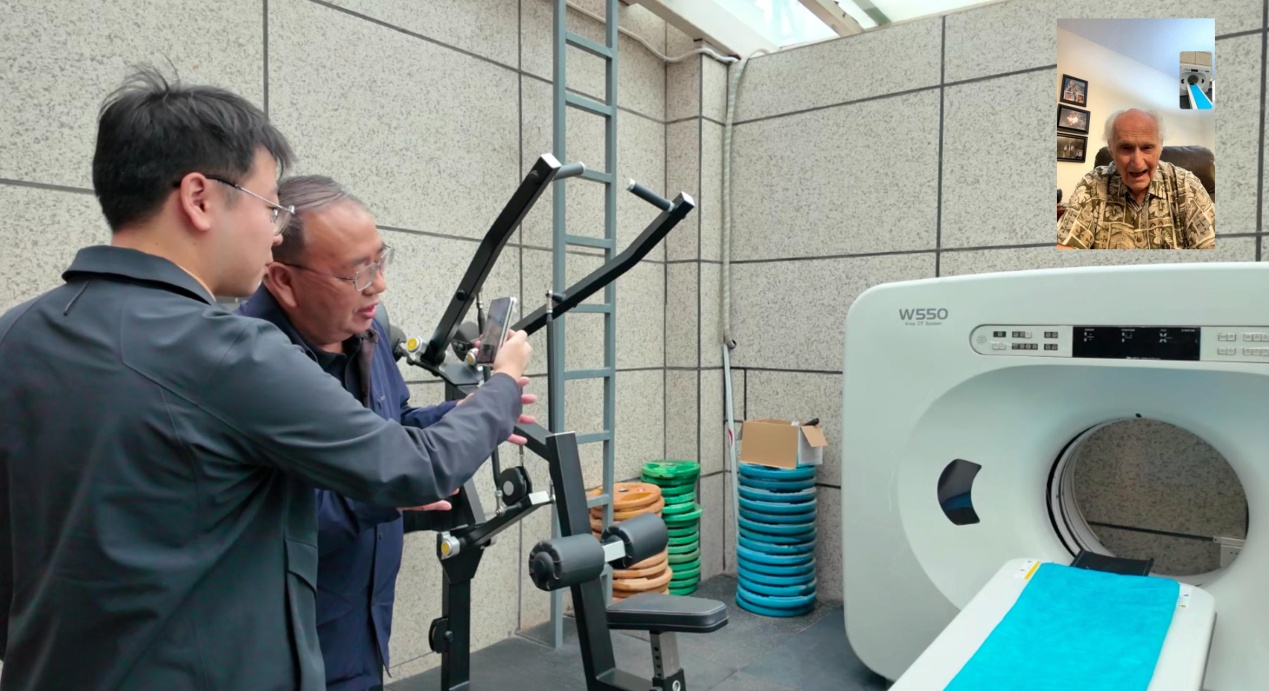
Wang Shikang (right), former president of Huangyuan county people's hospital, shows David Victor Plymire the CT scanner he donated to the hospital. (People's Daily Online/Yang Qihong)
Li also recalls accompanying David on visits to several township clinics.
"Clinic conditions were rudimentary," he explained. "Residents with even minor ailments often had to travel to the county seat -- or sometimes the provincial capital -- for basic exams. It was time-consuming and expensive. David was visibly moved by what he witnessed."
"He didn't dwell on it. Instead, he quietly raised $10,000 and donated four ultrasound machines to four separate township clinics." Through these efforts -- and with contributions from family and friends -- David has helped donate over 6 million yuan ($895,836) worth of medical equipment to Huangyuan County. The shipments included ultrasound units, gastroscopes, ECG monitors, automated hematology analyzers, and anesthesia machines.
During a recent video conference, Huang Jiong, the current director of Huangyuan county people's hospital, shared a telling statistic: the facility now serves 300,000 outpatient visits annually, despite a county having a population of just over 100,000.
"That capacity exists because of your unwavering support and generosity," Huang told David.
When a People's Daily journalist asked what had sustained him through the decades, David's response was simple yet profound. "It's a quiet conviction in my heart -- I have to keep doing this, because these people are my family," he said. "Some call my work a great contribution to my adopted hometown. I don't see it that way. It's not charity; it's responsibility. It's simply the right thing to do."
Today, David's legacy is formally woven into the hospital's archives. According to Huang, hearing his story is the very first orientation given to every new staff member.
The hospital is also preparing to open a dedicated museum chronicling its evolution, where David's donated equipment, decades of correspondence, and vintage photographs will be permanently exhibited.
Yet David's impact extends far beyond medical infrastructure. Recognizing the transformative power of education for children on the plateau, he facilitated partnerships with international educators and organized English-language training programs for local primary and secondary school teachers.
His father, Victor, was also a gifted photographer. Over the years, he documented hundreds of images capturing daily life, culture, and landscapes across Gansu, Qinghai, and Xizang autonomous region.
David has since donated hundreds of these historically significant photographs to Huangyuan county. They formed the foundation of Imprints, a published photo album that has since been archived in China's national documentary collections. Thanks to Victor's lens, the visual history of this western Chinese county has been preserved for nearly a century.
Tragedy struck in 1927, when Victor's first wife and their young son, John, succumbed to smallpox in Huangyuan. They were laid to rest on a northern hillside.
In 2016, David's sister Mary Ann passed away in Canada. Before her death, she expressed a heartfelt wish: to have her ashes returned to Huangyuan. Her family fulfilled that request, bringing her remains to the county.
During the call, the journalist shared that local residents have consistently maintained the family gravesite over the years. A tree, planted alongside the resting place, has grown tall and strong.
"That tree stands as a living symbol of China-American friendship," the journalist remarked. "It reflects the enduring bond between Huangyuan and your family. May it continue to thrive, just as your connection has." David's voice caught, overcome with emotion.
"Thank you to the people of Huangyuan for taking such good care of the cemetery. I'm very grateful," he said.
Now 95, David is no longer able to return to Huangyuan because of his physical condition. But whenever he speaks by phone with his old friends there, his fluent Huangyuan dialect instantly brings back the unmistakable flavor of home.
From Victor's arrival on Chinese soil in 1908 to David's virtual "return" to his hometown of Huangyuan in 2026, two generations and more than a century have passed, but the longing for home across the Pacific has never faded.
Photos


Related Stories
- U.S. youth receive Xi's reply letter ahead of his state visit
- China and the U.S. advance the constructive bilateral relationship of strategic stability toward steady, long-term development
- Feature: Chinese initiative gives fresh momentum to China-U.S. youth exchanges
- Xi's upcoming U.S. visit to chart course for bilateral ties
- Heartwarming moments of China-U.S. people-to-people exchanges
Copyright © 2026 People's Daily Online. All Rights Reserved.
