Dimitris Sotakis: Literature unites all of us
Under the heat of the Mediterranean summer, the streets of Athens remained bustling with life as locals and visitors made their way through the city. Stepping indoors offered a moment of respite. Here, renowned writer and translator Dimitris Sotakis reflected on a career that has connected the literary worlds of Greece and China. So far, he has translated more than 10 Chinese novels into Greek, while his own works have been translated into more than 12 languages, including Chinese.
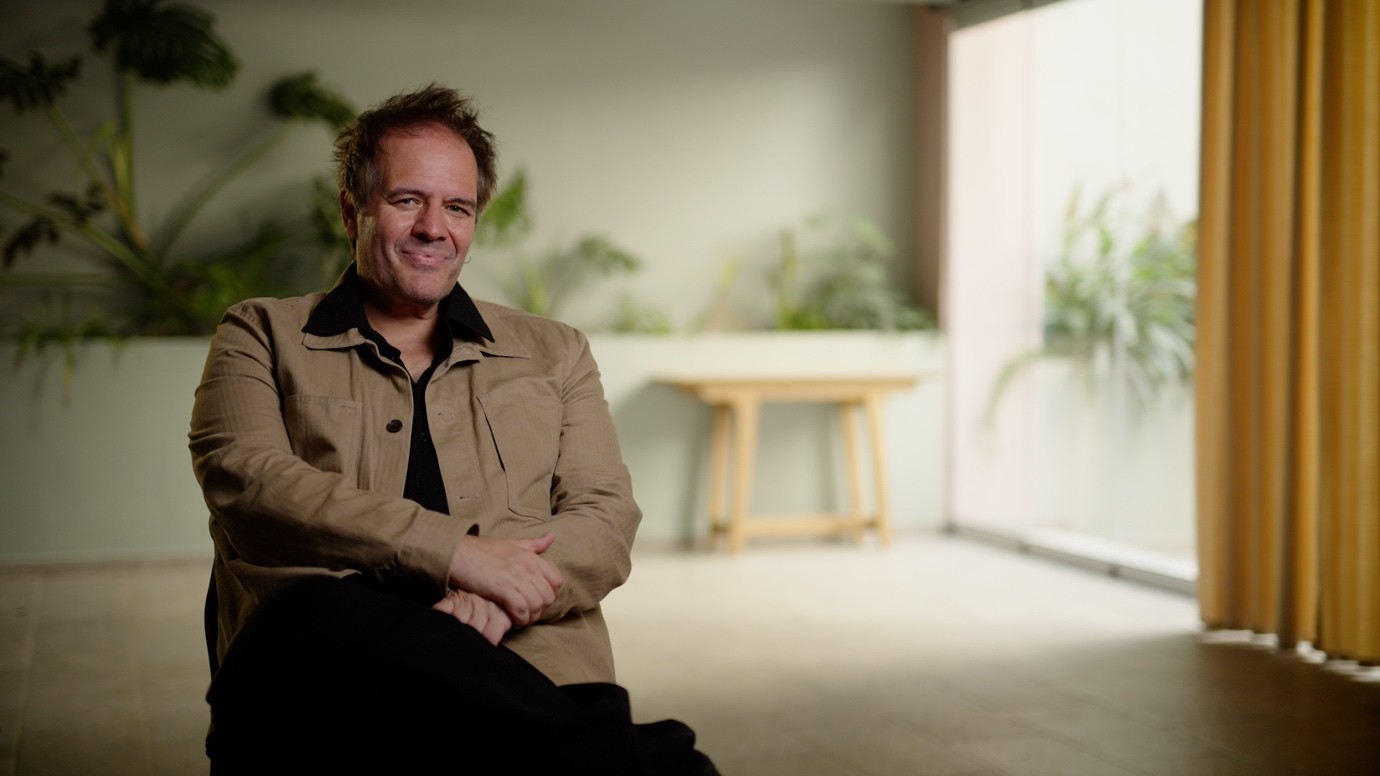
Dimitris Sotakis, Greek writer and translator, poses for a photo during an interview. (Photo/Patrick Shead-Simmonds)
Sotakis' eyes lit up when he talked about China. "My first encounter with China was during the 2004 Olympic Games in Athens," he said, "where I met a few Chinese tourists." He looked back on this early encounter as a revelation that ignited his desire to discover more about China.
The following year, he went to study at Beijing Language and Culture University. Rather than confining his learning to formal education, he immersed himself in everything from the people and food to Chinese traditions. "The most amazing thing was exploring the city and talking to local people in little shops," he said.
For Sotakis, going to China was an adventure, a journey into the unknown. "To me, China is like another universe. There are so many things to discover, so much complexity to the etymology of the words and so much richness in the culture," he said. He also credited China with completing a part of himself, allowing him to discover something he could not find in Greece.
Sotakis' love for China and the Chinese language deepened through his work as a translator of Chinese literature. "As a writer myself, when I first started translating, I did not enjoy the work," he said. "As time went by, however, I found translation to be an equally magical process." Books he has translated include Cao Wenxuan's award-winning "Bronze and Sunflower" and Ai Mi's "Hawthorn Tree Forever," which was later adapted for the screen.
More recently, Sotakis finished translating the avant-garde writer Can Xue's "The Barefoot Doctor" and "Love in the New Millennium." He said he was captivated by her unique writing style that creates an eerie atmosphere. While "Love in the New Millennium" gave him a "creative headache" during the translation process, Sotakis considers it his favorite work by Can Xue. "It describes a new moral approach to love in a new century as people's mentalities shift," he said. "Everybody is trying to build a social life, and love is the most important aspect."
As a writer, Sotakis has published about 14 novels, as well as a collection of short stories. While Greek writers tend to take a more realistic and historical approach to literature, he prefers exploring the absurd in his work. "My books describe real life with a twist," he said. "They deal with the human quest for happiness in this world, and the protagonist is desperately trying to find himself in the chaos."
In 2024, his novel "The Consummate Servant" was published in Chinese by New World Press. The book tells the story of a man who struggles to manage his life and subsequently hires a servant to help restore order to his home. "In a very strange way, however, these two men change places with each other. They become one, in a way," Sotakis said.
Sotakis was invited to Chongqing University in April 2026 for the third Global Forum on Mutual Learning Among Civilizations. During his visit, he had the chance to meet many scholars and students interested in Greek literature and language.
"Literature is a way to communicate," Sotakis said. "It is a form of art that breaks down barriers, uniting people across the world."
Sotakis feels it is a pity that many great Chinese books have yet to be translated into Greek. Currently, he is translating Wu Cheng'en's "Journey to the West," regarded as one of the Four Great Classical Novels of Chinese literature.
Looking ahead, he wants to take part in more cultural exchanges between China and Greece, especially by translating more books by Chinese writers into Greek. "I always try to be a link between Greece and China," he said. "It is not easy because geographically the two countries are far away from each other, but I think mentally we are very close."
(Web editor: Hongyu, Wu Chengliang)