



Clued-in | U.S. drains Japan's economy, and Japanese people are paying the price
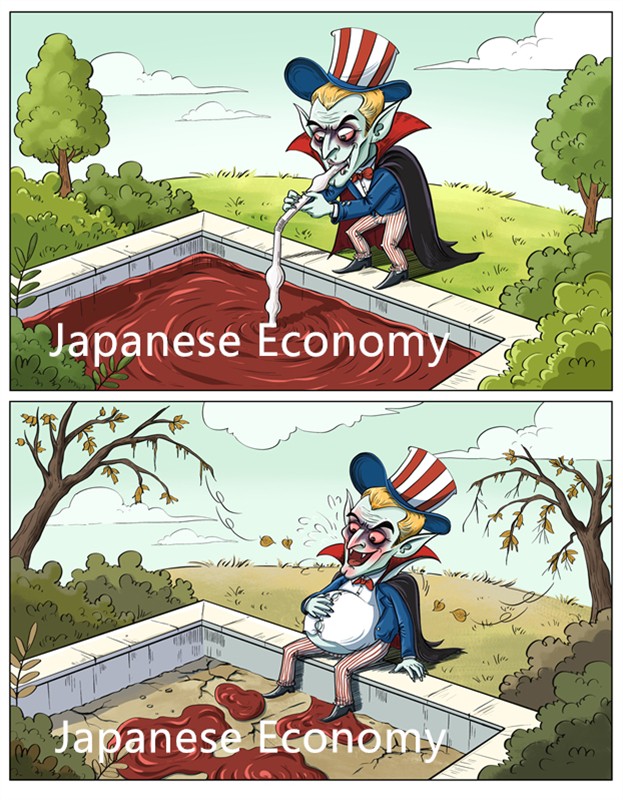
Cartoon by Tan Xiguang
In 2011, an entry-level Japanese office worker earning a monthly salary of 220,000 yen took home the equivalent of about 17,600 yuan ($2,600). Today, the same salary is worth only about 9,400 yuan — about half its former value.
With prices continuing to climb, the quality of life for Japanese people has taken an even bigger hit.
The country is facing its biggest wave of price hikes this year. According to Kyodo News, 4,923 food and beverage items in Japan are set to see price increases in September, nearly three times the number recorded in the same period last year.
Japan's current economic woes are not merely the result of a normal downturn. They reflect the consequences of a prolonged and systematic practice led by the U.S. that drains the Japanese economy.
One major factor is the yen carry trade. Japan's policy interest rate remains at 1 percent, while the U.S. Federal Reserve has kept its federal funds rate target range between 3.5 percent and 3.75 percent.
The wide interest-rate gap encourages investors to borrow yen cheaply, convert it into U.S. dollars and invest in higher-yielding assets. As long as the gap persists, Japan will remain caught between a weak yen and high debt, while capital flows continue to transfer wealth out of the country.
Japan's massive holdings of U.S. Treasury securities have also become a source of vulnerability. As of June, Japan held around $1.12 trillion in U.S. Treasury securities, making it the largest foreign holder.
Amid concerns that Japan might sell U.S. Treasuries to prop up its currency, Washington and Tokyo jointly announced measures in late July aimed at stabilizing the yen. Yet just two weeks later, the yen fell back to around 160 per U.S. dollar.
The U.S. has also backed Japan's use of the Federal Reserve's Foreign and International Monetary Authorities (FIMA) Repo Facility, which allows Japan's central bank to obtain U.S. dollars by pledging its U.S. Treasury holdings as collateral, while paying interest on the funds.
For ordinary Japanese people, the most tangible impact is that their money simply buys less. Japan relies heavily on imports for energy and food, so a weaker yen directly drives up the prices of food and consumer goods.
In 2025, Japan's Engel coefficient, the share of household spending devoted to food, reached its highest level since 1980. The pain of yen depreciation and the costs of the U.S. economic drain are ultimately being borne by ordinary Japanese people.

Photos




Related Stories
- U.S. 10-year treasury yield hits highest level since 2007 amid inflation fears, Fed hike bets
- U.S. judge blocks new stay limits for foreign students, journalists
- Trump expects war with Iran to end after U.S. midterm elections
- Trump's Irish unification remarks draw opposition from Britain
- U.S. consumer sentiment slips in September, inflation expectations rise
- Trump orders Canadian products removed from U.S. gov't contract lists
- Trump threatens to bar Canada's Bombardier jets from U.S. market
- Monroe's crown
- U.S. services expand in August, but inflation still bedevils Americans
- Trump announces pick for acting Army secretary
Copyright © 2026 People's Daily Online. All Rights Reserved.
