



Clued-in | From 'China Shock' to 'China Squeeze': 'China threat' narrative falls apart
China's economy has delivered a strong performance in the first year of the 15th Five-Year Plan period (2026-2030), with its GDP expanding 4.7 percent and total goods trade surging 16.9 percent year on year.
Yet the more impressive China's economic performance becomes, the more reluctant some quarters appear to acknowledge it.
In the global discourse surrounding China's development, narratives have been repeatedly repackaged, from "China Shock 1.0" to "China Shock 2.0" and now to the so-called "China Squeeze."
These narratives all serve the same purpose: portraying China's development achievements as "abnormal" and providing a pretext for protectionist policies.
Increasingly, voices around the world are exposing the flaws in these narratives, and the view that China's development creates opportunities rather than squeezes others is gaining wider recognition.
'China Shock 1.0': A one-sided reading of economic history
In an article titled "The Myth of the China Shock" published on the website of Project Syndicate on Aug. 18, Michael R. Strain, director of economic policy studies at the American Enterprise Institute, argues that the "China Shock 1.0" narrative oversimplified the complex economic adjustments brought about by trade liberalization, reducing them to a cause-and-effect story that blamed U.S. job losses on Chinese exports.
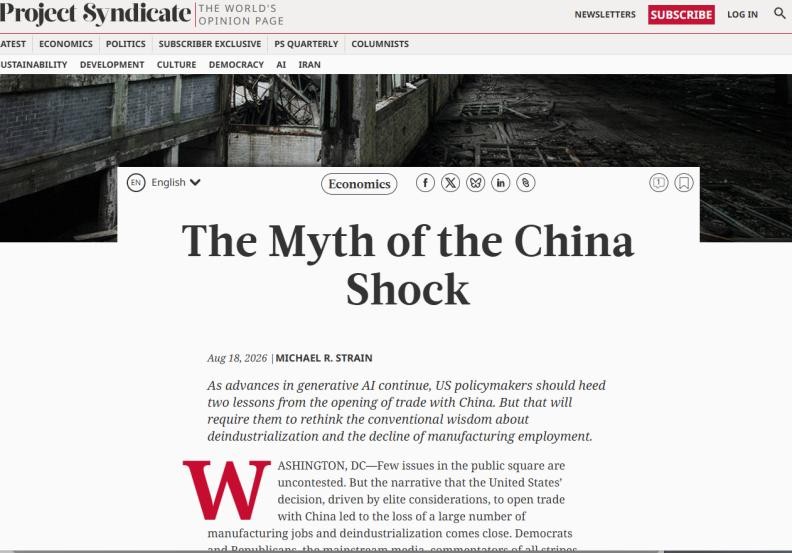
A screenshot of the article "The Myth of the China Shock" published on the website of Project Syndicate.
The "China Shock 1.0" argument claims that competition from Chinese imports between 1990 and 2007 contributed to the loss of around 1.5 million manufacturing jobs in the U.S.
Yet Strain argues that this interpretation presents only one side of the trade story. During the same period, the expansion of U.S. exports created nearly as many jobs, meaning that the effects of trade were not simply a one-way loss caused by imports.
He also argues that the "China Shock 1.0" narrative ignores longer-term structural trends in the U.S. economy. Manufacturing's share of total U.S. employment had already been declining since the early 1950s, decades before the so-called "China Shock."
China, however, has often been used as a convenient scapegoat for broader changes in the U.S. industrial structure.
As Strain writes, every part of the "China Shock" narrative is "off base."
'China Shock 2.0': Framing competition as 'overcapacity'
"China Shock 2.0" shifts the focus from labor-intensive sectors to advanced manufacturing, including electric vehicles, batteries and solar energy. It portrays normal industrial competition as "unfair" and frames China's scale advantages as evidence of "overcapacity."
Jostein Hauge, a political economist and assistant professor in development studies at the University of Cambridge, has highlighted the double standards behind such accusations. When China uses industrial policies to build manufacturing capabilities, they are often portrayed as unfair. When the U.S. adopts similar measures, such as those under the $280 billion CHIPS and Science Act, they are generally viewed as legitimate policy tools.
An article titled "The Costs of Keeping China Out," published on the website of Foreign Affairs on Aug. 17, warns of the risks of shielding U.S. companies from Chinese competition.
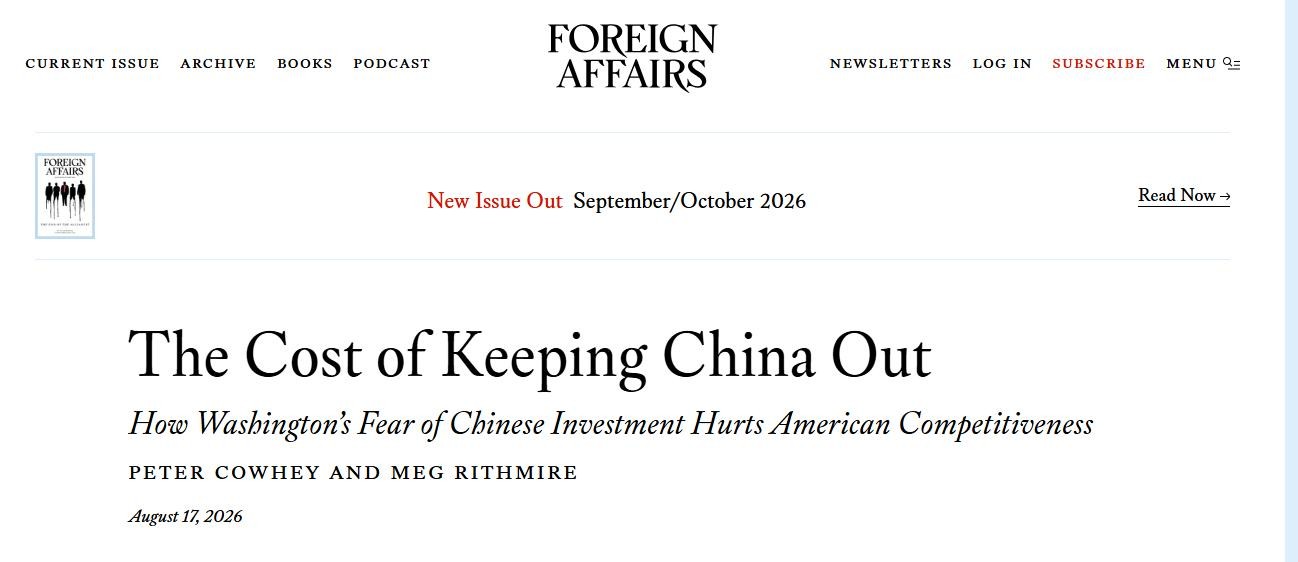
A screenshot of the Foreign Affairs article "The Costs of Keeping China Out" by Peter Cowhey, a professor at the University of California San Diego, and Meg Rithmire, a professor at Harvard Business School.
The authors, Peter Cowhey, a professor at the University of California San Diego, and Meg Rithmire, a professor at Harvard Business School, argue that blocking Chinese products such as electric vehicles may protect U.S. companies in the short term, but also prevents them from facing stronger competition and catching up with the technological frontier.
"Chinese firms are no longer merely efficient producers or copycats; in terms of knowledge and production capability, they are increasingly global leaders in many industries," the authors write. "Denying them access to the American market harms U.S. competitiveness, hinders U.S. efforts to build industrial capacity at home, and ensures that U.S. industry and consumers remain far from the frontier of technological advancement."
They also suggest that the U.S. should learn from China's development experience, adopting a strategy of selective openness that "permits carefully structured Chinese investment in areas in which the economic and technological benefits are substantial while imposing stringent safeguards to mitigate security risks."
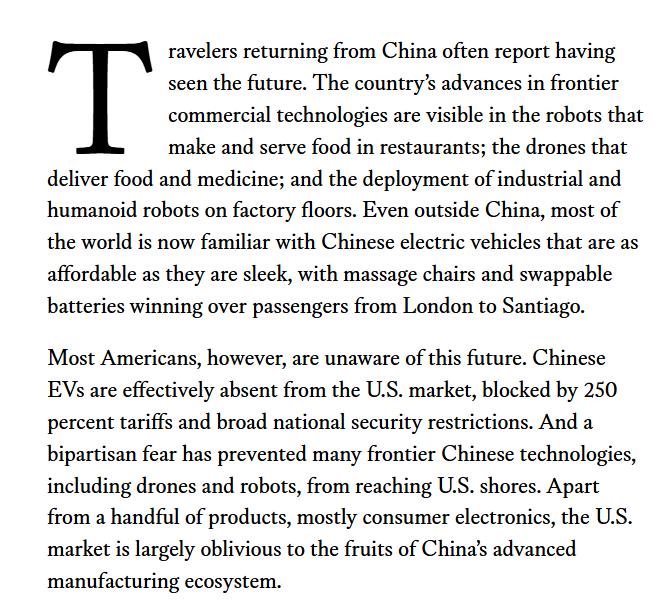
A screenshot of the opening of the Foreign Affairs article "The Costs of Keeping China Out."
"There is a clear precedent for this strategy," they write. "It is, in fact, exactly what China did to Western companies for decades."
'China Squeeze': A narrative built on counterfactual assumptions
The latest "China Squeeze" argument extends a debate rooted in Western economic anxieties to the Global South.
Put forward by some Indian economists, it holds that if China had not industrialized, countries such as India and those in sub-Saharan Africa would have had greater opportunities to develop low-skilled manufacturing industries.
However, Adam Tooze, a historian at Columbia University, challenges this logic in an article on Substack, describing it as a form of counterfactual speculation.
According to Tooze, development is not a queue; it is not so much a process as a project.
"Each such project is more or less well adjusted to its context," he writes.
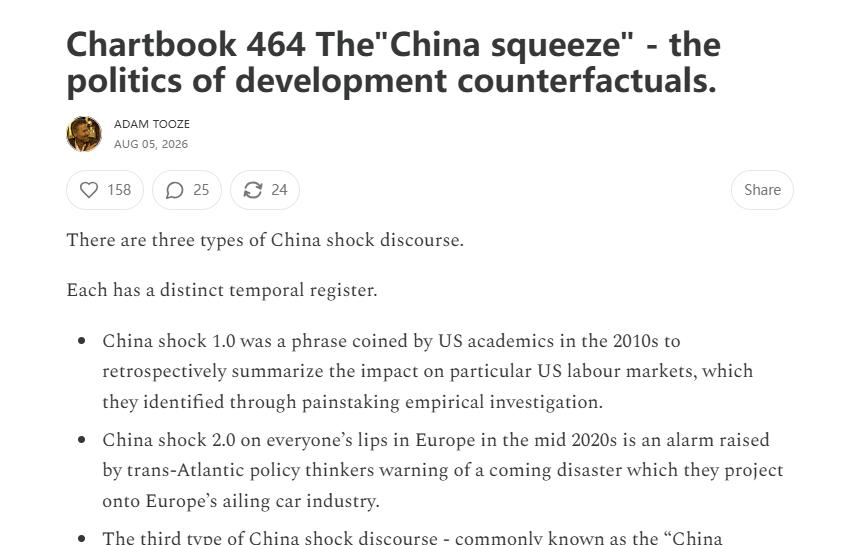
A screenshot of a Substack article by Adam Tooze, a historian at Columbia University, challenging the logic of the "China Squeeze" narrative.
Another scholar, Leon Liao, identifies three major flaws in the logic of the "China Squeeze" narrative in a lengthy Substack article titled "The Myth of the China Squeeze: Part I."
First, it rests on flawed counterfactual reasoning. The argument assumes that if China exported less, developing countries would automatically export more. But a shirt no longer produced in China would not necessarily be made in the poorest countries. Orders could move to other manufacturing hubs, shift to highly automated producers elsewhere, or disappear altogether as higher costs push up prices.
Second, it mistakes market share for "squeezing" others. The argument treats market share won through Chinese industrial competitiveness as an excessive claim on global development space, effectively turning industrial success into evidence that China is crowding out other countries. But gaining market share through competition does not by itself mean that China is preventing others from developing.
Third, it treats industrialization as a predetermined sequence. The argument presents postwar industrialization as a relay race in which advanced economies withdraw from lower-skill manufacturing and pass the baton to later developers. Yet, as Liao writes, the "flying-geese" model does not establish a general obligation for successful economies to abandon industries in which they remain competitive.
The U.S. did not withdraw from agriculture or aerospace after becoming rich; Germany did not abandon automobiles, machinery or chemicals; and Japan and South Korea retain major positions in steel, shipbuilding and other industrial sectors, according to Liao.
"There is no historical formula for how much industry China 'should' abandon," Liao writes.
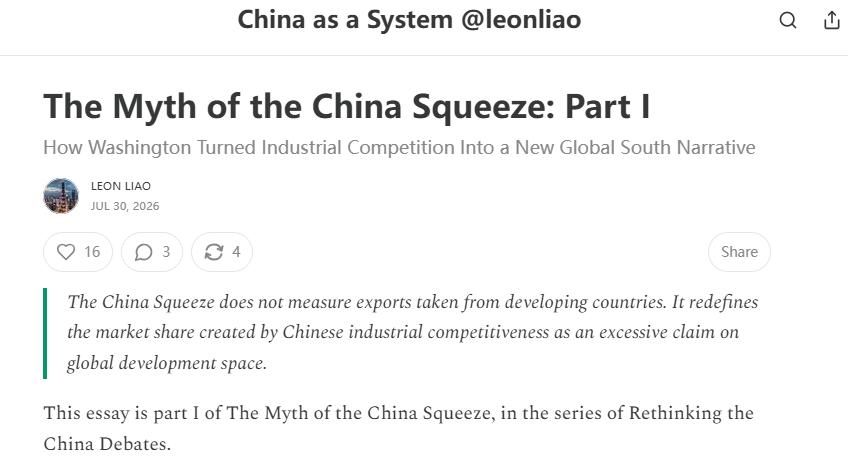
A screenshot of a Substack article by Leon Liao titled "The Myth of the China Squeeze: Part I."
The evolution from "China Shock 1.0" to "China Shock 2.0" and then to "China Squeeze" reveals a consistent pattern: whenever Chinese industries make breakthroughs in a new field, a new accusation is leveled against China, recasting its competitiveness as somehow illegitimate.
The political function of these narratives remains unchanged: providing domestic legitimacy for protectionism while seeking international sympathy.
The facts point in the opposite direction. China has emerged as an anchor of stability in the global economy.
In the first half of 2026, China's imports reached 10.74 trillion yuan ($1.6 trillion), up 22.1 percent year on year. China has granted zero-tariff treatment to 53 African countries, South-South trade has grown tenfold over the past three decades, and Chinese companies' investments and manufacturing operations in Southeast Asia have helped strengthen local supply chains. All of this shows that China's development is creating demand, transferring technology and generating new growth opportunities rather than crowding other economies out.
Whether labeled "China Shock" or "China Squeeze," these narratives share the same fundamental mistake: treating competitiveness itself as a problem while blaming one's own lack of competitiveness on the efforts of others.
China's development has never been a shock to the world. It has been more like a fast-moving train offering opportunities to those willing to get on board. The choice between joining the competition and retreating behind protectionist walls will determine who comes out ahead.

Photos




Related Stories
- China strengthens national defense mobilization – only those with something to hide feel threatened: Global Times editorial
- Commentary: What is behind the "China shock" concoction
- China urges U.S. to stop promoting bill exaggerating "China threat" rhetoric
- Commentary: Real "China threat" is China's underrepresentation in global governance
- Setting up ideological barriers to smear China doomed to be futile
- Op-Ed: Stirring up anti-China hysteria ahead of the US election is a losing strategy
- Time to lay “China threat theory” to rest: Chinese FM
- Commentary: China is rising. Get used to it
- Op-Ed: The absurd generalization that all Chinese are spies belongs in Hollywood, not in Washington
- 'China threat' theory reflects narrow-minded mentality
Copyright © 2026 People's Daily Online. All Rights Reserved.
