



Chinese Arctic expedition finds anti-freeze fish beneath high-latitude ice
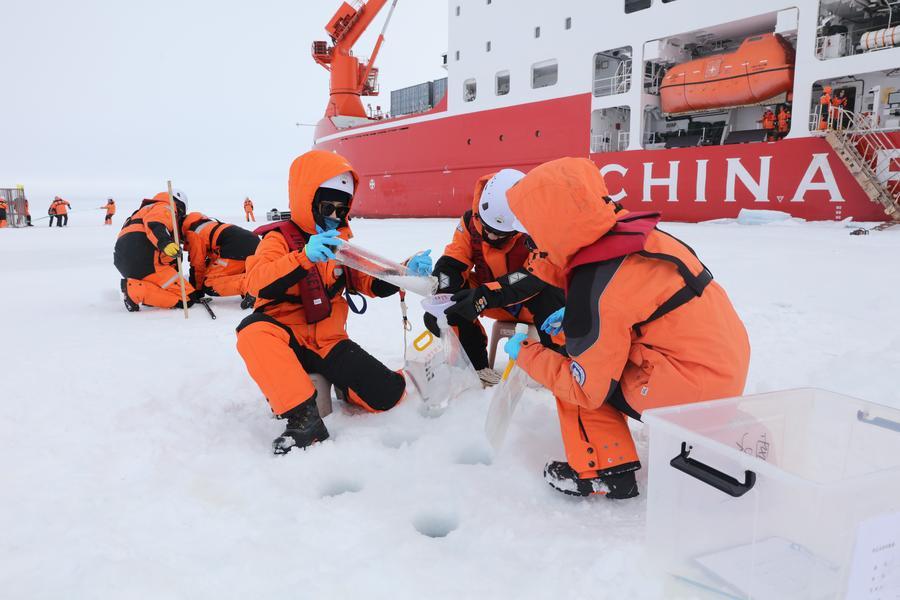
Members of China's 16th Arctic Ocean scientific expedition team work on the ice surface of the Arctic Ocean on Aug. 9, 2026. (Xinhua/Wen Jinghua)
BEIJING, Sept. 7 (Xinhua) -- Chinese researchers have captured five juvenile polar cod in a densely ice-covered area in the high Arctic, a discovery that may deepen scientists' understanding of the species and its habitat's ecosystem.
The young fish, aged one to two years, were caught in the northern Canada Basin above 86 degrees north latitude during a long-term ice station survey by members of China's 16th Arctic Ocean expedition aboard the icebreaker Xuelong 2.
An unmanned ecological observation system deployed at the same station captured video footage of such fish moving beneath the ice.
The species is built for life under the ice, where water temperatures can fall to minus 2 degrees Celsius.
Special antifreeze proteins keep the fish's body from freezing, allowing them to live beneath the ice and feed on zooplankton, or tiny animals, there, said Kim Vane, an onboard fish biologist from the Alfred Wegener Institute in Germany.
"An unexpected harvest," said Zhang Jichang, an expedition member from the Yellow Sea Fisheries Research Institute of the Chinese Academy of Fishery Sciences, who has taken part in multiple Arctic expeditions.
During China's 13th Arctic Ocean expedition in 2023, researchers caught a single juvenile polar cod in an ice hole and treated it as a chance occurrence. "The concentrated discovery this time shows that a certain number of juvenile polar cod live beneath the ice in these high-latitude waters," Zhang said.
Chinese scientists had previously known the species inhabited the icy surface waters of the Arctic Ocean mainly through published literature, he said, and physical specimens had been hard to obtain.
Results from China's successive Arctic surveys indicate that juvenile polar cod live mainly beneath the sea ice of the central Arctic Ocean, while adults stay near the seabed over the continental shelf and slope.
The Canada Basin has long been considered mostly "barren," with low productivity, and repeated trawl surveys in its central and southern waters on this voyage failed to catch any fish at all.
Finding so many juvenile polar cod at a single ice station in the basin's far north was surprising, said Lan Musheng, assistant to the expedition's chief scientist, adding that the northern high-latitude ice zone could become an important area sustaining the development of polar cod populations.
"These polar cod are the native fish of the central Arctic Ocean, they belong here," said Vane.
A study recently published by Vane and her colleagues showed that, on the basis of fish ear stones, or otoliths, collected from the sea floor of the Lomonosov Ridge not far from where the expedition caught these fish, that polar cod have been present in the central Arctic Ocean for at least 48,000 years.
The new observations also help explain why the fish are present in the area. On the day of the catch, Zhang and Vane dissected one specimen on site and found its stomach strikingly full. A vertical plankton tow at the same station brought up dense swarms of zooplankton and abundant phytoplankton, or small algae.
"We can preliminarily conclude that some high-latitude waters hold enough prey organisms for juvenile polar cod to feed on," said Wang Honggen, an expedition member from the Institute of Oceanology of the Chinese Academy of Sciences.
The discovery is the latest marker of China's advancing Arctic research, which began with the icebreaker Xuelong's first Arctic expedition in 1999 and the opening of Yellow River Station in Norway's Ny-Alesund in 2004. In 2019, Xuelong 2 -- China's first domestically built polar research icebreaker -- entered service. Four years later, it carried researchers on China's 13th Arctic Ocean expedition to the vicinity of the North Pole, the first comprehensive survey there by a Chinese research vessel.
The current expedition left port in early July and has since carried out comprehensive surveys in the central Arctic Ocean, monitoring the atmosphere, the melting ice and the ecosystem beneath it.
The stakes reach beyond one species. Polar cod are considered a keystone of the ice-associated Arctic marine food web -- one of the few fish linking zooplankton to other fish, seabirds and marine mammals.
The discovery also feeds into Arctic governance. China is one of the 10 parties to the Agreement to Prevent Unregulated High Seas Fisheries in the Central Arctic Ocean, which was signed in 2018 and imposes an initial 16-year ban on commercial fishing in the area while the parties carry out a joint program of scientific research and monitoring.
Yang Lei, deputy leader of the expedition, said the discovery will provide a scientific basis for China's continued participation in the joint research and monitoring program under the agreement, helping expand and deepen international understanding of Arctic Ocean fish stocks and improve Arctic Ocean governance.
"Where do the juvenile fish come from? How do they connect with the adult populations? And what are their migration routes?" Zhang said, "If we can clarify these questions, it will be of great scientific significance for understanding the life history and population status of polar cod in the future."
Photos




Related Stories
- China's research icebreaker Xuelong 2 carries out operations at ice stations in Arctic Ocean
- China launches 15th western Pacific expedition featuring LangYa sensing and forecasting framework
- China's icebreakers Xuelong, Xuelong 2 open to visitors in Dalian port
- Chinese icebreaker Xuelong returns after fruitful Antarctic expedition
- Feature: Decoding climate engine: Chinese expedition sheds light on Antarctic ice openings
Copyright © 2026 People's Daily Online. All Rights Reserved.
