



Changshan Archipelago's World Heritage listing highlights China's efforts to advance ecological progress
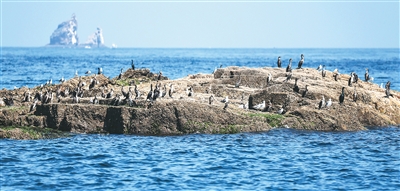
Seabirds rest on the rocks of Dahaozi Island, part of the migratory bird habitat on the Changshan Archipelago in Dalian, northeast China's Liaoning Province. (Xinhua/Pan Yulong)
At dawn, flocks of birds take flight together, their calls filling the air above the uninhabited islands and reefs of the Changshan Archipelago in Dalian, northeast China's Liaoning Province.
On July 27, 2026, the 48th session of the UNESCO World Heritage Committee in Busan, South Korea, approved the boundary modification of the Migratory Bird Sanctuaries along the coast of the Yellow Sea-Bohai Gulf of China, officially incorporating the Changshan Archipelago onto UNESCO's World Heritage list.
This marks another expansion of the World Natural Heritage site following its previous expansion in 2024, further improving the integrity of the migratory birds' sanctuaries.
The Changshan Archipelago in Dalian's Changhai county sits on the only sea route of the East Asian-Australasian Flyway, serving as a critical energy supply stop for tens of millions of migratory birds during their migration across the Bohai Sea.
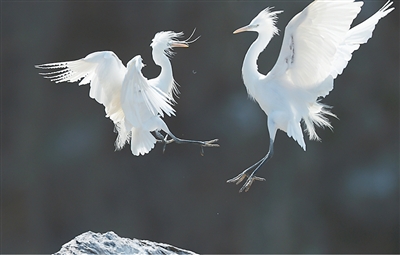
Chinese egrets fly over on the Changshan Archipelago in Dalian, northeast China's Liaoning Province. (Photo/Wang Xiaoping)
"Migration is an unbroken chain — damage to any single habitat can trigger a reaction across the entire route," said Wang Xiaoping, deputy director of the Liaoning Snake Island-Laotie Mountain National Nature Reserve Administration.
Wang noted that the Changshan Archipelago now complements two other heritage sites in Liaoning — the Yalu River estuary in Dandong and the Snake Island-Laotieshan National Nature Reserve in Dalian — forming a coastal shield that supports birds' full life cycle.
The archipelago has recorded 255 bird species, including more than 140 within the core heritage area, with over 100,000 waterbirds present during migration seasons. A 2026 survey found more than 2,500 breeding adult Chinese egrets and over 3,000 chicks.
These gains follow more than a decade of conservation work. Unregulated aquaculture, marine debris and human disturbance once strained the archipelago, and guano buildup at Fantuozi had acidified the soil and killed off shrubs, reducing nesting space for Chinese egrets.
Li Qingsen, a member of Changhai county's forest fire brigade, has led protection efforts on Fantuozi Island for years. During the April-to-July breeding season, 20 team members rotate onto the island in pairs, enduring life in a bare metal shed with no fresh water, dock or power. They are sometimes stranded alone for days whenever rough seas prevent boats from reaching the island.
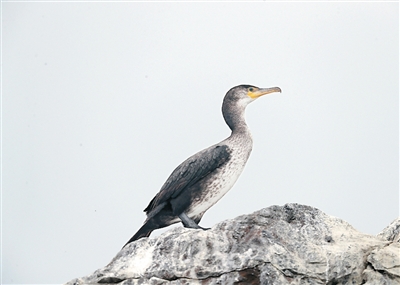
A Japanese cormorant is pictured on the Changshan Archipelago in Dalian, northeast China's Liaoning Province. (Photo/Wang Xiaoping)
The county launched a shrub replanting project in 2022, replacing surface soil with fertile earth and planting more than 2,200 shrubs, effectively restoring native vegetation and creating a secure, stable nesting and breeding base for the Chinese egret.
The county has also returned aquaculture areas to wetlands, remediated shorelines and built a layered protection system combining red-line zoning, full breeding-season closures of core islands and reefs, joint patrols by the coast guard, fishery and natural resources agencies, and drone and infrared monitoring.
"This is ecological wealth generations have worked to protect," said Wang Piyu, deputy director of the county's natural resources affairs service center, who cuts his boat's engine just before reaching Fantuozi to avoid startling the birds. Former fishermen on the islands have also joined patrol teams, clearing marine debris and monitoring birds.

Photo shows the southern reef belt of Bashao Island, part of the Changshan Archipelago in Dalian, northeast China's Liaoning Province. (Photo/Jia Yifei)
With the Changshan Archipelago's inclusion into the sanctuary, Liaoning becomes a province with three World Heritage-listed bird habitats.
Satellite tracking data shows that Chinese egrets breeding in the archipelago migrate as far as the Philippines and Kalimantan in Indonesia, underscoring the archipelago's role in the global migratory bird network.
Changhai County is also advancing a second-phase, 400-million-yuan (about $59.28 million) marine ecological restoration project to upgrade vegetation restoration, marine management, and smart monitoring.
Lyu Yongquan, head of the county's Bureau of Natural Resources, said core heritage zones will remain closed to commercial development, permitting only low-impact educational activities, as the county works together with neighboring heritage sites to build connected ecological corridors.
The Changshan Archipelago's inclusion marks a milestone for coastal ecological protection in Liaoning Province and reflects China's efforts to advance ecological progress, fulfill the Convention Concerning the Protection of the World Cultural and Natural Heritage, and participate in global biodiversity governance.
Photos




Related Stories
- China advances ecological governance under the rule of law
- China marks National Ecology Day with solid gains in green push
- EcoChina | Ecological restoration achievements in SW China's Zoige Wetland
- EcoChina | Improved ecology draws more migratory birds to Heilongjiang
- Scenery of Fujin National Wetland Park in China's Heilongjiang
- China issues plan to build Beautiful China from 2026 to 2030
- Spotted seals return as marine ecosystems recover in Panjin, NE China
- Tidal-flat seaweed in East China becomes ecological asset
- China issues plan to advance integrated ecological compensation
- Ecological barrier consolidated in S China's Xishuangbanna
Copyright © 2026 People's Daily Online. All Rights Reserved.
