



Spotted seals return as marine ecosystems recover in Panjin, NE China
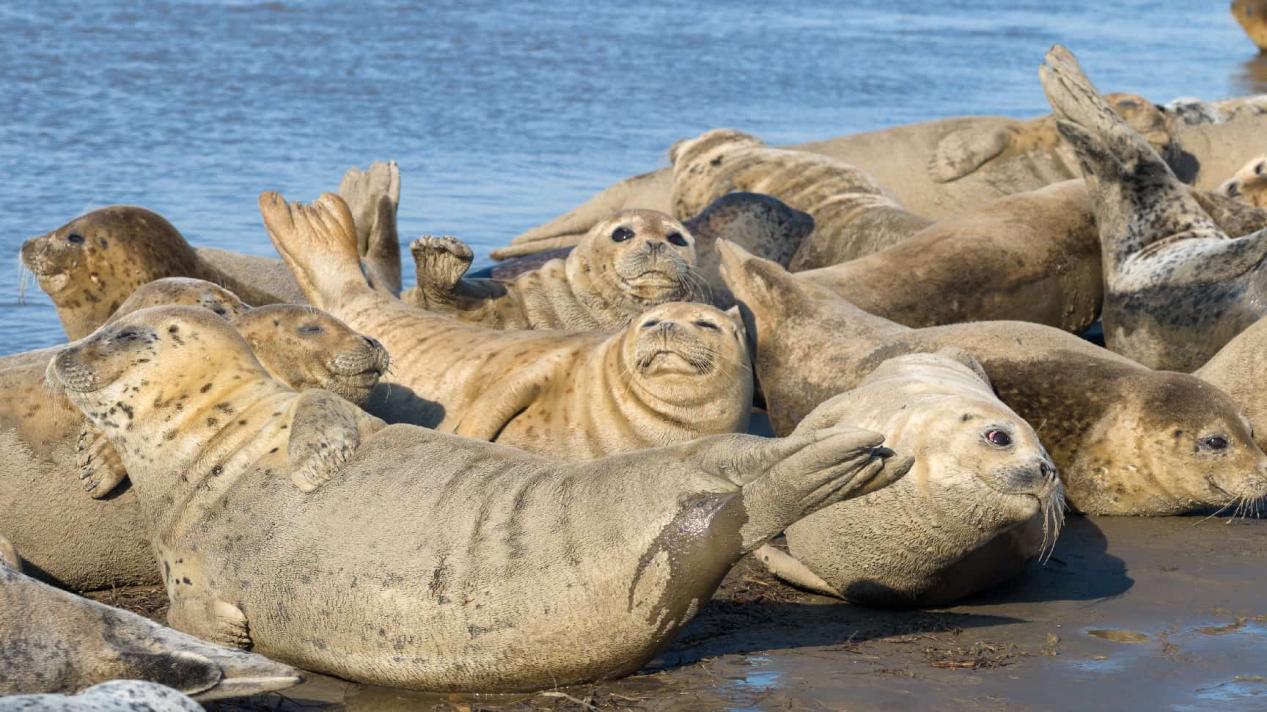
Photo taken on March 31, 2026 shows spotted seals in Liaodong Bay in Panjin, northeast China's Liaoning province. (Photo/Xue Jinlong)
At the Liaohekou National Nature Reserve in Panjin, northeast China's Liaoning province, Tian Jiguang, director of the marine animal research office at Panjin wetland conservation association, pointed to a nearby mudflat where over 10 grey-and-white spotted seals gathered.
"The western Pacific spotted seal is a national first-class protected species, and the Liaohe River estuary is its only breeding ground in China," Tian explained. This year, the peak daily count of seals coming ashore reached 451, setting a new record for the third consecutive year, he added.
"Whenever boats pass by, people now make a point of steering clear of the mudflats, slowing down, and keeping noise to a minimum," said Song Jiali, a 63-year-old fisherman who also serves as an information officer at the association and patrols local waters every day.
More than 30 fishermen like him now work as volunteer observers and patrol personnel. Over the past decade, more than 20 spotted seals have been successfully rescued and released back into the wild in the Liaohe estuary region.
In the past, spotted seals would breed and recuperate at the estuary before migrating northward. In recent years, however, Tian has noticed a growing number choosing to stay.
"Spotted seals are highly sensitive to changes in the marine environment. Their population is an important indicator of ecosystem health," he said. "More than a decade ago, we could monitor only a few dozen."
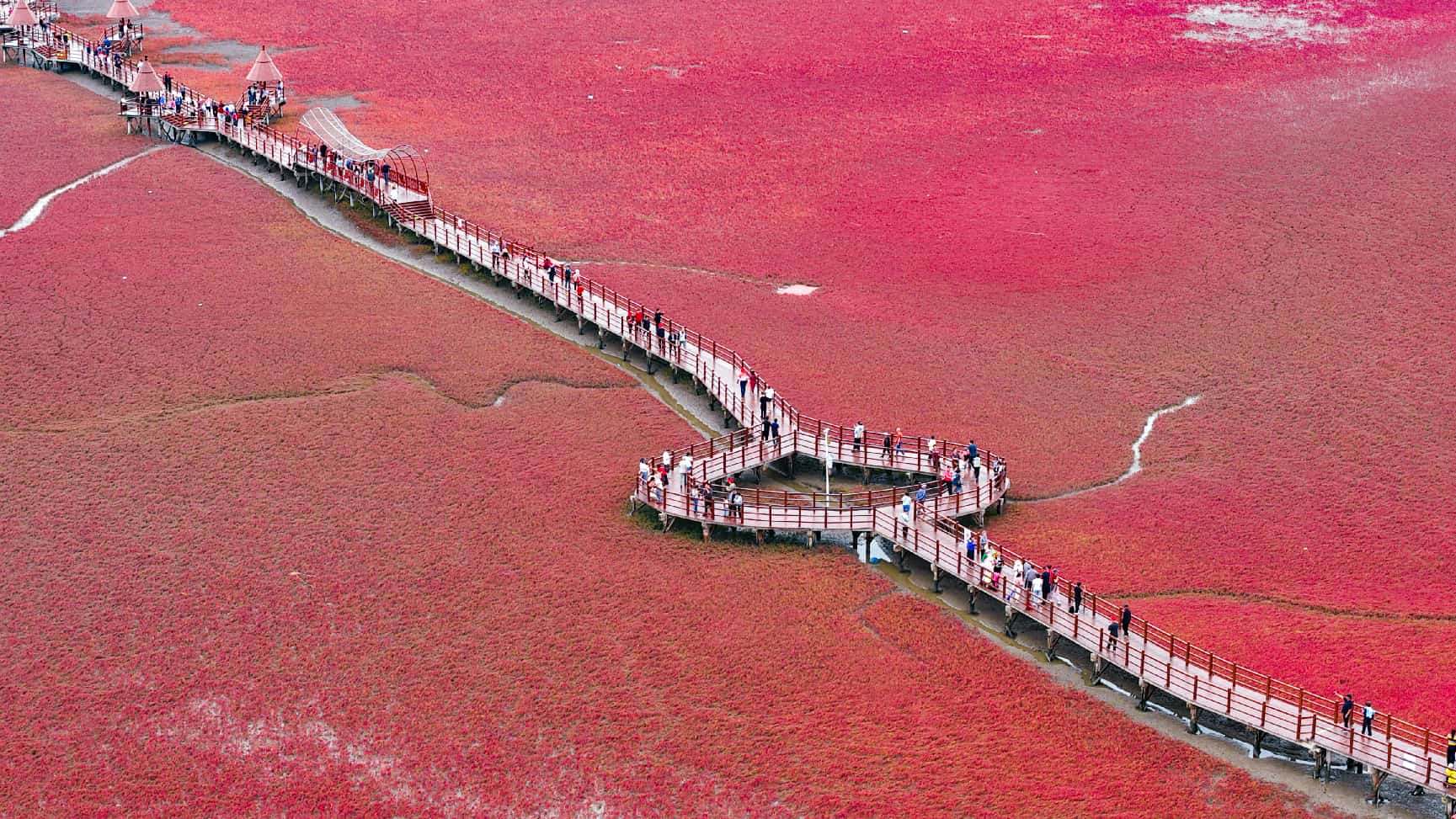
Tourists visit the Honghaitan Red Beach scenic area in Panjin, northeast China's Liaoning province, Sept. 23, 2025. (Photo/Ma He)
The situation was very different in the past. Large-scale coastal aquaculture has fragmented extensive wetland areas into a patchwork of enclosed ponds. Vegetation deteriorated, seawater became polluted, and coastal ecosystems suffered significant damage.
"When vegetation disappeared, bottom-dwelling organisms declined. Without them, fish stopped coming, and naturally the seals lost interest in the area as well," Tian explained.
In 2015, an ecological restoration project was launched in the Liaohe estuary, focusing on converting aquaculture ponds back into wetlands and rebuilding the ecological cycle linking rivers, the sea, and wetlands.
According to Sun Lei, deputy director of Panjin's natural resources bureau, years of restoration efforts have led to the withdrawal of all 598 aquaculture operators from the area. Aquaculture facilities were completely dismantled, 366 sewage discharge outlets flowing into the sea eliminated, around 5,727 hectares of wetlands restored, and 17.6 kilometers of natural coastline rehabilitated, breathing new life into the coastal wetland ecosystem.
On the mudflats, five wetland transport vehicles line up as workers sow seeds of seepweed, while drones on the other side of tidal channels scatter the same seeds from above. Combining manual planting with drone technology has overcome terrain constraints and enabled more comprehensive and targeted ecological restoration.
"Seepweed helps reduce soil salinity, enrich soil nutrients, and provide habitat for a wide range of species, but it needs very specific growing conditions," Sun said.
As part of marine ecological conservation and restoration efforts, Panjin conducted extensive surveys of topography, soil conditions, and ecological environments. Researchers carried out hydrodynamic simulations, soil salinization analyses, and vegetation suitability studies to develop targeted plans for micro-topography adjustments and tidal channel excavation.
As the marine ecosystem improves, fishery resources are also recovering.
Panjin Agricultural Development Group has established two national-level marine ranching demonstration zones. Surveys have identified five major categories of harvestable resources, including fish, shrimp, crabs, cephalopods, and specialty marine products.
Community structures have become healthier and more stable, reversing previous trends of resource depletion and limited species diversity. The result has been a win-win outcome of ecological restoration and industrial upgrading.
Last year, Panjin produced 40,000 tons of marine aquaculture products, up 4.1 percent year on year.
Wetland restoration has also transformed reeds into a thriving local industry. Degraded reed marshes have gradually recovered, with both reed growth and overall stock increasing steadily. Panjin's reed wetlands now remain stable at around 800 kilometers, producing approximately 400,000 tons of reeds annually.
Industries such as ecological co-cultivation of fish, shrimp, and crabs beneath reed stands, along with reed-straw processing, have continued to expand. Various business entities have created employment opportunities, helping local residents increase their incomes close to home.
Spotted seals are not the only sign of Panjin's marine ecological recovery.
A total of 336 bird species have been recorded in the Liaohe estuary, the world's largest breeding ground for the Chinese black-headed gull. Along the 18-kilometer beachside corridor, photography enthusiasts capture spectacular scenes of flocks taking flight, visitors participate in immersive eco-tourism experiences, and children learn about wetland ecosystems through educational exhibits.
Last year, the area welcomed 1.05 million tourist visits and generated more than 50 million yuan ($7.38 million) in tourism revenue.
Against blue skies, amid red seepweed beaches, green reed fields, and the calls of birds, a picture of harmony between people and nature is unfolding across the Liaohe estuary.
"Prioritizing conservation while using resources rationally lets the marine economy deliver both economic and ecological benefits," said an official from the Panjin development and reform commission. "This is higher-quality, truly sustainable development."
Photos


Related Stories
- Tidal-flat seaweed in East China becomes ecological asset
- China issues plan to advance integrated ecological compensation
- Ecological barrier consolidated in S China's Xishuangbanna
- China's ecological protection red line system strengthens ecosystem protection
- China steps up efforts in field observation to protect grassland ecology
- Dongzhai nature reserve marks milestone achievement in crested ibis conservation
- Wild baby otter spotted in Ergune Wetland
- NPC deputies, CPPCC members highlight green as defining feature of a Beautiful China
- China's key terrestrial wild animal, plant species see steady growth amid better ecological environment
- Improved water ecology transformed into economic benefits in Kaizhou district, Chongqing
Copyright © 2026 People's Daily Online. All Rights Reserved.
