



China's emotion-driven consumption market to exceed 4.5 tln yuan by 2029
China's emotion-driven consumption market is projected to exceed 4.5 trillion yuan ($663 billion) by 2029, encompassing sectors such as designer toys, blind boxes and handicraft experiences.
Paying for experiences that generate positive emotions has become a defining feature of spending among young Chinese consumers.
At a family farm in Beizhai subdistrict, Laoshan district, Qingdao, east China's Shandong Province, Wang Shan rents a 60-square-meter plot at the farm's "shared vegetable gardens," where seasonal vegetables grow in neat rows.
Wang values not only the fresh produce but also the opportunity to relax outdoors with family members on weekends, often sharing the harvest with friends.
Farm operator Lei Ming said the farm launched the rental program in 2008, allowing renters to take part in the entire farming process, from sowing and field management to harvesting. Lei returned to run the farm full-time in 2015 after sensing growing urban demand for rural experiences.
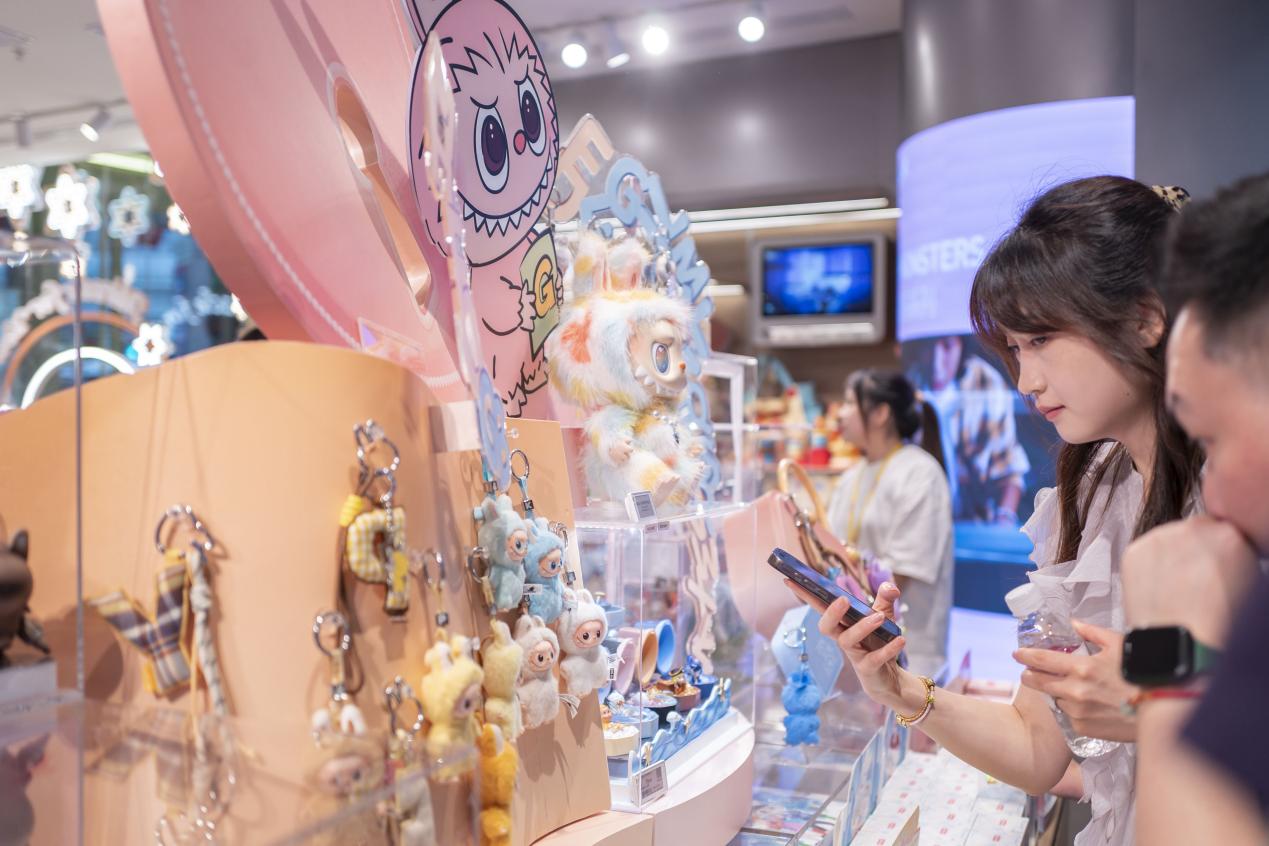
Labubu toys attract shoppers at a Pop Mart store in Shanghai. (Photo/Wang Chu)
According to Lei, a plot covering about 66.7 square meters rents for 3,500 yuan a year. Renters enjoy a fully managed service package, with the farm handling planting, fertilizing, watering, weeding and other routine tasks, while allowing them to participate whenever they wish.
He now rents out all 70 plots on his farm, most of them to residents born in the 1980s. The shift has significantly improved the farm's profitability. Per-mu (667 square meters) income has risen from 6,000–7,000 yuan under traditional cultivation to roughly 35,000 yuan under the shared vegetable garden model.
Liu Qiang, a professor at Shandong Normal University's School of Economics, said the popularity of shared vegetable gardens reflects a broader shift in consumer behavior, from satisfying material needs to pursuing emotional fulfillment.
The trend is equally visible in urban retail. In Hangzhou, east China's Zhejiang Province, stress-relief toys — particularly squishy toys — have become a popular purchase among young consumers, fueling a new wave of emotion-driven spending. One frequent buyer said she instinctively reaches for one whenever she feels stressed.
Zhu Yingying, founder of a company in Zhejiang, pivoted from online apparel sales to making squishy toys in late 2024 after noticing surging demand. Her factory in Jinhua city, Zhejiang, now produces roughly 1,000 units a day and has also attracted overseas orders. Products launched by her company in December last year sold 60,000 units within a short period.
In Wuhan, central China's Hubei Province, handicraft stores occupying about 2,000 square meters on the fourth floor of Zhongbai Group's Wuhan Central Department Store have attracted a steady stream of visitors. At a silver jewelry workshop, customers can create customized silver rings by hammering their initials onto silver bars and having them finished by in-store craftspeople.
"Creative handicraft products allow customers to express their personal aesthetic. It's a niche market that is both dynamic and full of promise," said Liu Pengxiang, the store owner, adding that the shop receives roughly 1,000 customer visits a month on average.
The department store, which had long focused on clothing and accessories, began introducing handicraft outlets in 2021 to cater to the rise of emotion-driven consumption. Management estimates that about 60 out of every 100 shoppers visit handicraft stores.
Hu Jiliang, deputy director of the Economic Research Center at Central China Normal University, said the sense of accomplishment and satisfaction provided by creative handicraft experiences is precisely what many young consumers are seeking today.
Hu called for strengthening the legal and regulatory framework governing emotion-driven consumption, establishing clear product safety and transaction standards, and guiding the sector toward healthier and more sustainable development.
Photos


Related Stories
- China's consumption prospects won't be obscured by rhetoric
- China sees consumption recovery, robust growth in emerging industries
- China's consumer market posts steady growth in Jan.-April
- China improves departure tax refund services to boost inbound consumption
- China's consumption maintains growth as services gain momentum
- China to optimize departure tax refunds to boost inbound consumption
- China's consumer inflation continues mild recovery in April as domestic demand improves
- China's gold consumption up 4.41 pct in Q1
- Holiday consumption market underscores new growth drivers of Chinese economy
- Young people seeking diverse experiences boost May Day holiday consumption
Copyright © 2026 People's Daily Online. All Rights Reserved.
