



Dialogue between ancient and modern civilizations: contemporary inspiration from classical wisdom
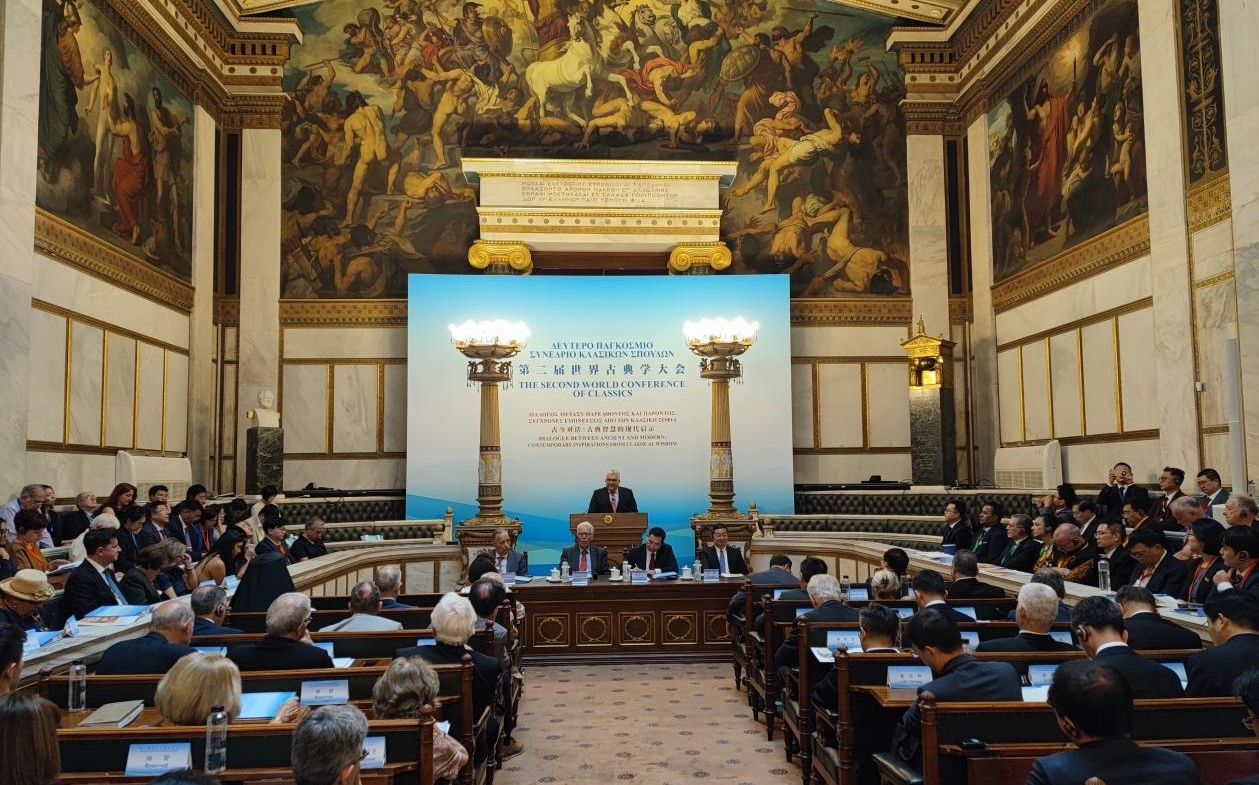
The two-day second World Conference of Classics, themed "Dialogue Between Ancient and Modern Civilizations: Contemporary Inspiration from Classical Wisdom," opened in Athens, Greece, June 9. (People's Daily/Xie Yahong)
From June 9 to 10 local time, the second World Conference of Classics was held in Athens, Greece. Following the successful inaugural session held in Beijing in 2024, this grand event, jointly organized by China and Greece, represented a cross-continental "academic relay" between the two pivotal cradles of Eastern and Western classical civilizations.
Participants generally agreed that the study of classics is no longer confined to any particular region, language or cultural tradition, but instead encompasses all classical civilizations throughout human history that have preserved enduring traditions, nurtured noble virtues and cultivated spiritual values.
By tracing the roots of civilizations, the study of classics provides humanity with spiritual guidance and intellectual resources for advancing civilization, allowing the light of classical civilizations to illuminate the path forward.
Under the theme "Dialogue Between Ancient and Modern Civilizations: Contemporary Inspiration from Classical Wisdom," this year's conference focused on how the study of classics can respond to the common challenges facing today's world and offer inspiration for the development of human civilization.
In a written address to the conference, director-general of UNESCO Khaled El-Enany said that bringing splendid classical traditions into modern dialogue is not about glorifying the past, but about drawing wisdom from ancient classics' profound reflections on knowledge, justice, responsibility, coexistence and peace, so as to address the pressing challenges of the modern time from a new perspective.
Greek Culture Minister Lina Mendoni said that the joint organization of the conference by Greece and China not only demonstrated the strength of cooperation between the two ancient civilizations, but also showed that the study of classics has become a truly global field of research and dialogue.
She added that scholars from different countries and academic traditions gathered in Athens, proving that when civilizations engage in exchanges with openness, inclusiveness and without prejudice, seeking understanding rather than confrontation, they can not only coexist, but also learn from and enrich one another.
Gao Xiang, president of the Chinese Academy of Social Sciences, said that against the backdrop of profound global changes and rising uncertainty, humanity is more eager than ever to draw wisdom from classical civilizations to address real-world challenges.
The contemporary value of classics, he said, lies in deeply exploring the rich intellectual resources of ancient civilizations, drawing on their valuable experiences in resolving conflicts and maintaining peace, and applying the ancient wisdom of "harmony without uniformity" to help build a more just and equitable international order.
In the late autumn of 2024, the inaugural World Conference of Classics was successfully held by Yanqi Lake in Beijing. More than 400 Chinese and foreign scholars from over 30 countries across five continents gathered to explore the theme "Classical Civilizations and the Modern World," opening a new chapter in dialogue among classical civilizations.
"The first World Conference of Classics was a great success. It set a new benchmark for global research on classics, made positive contributions to the inheritance and development of civilizations, and promoted exchanges and mutual learning among civilizations," said Roger T. Ames, vice president of the International Confucian Association and a participant in the conference.
"The second conference has once again brought together academic communities from around the world to explore new avenues for exchanges and mutual learning among civilizations, providing spiritual nourishment for building a better world," he added.
Stelios Virvidakis, secretary general of the Greek side at the Center of Chinese and Greek Ancient Civilizations, said that China is actively promoting the drawing of wisdom from global classical traditions to address contemporary global governance challenges. The World Conference of Classics, as an important platform for discussion and exchange, is crucial to building a better future for humanity.
Spanish sinologist Alicia Relinque Eleta, who has translated multiple Chinese classical literary masterpieces into Spanish, said that the Western world should open its eyes and truly seek to understand other civilizations. From this perspective, China's Global Civilization Initiative provides an important framework for promoting equal dialogue and exchanges among civilizations, helping overcome barriers between civilizations and enhance mutual understanding among peoples.
Kathryn Morgan, a professor of classics at the University of California, Los Angeles, expressed a similar view. She said that in a world filled with uncertainty and multiple challenges, the Global Civilization Initiative is like a remedy, offering a Chinese approach enriched by Eastern wisdom to address global challenges.
It goes beyond the outdated logic of zero-sum competition and the clash of civilizations, injecting valuable stability and positive energy into a world undergoing turbulence and transformation, she added.
During the conference, parallel forums were held on topics including "Virtue and Cultivation," "Friendship and Community," "Peace and Order," and "Technology and Civilization," along with a series of cultural exchange activities.
At the closing ceremony, the conference released a joint initiative titled "Illuminating Humanity's Future with Classical Wisdom" and launched a Global Visiting Scholar Program by the Chinese School of Classical Studies at Athens.
From Beijing to Athens, the conference served as a bridge connecting two major sources of Eastern and Western civilizations. More than an academic gathering, the event marked a milestone in putting the Global Civilization Initiative into practice, adding a profound and enduring classical chapter to the shared future of human civilization.
Photos



Related Stories
- Peaceful coexistence and mutual enrichment among civilizations: insights from Greek scholar
- World Conference of Classics calls for deeper dialogue among civilizations
- In Beijing, civilizations meet
- Italian sinologist committed to fostering communication between Chinese and Western cultures
- Cultural genes fuel distinct county economies across China: report
- Advancing world China studies to enrich the garden of world civilizations
- World Conference on China Studies serves as dynamic platform for promoting Global Civilization Initiative
- China lauded for bolstering cultural links
- Forum on China-Mexico civilization dialogue held in Mexico
- Global Civilization Dialogue: Towards a new global harmony
Copyright © 2026 People's Daily Online. All Rights Reserved.
