



Chinese automaker BAIC Foton expands global footprint
From urban delivery routes in Barcelona to public bus lines in Santiago and minibus taxi fleets in Johannesburg, commercial vehicles bearing the "FOTON" badge have become a familiar sight on roads far beyond China.
The company behind them, Chinese automaker BAIC Foton Motor Co., Ltd. (BAIC Foton), will mark its 30th anniversary on Aug. 28 this year. Its journey to becoming a global player reflects a broader transformation in China's commercial vehicle industry, which surpassed 1 million overseas shipments in 2025.
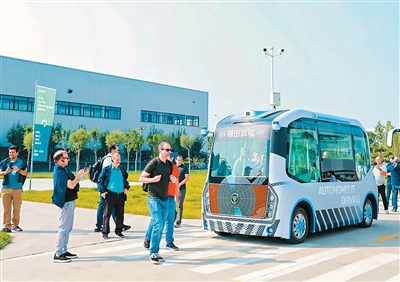
Overseas customers take part in an activity organized by BAIC Foton Motor Co., Ltd. (Photo courtesy of BAIC Foton Motor Co., Ltd.)
"Going overseas used to be a dessert — a bonus on top of the main business. Now it has become the main course," said Dai Hongkai, an executive in BAIC Foton's overseas division.
BAIC Foton's international expansion began in 2004, and the company has since extended its presence to more than 140 countries and regions, with 32 assembly plants operating overseas.
Dai said the company's overseas strategy is shifting from simply "going global" to truly "going deep." This means bringing upstream and downstream partners along the industrial chain into international markets and pursuing shared growth with local partners and customers wherever BAIC Foton operates.
That philosophy is especially evident in Africa. Wang Hui, a member of BAIC Foton's Africa division established in late 2023, has spent the past two-plus years traveling through muddy mining sites in the Democratic Republic of the Congo, construction sites in Guinea, and mountain roads in Burkina Faso. She has also visited dealerships in South Africa, where she helped train local staff on showroom standards.
Wang has not only contributed to BAIC Foton's rapid expansion across Africa but also witnessed how a Chinese brand can earn genuine recognition on the continent. "We are not just here to sell products. We treat ourselves as locals, and local matters as our own," she said.
In Cote d'Ivoire, BAIC Foton engineers spent three consecutive days inside sweltering shipping containers to train local employees on how to use newly delivered pickup trucks. In Ghana, the company's team spent 10 months pursuing a client before securing a direct heavy-truck order — a deal that later helped enhance the brand's reputation across the industry.
The results have been striking. Since its establishment, the Africa division has built 12 assembly plants, established eight training centers, and deployed a service workforce of more than 1,000 people. Sales in the Africa division grew more than 120 percent year on year in 2025 and rose 96 percent year on year in the first quarter of 2026.
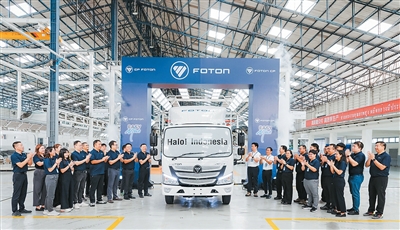
The Thailand plant of BAIC Foton Motor Co., Ltd. holds a roll-off ceremony in March 2026 for the first batch of light trucks destined for export to Indonesia. (Photo courtesy of BAIC Foton Motor Co., Ltd.)
Momentum is also building in other regions. In Southeast Asia, BAIC Foton's Thailand plant has obtained multiple local certifications, with the first batch of light trucks to be shipped to Indonesia already rolling off the production line. In South America, a manufacturing hub in Brazil serves as a regional base. In Europe, BAIC Foton exported more than 5,000 vehicles in the first three months of 2026 alone.
Overall, the company sold 184,000 vehicles in the first quarter of 2026, up 7.8 percent from the same period last year, while exports exceeded 53,000 units, a 34.4 percent year-on-year increase.
Behind BAIC Foton's global ambitions is an intelligent manufacturing system. Beijing Foton Cummins Engine Co., Ltd. (BFCEC), a joint-venture subsidiary of BAIC Foton, operates a 320,000-square-meter plant in Beijing's Changping district. The facility was selected as a "Lighthouse Factory" in 2020 — a designation jointly awarded by McKinsey and the World Economic Forum to recognize leaders in advanced smart manufacturing. In 2025, the facility was further recognized as an excellence-level smart factory by China's Ministry of Industry and Information Technology.
The plant's "future workstation" integrates 13 core intelligent modules, including vision-guided tightening, humanoid robot sorting, and virtual commissioning systems.
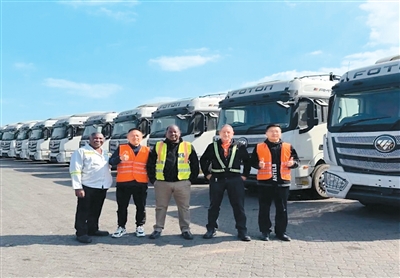
Heavy trucks of BAIC Foton Motor Co., Ltd. are delivered to Zimbabwe on June 23, 2025. (Photo courtesy of BAIC Foton Motor Co., Ltd.)
"Our shift toward intelligent manufacturing is aimed at freeing workers from onerous and repetitive tasks, rather than replacing them outright," said Li Qiang, director of BFCEC's manufacturing engineering department.
The joint venture has delivered diverse powertrain solutions to more than 100 countries and regions worldwide.
The facility has also impressed overseas visitors. A dealer from Trinidad and Tobago who toured the plant said he had visited many factories before, but was particularly struck by the layout and technologies. The plant's comprehensive smart transformation — lean management integrated throughout the entire production process, not just in isolated equipment — gave him strong confidence in its product quality.
BAIC Foton's push into new energy vehicles (NEVs) is also gaining momentum at home and abroad. The company sold 101,000 NEVs in 2025, up 87.2 percent year on year. In the first quarter of 2026, its NEV exports increased 80.4 percent from the same period last year.
BAIC Foton's NEV lineup includes pure electric, fuel-cell and hybrid vehicles designed for different application scenarios. To date, the company has sold more than 3,600 fuel-cell vehicles, including trucks and buses.
In January 2026, BAIC Foton became a key supplier to European logistics giants DSV and Dachser, delivering purpose-built electric light trucks tailored for Spain's urban delivery demands.
BAIC Foton is exporting not only products but also technical standards and business models, contributing a Chinese solution to the global green transition of commercial vehicles, said Guo Fenggang, president of the company's engineering research institute.
Photos



Related Stories
- Chinese automaker XPeng Motors leads Israel's electric car sales in Jan.-May
- China's SAIC Motor to build electric vehicle factory in Spain
- Chinese car brands expand presence in Spanish market
- Chinese carmaker SAIC Motor marks 100-million-vehicle milestone
- China's auto sector powers high-quality transformation amid global cooperation
- German state minister calls for more cooperation with Chinese automakers
- Auto China 2026 spotlighting AI-driven shift in car industry
- China's automotive development path provides footnote to 'people-centered' approach
- Chinese car brands shine at auto show in Riga
- Intelligence the new horsepower at world's biggest car show in Beijing
Copyright © 2026 People's Daily Online. All Rights Reserved.
