



Chinese researchers propose new pathways for millisecond pulsar formation
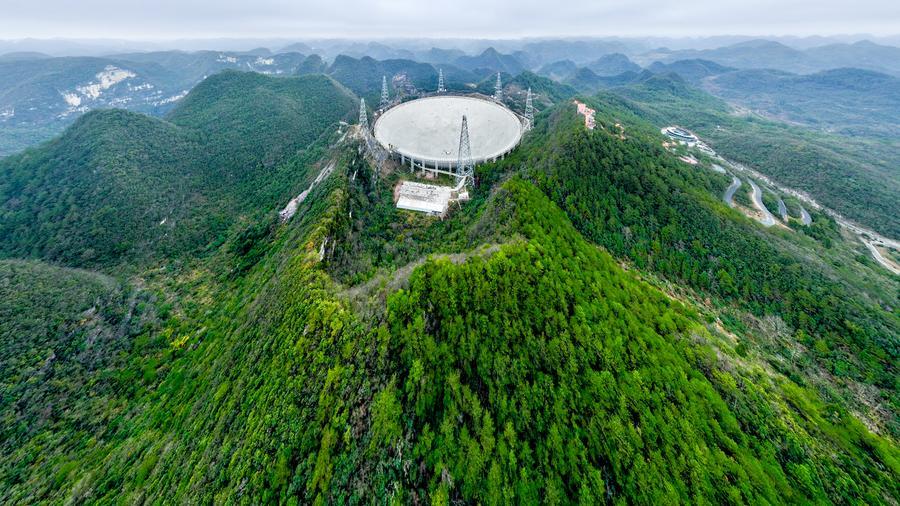
An aerial panoramic photo taken on Feb. 18, 2025 shows China's Five-hundred-meter Aperture Spherical Radio Telescope (FAST) under maintenance in southwest China's Guizhou Province. (Xinhua/Ou Dongqu)
BEIJING, April 15 (Xinhua) -- A group of Chinese researchers has reported the discovery of a new pulsar, which exhibits an exceptionally high spin-down rate, two orders of magnitude higher than that of other known millisecond pulsars, according to a recent research article published in the journal Nature Astronomy.
In terms of traditional theory, millisecond pulsars are formed via ordinary pulsars in binary systems that "accrete" matter from their companion stars, much like a spinning top being continuously whipped. This process leads to accretion-driven acceleration.
However, such acceleration is not without limits. Once millisecond pulsars reach the "spin-up line," their rotation periods gradually stabilize, achieving a precision that even surpasses that of atomic clocks.
All previously observed millisecond pulsars are indeed below the "spin-up line," in perfect match with theoretical predictions, said Wang Na, a professor at the Xinjiang Astronomical Observatory (XAO) of the Chinese Academy of Sciences.
This newly discovered millisecond pulsar resides in a binary system with an orbital period of approximately eight days, and of which the companion star is a white dwarf with a mass greater than 0.29 times that of the sun. Its spin period is 3.2 milliseconds, yet exhibiting an extremely high period derivative, placing it far above the "spin-up line."
This suggests that it is an exceptionally young millisecond pulsar with unusually intense energy loss.
All these features stand in contrast to the traditional perception of millisecond pulsars as being old, magnetically weak and rotationally stable.
This study, conducted by researchers from the XAO, Xinjiang University and Tsinghua University, imposes stringent constraints on the classical theories of accretion-driven spin-up in millisecond pulsars.
Photos




Related Stories
- Chinese scientists decipher centuries-old puzzle of human handedness
- Chinese scientists discover new way to strengthen rice resistance against devastating disease
- Scientists unearth how supervolcanoes form, evolve
- Chinese scientists achieve breakthrough in direct seawater hydrogen production research
- China's science foundation issues guidelines for international cooperation on sustainable development
Copyright © 2026 People's Daily Online. All Rights Reserved.
