



Sino-Lao rail link reshapes tourism map
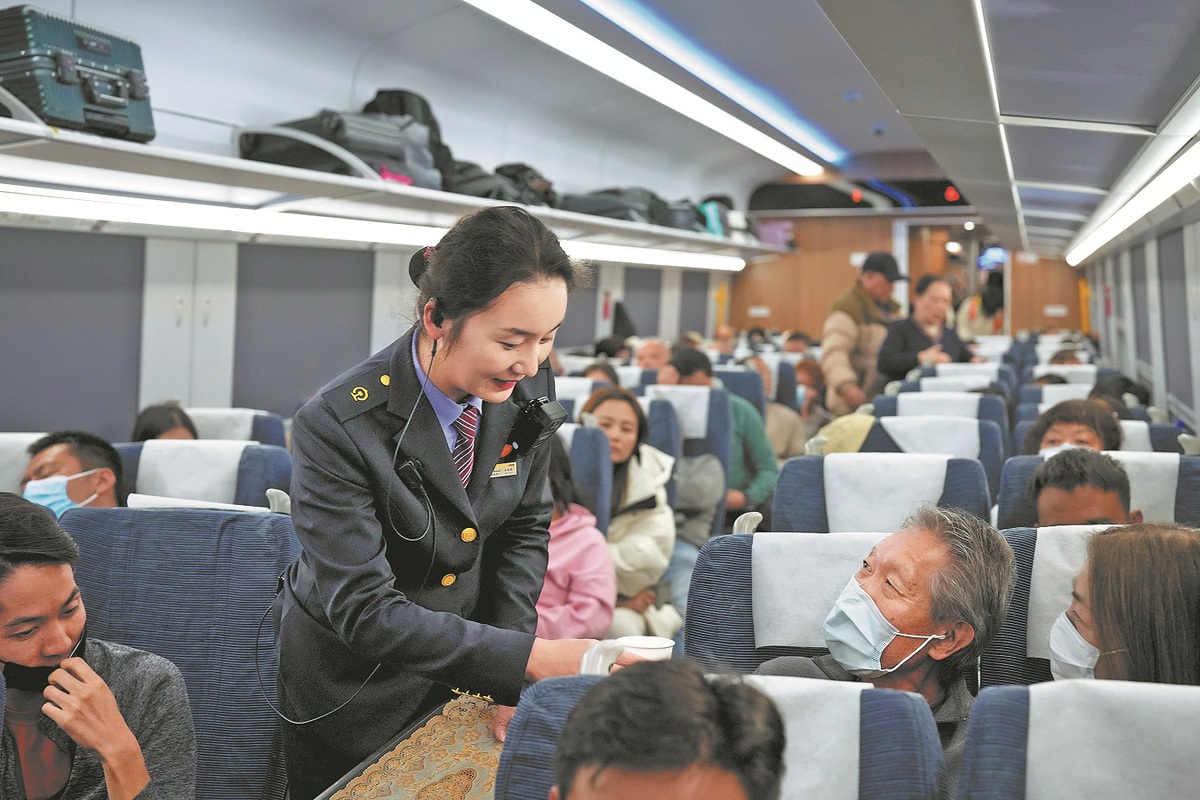
An attendant serves water to a passenger aboard a train running on the China-Laos Railway, which connects Kunming, Yunnan province, with Vientiane, the capital of Laos. YIN XUEHE/FOR CHINA DAILY
A morning train pulls out of Kunming in Southwest China's Yunnan province at 8:08 am, carrying more than 400 passengers toward Laos — part of a steady flow that, three years after international services began, has turned the China-Laos Railway into a busy cross-border corridor.
Since April 13, 2023, the railway has handled more than 800,000 cross-border passenger trips, with travelers from over 120 countries and regions taking the route, according to the operator.
The 1,035-kilometer line, linking Kunming with Vientiane, the Lao capital, began operations in December 2021, with international passenger services added in April 2023. It is increasingly serving as both a travel artery and a trade route, moving people and goods across borders.
Each day, four international passenger trains run between the two cities. Travel time has been reduced to nine hours and 36 minutes, while border clearance at Mohan, Yunnan, has been shortened to about 50 minutes.
"The trains have maintained a 100 percent on-time departure rate and a 99 percent on-time arrival rate," said Zi Li, head of the customer service center of China Railway Kunming Group. "The fastest clearance time at the border is just over 50 minutes."
To meet growing demand, cross-border seating capacity has increased from 250 to 420 per train. Multilingual services in Chinese, Lao and English, international bank card payments, and dedicated ticket counters have also been introduced to make travel smoother for international passengers.
The line's growing reach is reshaping tourism patterns across the region.
Destinations such as Kunming, Luang Prabang and Vientiane are now linked by rail-based itineraries, while tourism authorities in China and Laos have developed cross-border travel products supported by visa facilitation policies.
"Tourists from China and abroad now have a more affordable and convenient way to travel," said Jiang Jie, deputy director of the culture and tourism bureau of Xishuangbanna Dai autonomous prefecture of Yunnan. "Xishuangbanna has become an important regional hub for international tourism along the railway."
One popular route connects Xishuangbanna with Luang Prabang, Vientiane, Bangkok and Chiang Mai, forming a circular journey across the region, he added.
Passenger numbers continue to rise. In the first quarter of this year, the railway saw 112,000 cross-border traveler trips, up 32.4 percent year-on-year, with daily volumes roughly three times those seen in 2023.
For many, the journey itself has become part of the appeal.
"It's my first time taking a train abroad, and the experience feels very fresh," said passenger Li Yuling. "You can see the landscape and cities changing along the way. It's a wonderful trip."
Beyond passengers, freight traffic on the line has also surged, bringing Southeast Asian produce into China with increasing speed.
At 7 am on a recent morning, a freight train loaded with Thai durians arrived in Kunming after a 26-hour journey. Within 48 hours, the fruit was distributed to more than 30 cities across China, including Shanghai, Chengdu in Sichuan province, and Guangzhou in Guangdong province.
At a nearby logistics base, inspectors examined each durian by smell, sight and touch, checking ripeness before the fruit entered the market.
"Transport via the railway means faster clearance, shorter transit times and lower losses," said Wang Jian, general manager of an agricultural product trading company in Hunan province. "With Thailand's durian output expected to rise by about 30 percent this year, shipments to China will continue to grow."
To cope with the seasonal surges, railway authorities have increased cold-chain freight services from two trains a day to around six during peak periods, while introducing priority handling measures to speed up unloading and transfer.
Since operations began, the railway has transported 81.5 million metric tons of goods, including more than 18.6 million tons of cross-border cargo. Daily cross-border freight trains have increased from two in the early days to as many as 23.
The rise in both passenger and freight traffic is feeding into local economies, while destinations such as Xishuangbanna have seen strong increases in overseas visitors.
At 5:44 pm local time, the train arrives in Vientiane, completing the journey that has become a regular link for the movement of people and goods across the border.
Photos



Related Stories
- Yangtze River Delta to expand rail network with five high-speed sections in 2026
- Xinjiang leads China in cross-border rail traffic, central Asian connectivity in 2025
- Cross-border rail rallies regional connectivity
- New high-speed freight rail line launched to strengthen logistics in central, southern China
- Main span of Xi'an-Chongqing high-speed rail bridge smoothly installed in Dazhou, China's Sichuan
- A glimpse into China's futuristic urban transportation
- China's urban rail transit trips skyrocket 130 pct in December 2023
- China's rail transit industry weaves huge net of manufacturing
- Tracks laid for Malaysia's mega rail project
- China's urban rail transit trips surge over 80 pct in November
Copyright © 2026 People's Daily Online. All Rights Reserved.
